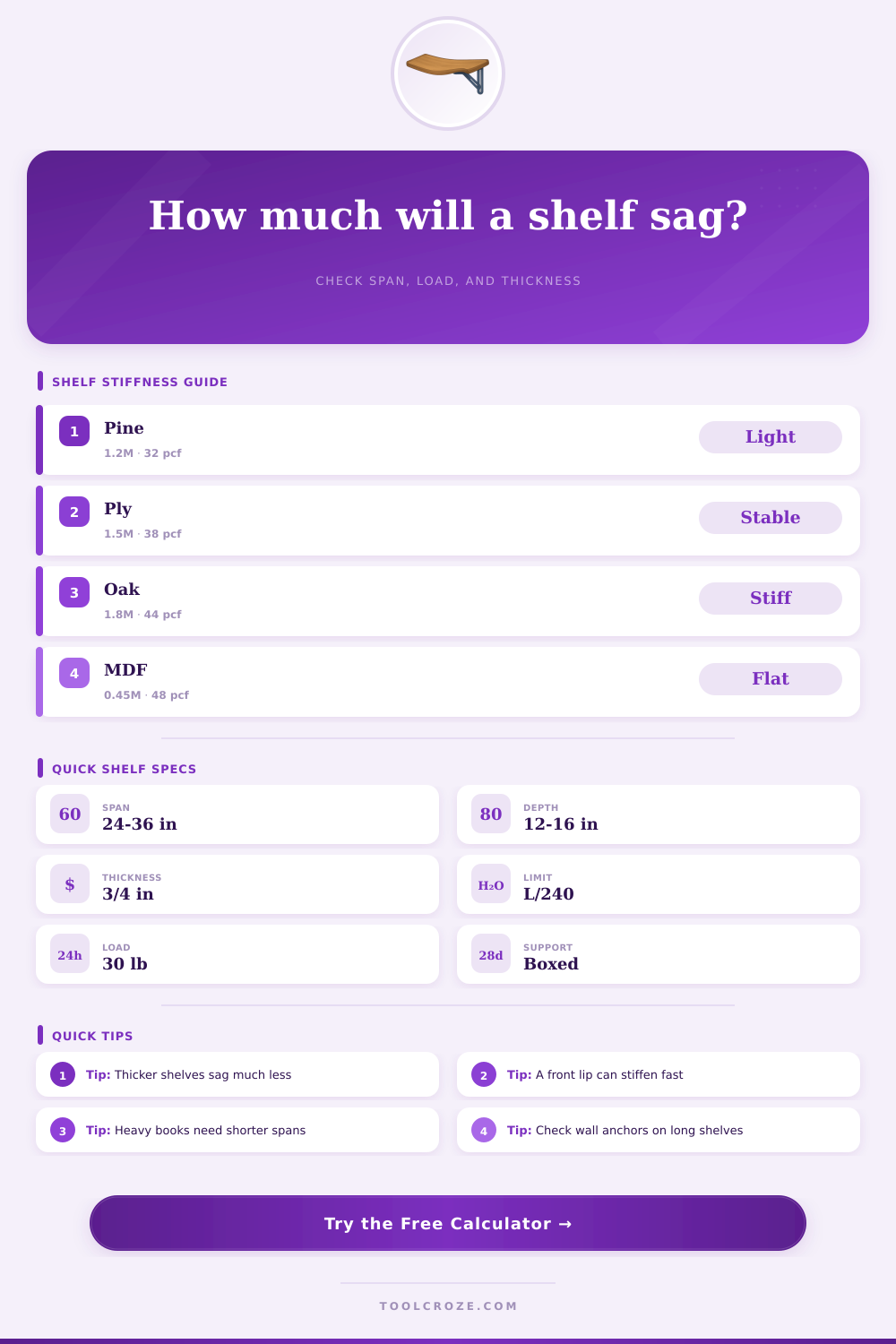
Shelf Sag Calculator
Estimate midspan sag, safe load, and deflection limits for wood shelves, bookcases, and built-ins using real stiffness inputs.
Light shelves
Stable panels
Heavier loads
High stiffness
Strong shelf core
Short display spans
Avoid long spans
Rigid modern shelf
| Material | Thickness | Span | Best use |
|---|---|---|---|
| Pine | 3/4 in | 24-30 in | Light storage |
| Plywood | 3/4 in | 30-36 in | Everyday shelves |
| Oak | 3/4 in | 36-42 in | Book shelves |
| Boxed shelf | 3/4 in | 42-60 in | Long spans |
| Use | Ratio | Sag at 24 in | Note |
|---|---|---|---|
| Display | L/180 | 0.13 in | Most flexible |
| General | L/240 | 0.10 in | Good default |
| Books | L/300 | 0.08 in | Stiffer feel |
| Premium | L/360 | 0.07 in | Very rigid |
Shelf sinks happen when the shelves start to dip in the middle part. That happens over time when more burden accrues on it. Wood alters its form under weight progressively, so the shelf continuously dips a bit every year
Some main reasons cause shelves to sink. If the support of brackets is not right or the middle part lacks enough support, the shelf can start to bend under pressure. It commonly happens to floating shelves.
Why Shelves Sink and How to Fix Them
Materials of low quality also create problems. Some shelves are made from particle board or like stuff that easily sinks under too heavy burden. MDF is especially problematic.
It bends under weight and even can sink under its own mass. Shelf from sheet products simply do not stay flat without sag.
Tool called Sagulator helps to design shelves, because it counts the sag according to kind of material, heavy burden, expansion of weight, size and fixture. You can add edging strip to strengthen the shelf. It addresses hardwoods, softwoods and sheets.
Sag more than 0.02 inches deserve attention. The Sagulator estimates only the initial sag. Later the shelf can add in 50 percentages.
Any shelf should not extend more than 32 inches in width. More than that, and it probablly will sink. Shelf above 36 inches long with three-quarter thickness requires support in front.
Bracket or double cornered lip operates well. Adjustable shelf of 30 inches broad and 10 inches deep, done from plywood, poplar or pine, last until 35 pounds each foot with reasonable sag.
Dense hardwood as oak or maple does not sink too a lot. Little changes in design, for instance half depth divider, entirely remove the problem. Melamine shelf sinks because of its particle internal board.
Support them every 32 inches and avoid too heavy objects. Add 1×2 edge for stop sag between brackets.
Fast resource is remove everything off the shelf, take it out and turn it over. The simplest mode to prevent sag is set stiffener, for example hardwood strip according to the front or bottom side. Dowels in three-quarter strip of one-inch hardwood around the front edge well helps.
Screw punched steel flat base along the bottom of the shelf is another good way. Vertical supports or dividers shorten the unsupportedspan half.