Cabinet Door Size Calculator
Size inset, overlay, slab, and shaker doors from a real opening, then compare leaf cut sizes, panel blanks, and material totals.
Door size guide
| Type | Width | Depth | Height |
|---|---|---|---|
| Inset pair | 18-48 in | 24 in | 34.5 in |
| Overlay pair | 12-36 in | 12-15 in | 30-42 in |
| Tall pair | 18-36 in | 24 in | 84-96 in |
| Single slab | 30-36 in | 24 in | 34.5 in |
Reveal guide
| Item | Inset | Overlay | Note |
|---|---|---|---|
| Side reveal | 1/8 in | 1/16 in | Keep even |
| Center gap | 1/8 in | 1/8 in | Match hinges |
| Scribe strip | 1-3 in | 1-3 in | Wall scribe |
| Bottom reveal | 4.5 in | 4.5 in | Bottom gap |
Material guide
| Material | Sheet | Thickness | Use |
|---|---|---|---|
| Door ply | 4x8 ft | 3/4 in | Door blanks |
| Panel ply | 4x8 ft | 1/4 in | Backs |
| MDF | 4x8 ft | 3/4 in | Painted doors |
| Melamine | 4x8 ft | 3/4 in | Clean blanks |
Leaf sizing guide
| Layout | Width math | Height math | Use |
|---|---|---|---|
| 2 doors | Span minus gaps | Opening height | Base runs |
| Double door stack | Span minus gaps | Stack height | Base run |
| Single leaf | Span minus gaps | Full height | Sink or pantry |
| Tall door | Opening width | 6 to 10 in | Tall openings |
Getting cabinet door sizes right is a big deal for every woodworking or DIY project. There is no unique standard for those sizes. Various regions of the land use their own rules for kitchen measures and builders commonly set their own rules for cabinet sizes.
Also trends in kitchen design can alter the standard sizes of doors which makes everything harder
How to Measure Cabinet Door Sizes
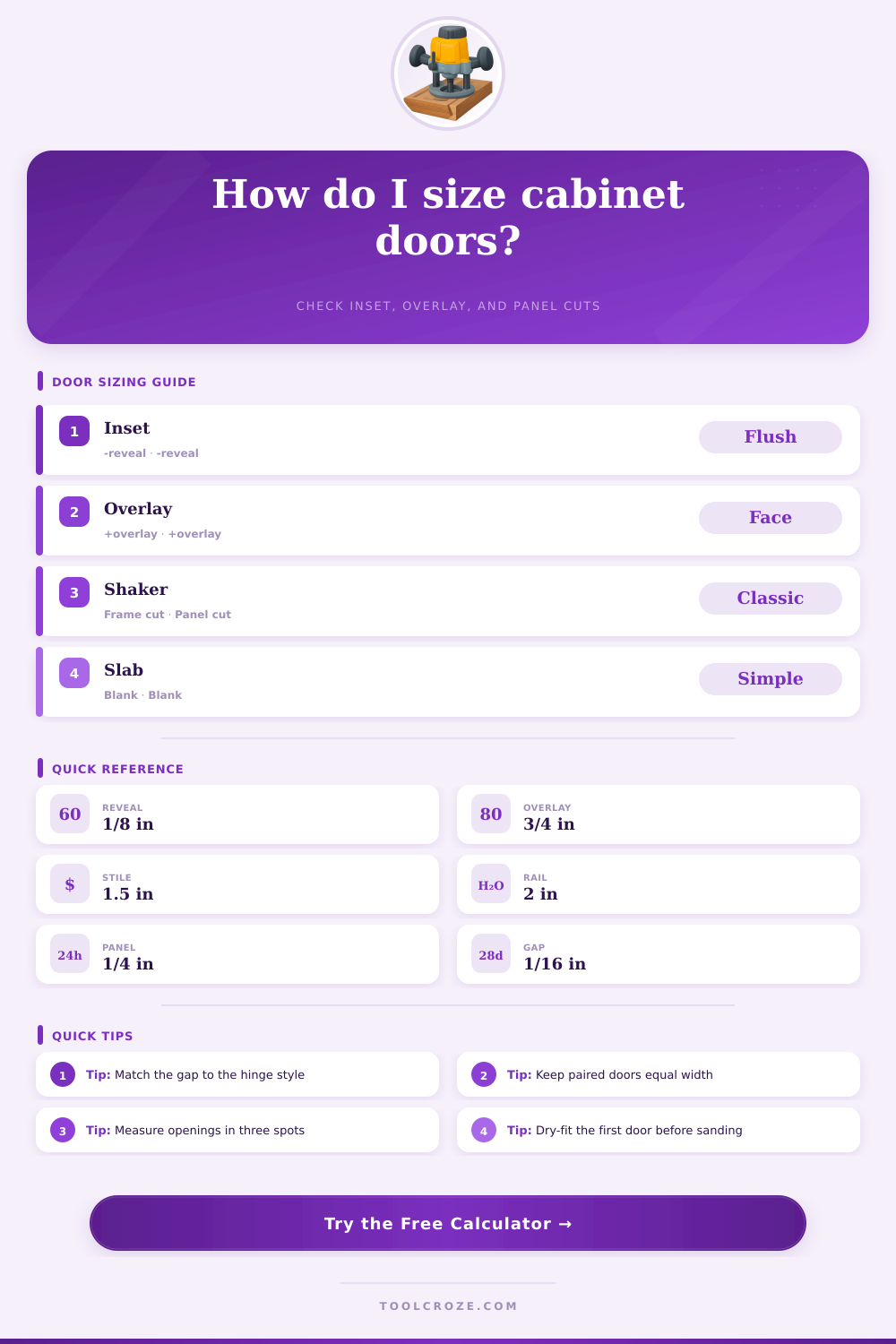
Always start by measuring the opening in the cabinet. Take the height from top to bottom and the width from left to right, later note the exact values. Those measures belong to the opening itself, or to the drawer, not to the door or drawer front.
When the opening is well measured, add the necessary overlaay. That overlay shows how the door covers the opening or frame of the cabinet, and it sets the final sizes. Usually you add one inch to width and height.
For instance, opening of 14 inches by 30 inches result in door of 15 by 31 inches. Like this you get half-inch space at every side. In United States for cabinets with face frame, commonly used is half-inch or one-and-quarter-inch overlay.
If you choose three-eighths hinges, make the door three-quarters of an inch higher and wider than the opening in the face frame.
Face frames have different widths; some are 1 inch, others 1.5 inch or even 2 inch. Because of that it is possible not to entirely cover a face frame cabinet. Inset doors fit inside the frame, while overlay doors sit above it and cover it.
For frameless Euro-style cabinets with full overlay hinges, commonly you leave little space, around one-eighth inch, between neighboring doors. Like this 18 inch cabinet receives door of 17 and seven-eighths inch. For 36 inch on each from two doors has 17 and seven-eighths inches.
The edges leave noticeably finish up, almost one-sixteenth of an inch.
Standard rule for stile and rail of cabinet doors are 2.25 to 2.5 inches. Three-quarter inch material is usual for doors and drawer faces. Wood products usually made to the nearest one-sixteenth inch, with a tolerance of plus or minus one-thirty-second inch.
Doors more than 50 inches high or broad are not covered by warranty.
Simple shaker doors you can do with some clamps, orbital sander and table saw. For doors with formed profile you need a router table with right bits for cabinet doors. Cabinets must open freely, so leave at least 15 inch clearance between door and the nearestunit.