Speaker Cabinet Calculator
Size sealed and ported cabinets, check internal volume, and verify port geometry before you cut a single panel.
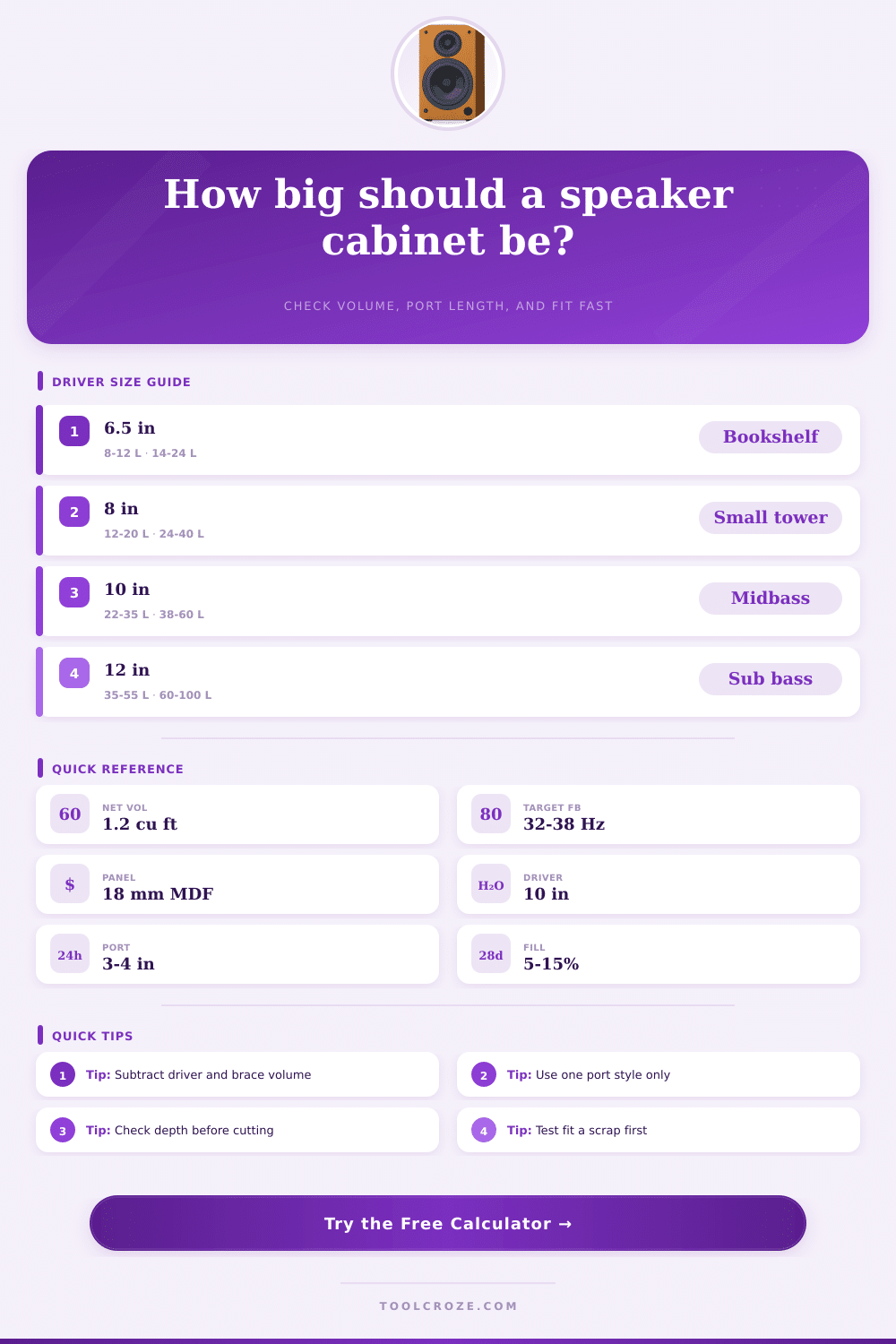
Driver size and volume guide
| Driver | Sealed | Ported | Use |
|---|---|---|---|
| 6.5 in | 8-12 L | 14-24 L | Bookshelf |
| 8 in | 12-20 L | 24-40 L | Small tower |
| 10 in | 22-35 L | 38-60 L | Midbass |
| 12 in | 35-55 L | 60-100 L | Sub bass |
Tuning frequency guide
| Fb | Response | Box feel | Use |
|---|---|---|---|
| 28-30 Hz | Deep | Large box | Home theater |
| 32-35 Hz | Balanced | Medium box | Music and movie |
| 38-45 Hz | Punch | Smaller box | Kick and bass |
| 50-60 Hz | Fast | Compact box | Nearfield |
Panel thickness guide
| Panel | Use | Brace need | Note |
|---|---|---|---|
| 12 mm | Small boxes | High | Light duty only |
| 15 mm | Bookshelf | Med | Needs ribs |
| 18 mm | Standard | Low | Good default |
| 25 mm | Subwoofer | Low | Very stiff |
Cabinet ratio guide
| Style | Ratio | Shape | Note |
|---|---|---|---|
| Bookshelf | 1:1.4:2.0 | Tall | Compact front |
| Tower | 1:1.6:2.4 | Balanced | Most common |
| Subwoofer | 1:1.3:1.9 | Deep | Short vent path |
| Center | 1:3.0:0.9 | Wide | Shallow profile |
A speaker cabinet is an enclosed box, usually rectangular, in which drivers install woofers and tweeters together with electronics like crossover circuits. It isolates the back sound from the front to stop mutual cancellation in low tones. If two woofers share one speaker cabinet, each of them thinks the space is only half big, which limits the base of the sound but not always reduces the output
The steps for making wooden speaker cabinets are too many and different to list them all. The main goal is however to create an extremely robust, airtight box. You rarely use solid wood, because it is hard to make a box of any size that will not split or leak after some years.
How to Make a Wooden Speaker Cabinet
Almost all wooden speakers are made of MDF with real or fake veneers. Plastic is not good for speaker cabinets.
For building speaker cabinets you require some basic tools. Table saw ensure precise cuts. It guarantees that the four side panels have the same length and width.
Dado stacks simplify sticking the parts, especially after rabbeting the sides and internal braces. Plunge router has many uses in cabinet construction. With a table saw it is enough for a good result.
Drill press are needed for precise holes, brad point bits center them well, and Forstner bits make flat bottom holes. Jasper jig is not a strict need, but it helps to cut perfect circles. Clamps matter, the more, the better.
And a good file is usefull a lot. Crimping tool for spade lugs to speaker cables are helpful. Solder do not mix with vibration, so crimping is better.
Some speaker cabinets come ready assembled and finished, while knockdown cabinets require assembly and finishing. Empty speaker cabinets are good for home-made builds and installations. There are also kits with everything cut.
For guitars they must be especially rugged, because you move them often and they house powerful speakers. Some musicians choose low power speakers with a microphone right in front of them.
Simple extension speaker cabinets commonly have a window left for open or closed configuration. It is made of half-inch birch plywood, metal corners, black rubber feet and jack cups. Covering it with black speaker carpet, you can stick or pull and staple it.
Also the surface matters, and many finishes are available for such speaker cabinets.