⚙ Helical Gear Pitch Diameter Calculator
Calculate pitch diameter, transverse module, axial pitch, virtual tooth count & center distance for helical gears
Detailed Breakdown
ℹ Additional Parameters
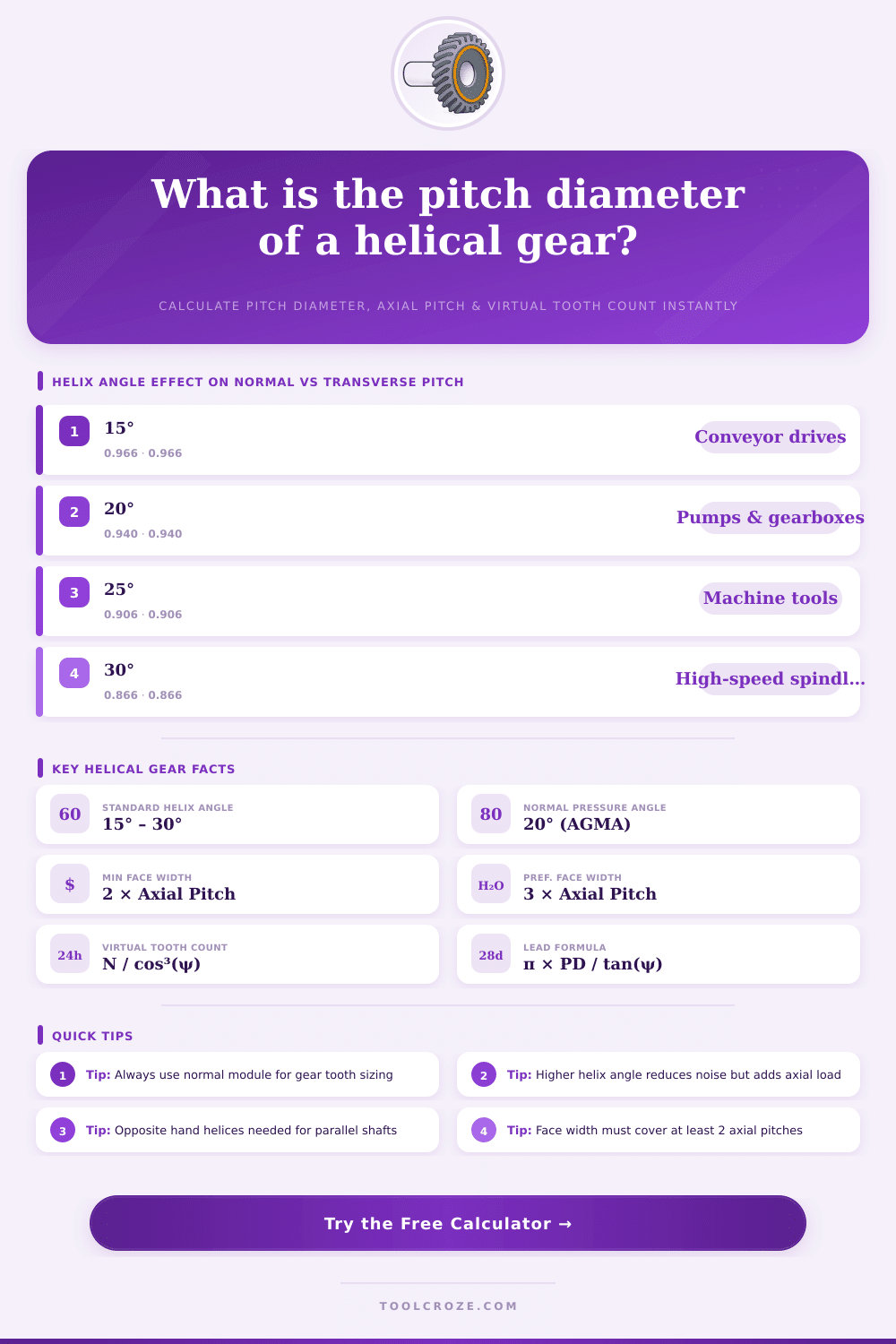
| Helix Angle ψ | cos(ψ) | mₙ / mₜ Ratio | DPₙ / DPₜ Ratio | Trans. Circ. Pitch Increase |
|---|---|---|---|---|
| 10° | 0.985 | 0.985 | 0.985 | +1.5% |
| 15° | 0.966 | 0.966 | 0.966 | +3.5% |
| 20° | 0.940 | 0.940 | 0.940 | +6.4% |
| 23° | 0.921 | 0.921 | 0.921 | +8.6% |
| 25° | 0.906 | 0.906 | 0.906 | +10.3% |
| 30° | 0.866 | 0.866 | 0.866 | +15.5% |
| 35° | 0.819 | 0.819 | 0.819 | +22.1% |
| 45° | 0.707 | 0.707 | 0.707 | +41.4% |
| Application | Helix Angle | Normal Module / DPₙ | Face Width Range |
|---|---|---|---|
| Automotive gearbox | 23° – 30° | mₙ 1.5 – 3 mm | 20 – 50 mm |
| Industrial pump drive | 15° – 25° | DPₙ 6 – 10 | 1.5 – 3 in |
| Machine tool spindle | 25° – 35° | mₙ 1 – 2.5 mm | 15 – 40 mm |
| Compressor drive | 15° – 20° | mₙ 2 – 5 mm | 40 – 100 mm |
| Printing press | 20° – 25° | mₙ 2 – 3 mm | 25 – 60 mm |
| High-speed turbine | 30° – 45° | mₙ 0.5 – 1.5 mm | 10 – 30 mm |
| Normal Module mₙ | Axial Pitch @ 20° (mm) | Min Face Width (mm) | Preferred Face Width (mm) |
|---|---|---|---|
| 1 | 9.14 | 18.3 | 27.4 |
| 1.5 | 13.7 | 27.4 | 41.1 |
| 2 | 18.3 | 36.6 | 54.9 |
| 2.5 | 22.8 | 45.7 | 68.6 |
| 3 | 27.4 | 54.9 | 82.3 |
| 4 | 36.5 | 73.1 | 109.6 |
| 5 | 45.6 | 91.3 | 137.0 |
The pitch diameter of a helical gear is one of those topics that seems easy, but can become a bit hard. It sits between the top and root diameters of the gear. One can not measure it directly on the gear itself.
Really it depends on how the gear meshes with another gear. The same idea counts for the pressure angle also.
Pitch Diameter in Helical Gears
The module of a gear is the pitch diameter divided by the number of teeth. So if a gear has a diameter of 10 inches and 50 teeth, the module would be 0.20. The other way around, if one knows the module and the tooth count, one can find the pitch diameter.
For spur gears with angled teeth one calls them helical gears. Most of the steps for them follow steps similar to those for spur gears.
Here is where things become interesting. The formula for the pitch diameter of helical gears is the same as for spur gears. But if one uses the normal module, it depends on the helix angle.
That extra angle adds a level of truoble. Also the direction of the helix matters. Left-hand helix must match with right helix, so that the gears work together.
One often makes mistakes when one creates a helical gear in software. With a module of 1 and 40 teeth, one expects a pitch diameter of 40. But the result can be around 56.5 instead.
If one does the same gear as a spur gear, one gets the right value. Those differences come from different guesses.
The pitch circle shows the shape of teeth for a basic gear with a one-unit diameter. Important to remember that it leads to the pitch diameter, that passes flat threw the center of the teeth, not the whole outer diameter.
Mistakes in measurement cause real problems. A simple mistake of only 0.005 inches in the outer diameters leads to the same mistake in the pitch diameter. That then messes up the calculation of the helix angle.
If the helix angle is wrong, the cutting of the gear will go bad, and the new gear will not mesh well, because its axis will not be parallel to the old gear. Knowing the center distance between involved gears is really needed.
For profile-shifted helical gears in a normal system, the working pitch diameter and the working pressure angle in the cross system are found by using special equations. Every gear in a pair gets its own value, for example the pitch diameter of the first gear is different than that of the second. As a sample, a pinion with 20 teeth and module 2 gives a base diameter of 40, while a gear with 40 teeth and same module gives 80.
Gears must have equal module and pressure angle to mesh correctly. The pitchdiameter always must be larger than the root diameter.