🚗 Automotive Paint Coverage Calculator
Calculate exact paint, reducer, and mixed volumes for full resprays, panel repairs, and custom work.
Quick Presets
Calculation Breakdown
| Vehicle Type | Surface Area | Approx. Panels | Notes |
|---|---|---|---|
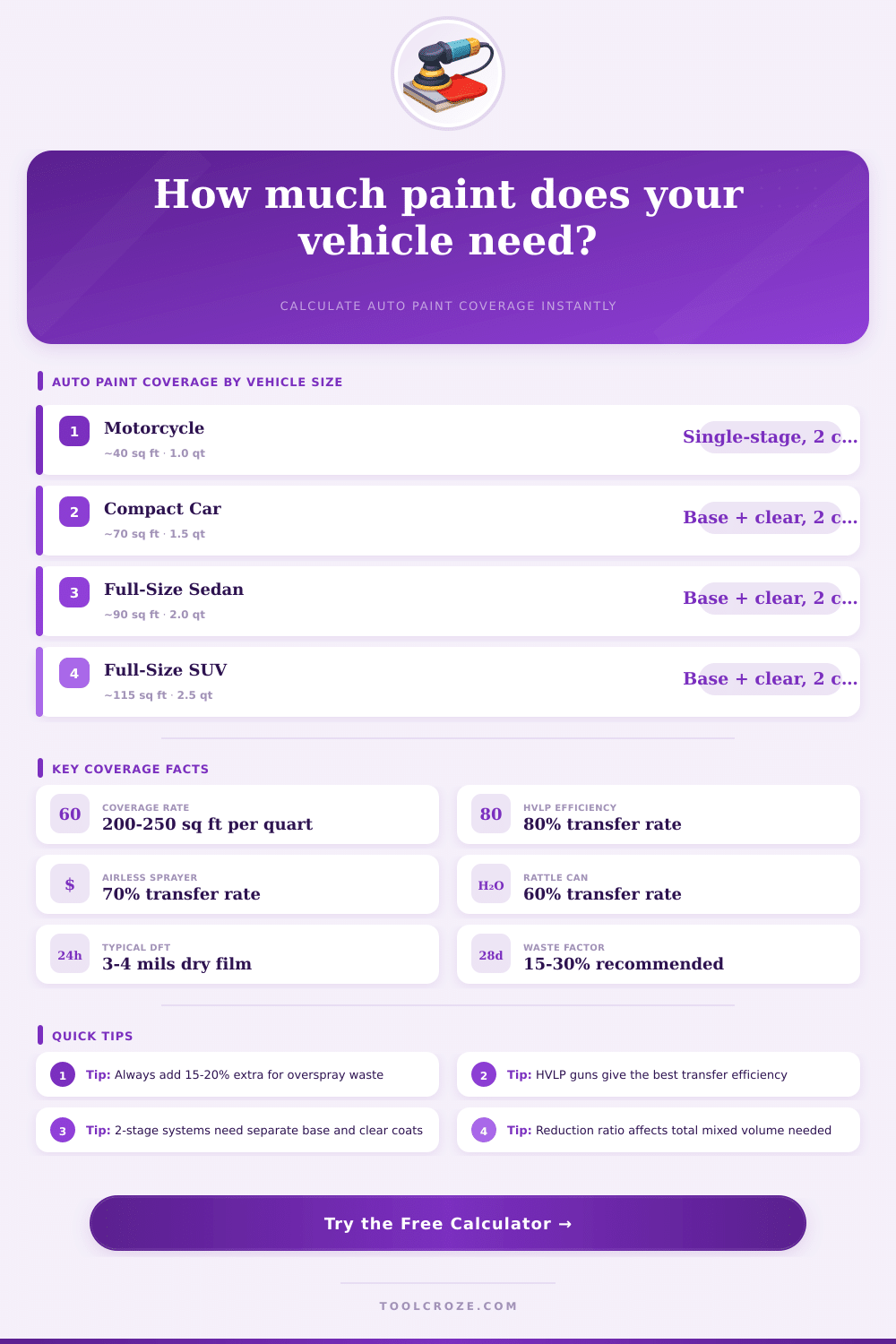
| Motorcycle | ~40 sq ft | 6–8 panels | Tank, fairings, fenders |
| Compact Car | ~70 sq ft | 10–12 panels | Hatchback or small sedan |
| Mid-Size Sedan | ~80 sq ft | 12–14 panels | Standard 4-door sedan |
| Full-Size Sedan | ~90 sq ft | 12–14 panels | Large body, longer roof |
| SUV / Crossover | ~100 sq ft | 14–16 panels | Taller profile adds area |
| Full-Size SUV | ~115 sq ft | 16–18 panels | Body-on-frame, full size |
| Pickup Truck | ~110 sq ft | 14–16 panels | Bed sides add area |
| Van / Minivan | ~130 sq ft | 16–20 panels | High roof and long sides |
| System | Stages | Coverage Rate | Typical Use |
|---|---|---|---|
| Single-Stage Urethane | 1 | ~220 sq ft/qt | Fleet, older vehicles, solid colors |
| Base Coat Only | 1 (of 2) | ~230 sq ft/qt | Metallic/pearl base in 2-stage job |
| Clear Coat Only | 1 (of 2) | ~240 sq ft/qt | Protective top layer in 2-stage job |
| Base + Clear (2-Stage) | 2 | ~220 sq ft/qt each | Most modern factory-style finishes |
| Reduction Ratio | Mix Multiplier | Viscosity Result | Typical Use |
|---|---|---|---|
| 25% | ×1.25 | Thick / Low temp | Cold weather spraying |
| 50% | ×1.50 | Standard | General purpose, most jobs |
| 100% (1:1) | ×2.00 | Thin / High temp | Hot weather, fast flash |
| 150% (1:1.5) | ×2.50 | Very thin | Blending, spot repairs |
| Application Method | Transfer Efficiency | Overspray Factor | Notes |
|---|---|---|---|
| HVLP Spray Gun | 80% | 20% wasted | Best for automotive finishing |
| Airless Sprayer | 70% | 30% wasted | Faster but higher overspray |
| Rattle Can (Aerosol) | 60% | 40% wasted | Touch-ups and small panels only |
Automotive paint cover in short description deals about the area that covers a certain amount of paint. One usually measures it in square feet for one gallon. The cover that one gets depends on several factors, for example the kind of paint and the chosen colour.
Various paint systems deliver different results. For instance, single-stage paint in ratio 3:1 for GM Solicit Red cover around 125 square feet for gallon. The same shade in 4:1 base-clear system reaches about 160 square feet for gallon.
How Much Paint Do You Need for a Car
That shows quite a big difference only because of the change of system. Some paints work more effectively than others. The metallic base cover PPG DBU can cover with 3 or 4 coats, while PPG Omni metallic base cover commonly requires up to 8 coats or even more for certain colours, because this product is known for poor cover.
Pearls and metallic paints usually cover less surface than average solid colours. Paints by colour code or special mixes normally have tricky cover of around 4 to 5 square metres for liter of ready product. Some makers add blue base under blue metals too help the cover, because metallic paints hold a lot of clearness and do not cover well on their own.
To reach full cover, one usually applies 2 to 4 coats. Leave every coat dry before wearing the next, to avoid runs or uneven spots. Every colour has different hidden traits, so always check the code of automotive paint before ordering.
A common way to estimate the needed paint uses this formula: total area multiplied by number of coats, divided by the cover rating, then multiplied by waste number. Some calculators estimate average 286 square feet for gallon. A quart covers about 50 to 80 square feet.
Prior sanding and preparation helps to lower difference in how the surface absorbs the paint.
For full respraying of a standard car, here is a sample. A car long at 15 feet and wide at 6 feet gives around 270 square feet. Multiply that by 3 coats and one requires 810 square feet of total cover.
Divide by 350 square feet for gallon and the result is around 2.3 gallons. Add 15 percent for waste and the amount becomes about 2.7 gallons. This covers base, base coat and clear coat.
When using spray cans, the needed number depends on the size of the panel and the applied coats. Base usually requires the fewest cans, base coat requires several wet coats and clear coat commonly the most. One spray can covers around 12 to 16 square feet.
Paint that dried outside or became old can require extra thinning andmore coats to reach the same cover that it had before.