💨 Bar to PSI Converter
Convert bar, PSI, kPa, MPa, atm, mmHg and more — all units simultaneously
pneumatic tools
passenger vehicles
heavy machinery
boilers, tanks
| Bar | PSI | kPa | atm |
|---|---|---|---|
| 0.5 | 7.25 | 50 | 0.493 |
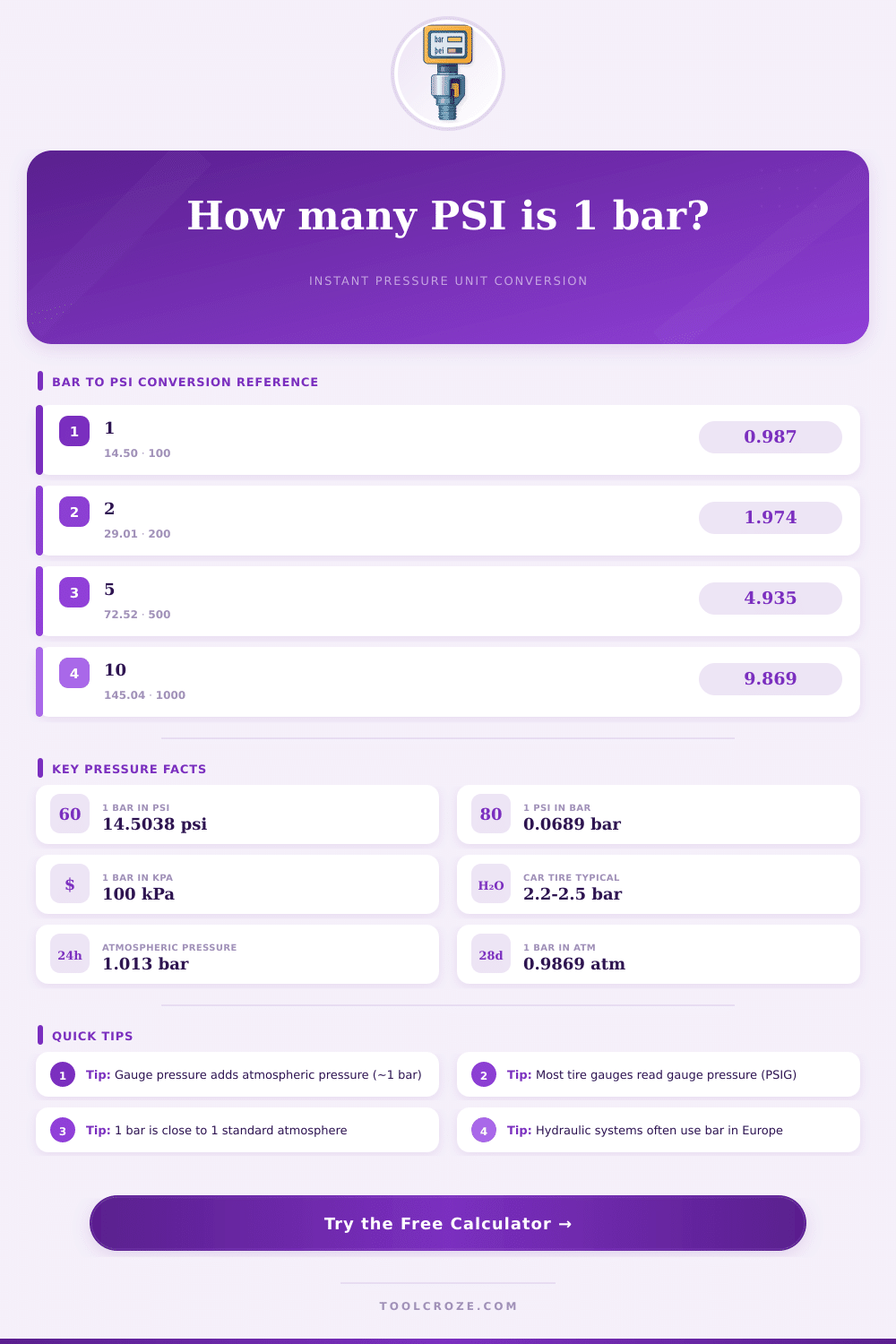
| 1 | 14.50 | 100 | 0.987 |
| 1.5 | 21.76 | 150 | 1.480 |
| 2 | 29.01 | 200 | 1.974 |
| 3 | 43.51 | 300 | 2.961 |
| 4 | 58.02 | 400 | 3.948 |
| 5 | 72.52 | 500 | 4.935 |
| 6 | 87.02 | 600 | 5.922 |
| 7 | 101.53 | 700 | 6.908 |
| 8 | 116.03 | 800 | 7.895 |
| 10 | 145.04 | 1,000 | 9.869 |
| 15 | 217.56 | 1,500 | 14.804 |
| 20 | 290.08 | 2,000 | 19.738 |
| 50 | 725.19 | 5,000 | 49.346 |
| 100 | 1,450.38 | 10,000 | 98.692 |
| 200 | 2,900.76 | 20,000 | 197.385 |
Pressure is commonly measured by means of various units, depending on the place where one lives or the task that one does. Between the common variants you find bar, pascal, kilopascal and psi, which stands for pounds per square inch. Converting between bar and psi leads to practical knowledge especially for those who deal with tire pressures or air compressors.
What does psi exactly mean? This is a unit that mostly uses the imperial and American system. It rests on a base of pound units.
How to Convert Between Bar and Psi
One defines psi as the pressure that develops when one pound-force weighs on a surface of one square inch. One psi is around 6,895 pascals. One can express that also by means of an equation: one psi matches one pound-force divided by surface in square inches.
Bar is another popular unit for pressures. It relates to the International System of Units. One bar almost matches one atmosphere, or around 14.5 psi according to imperial measures.
The accurate number for converting bars to psi comes to 14.503774. To pass from bar to psi, simply multiply the bar value by means of that pattern.
Here is a fast example. Assume that a tire has pressure of 2.5 bars. Multiply 2.5 by means of 14.5038 and receive 36.2595 psi.
Extra sample: 3 bars tiems 14.50377 result in 43.51131 psi. Really easy once you get the idea.
For going the other way it is also simple. To convert psi to bars, multiply the psi value by means of 0.0689476. For instance, 150 psi times 0.0689476 give 10.34214 bars.
One psi carries 0.0689476 bars. And one pascal matches 0.00014503773800722 psi.
Some more small conversions worth recalling. Every tenth of bar results in around 1.47 psi. Like this 0.5 bars match roughly 7.35 psi, while 0.6 bars come too approximately 8.82 psi.
There is also a good trick for big values. To pass from bar to psi, add 50 percent to the bar value and then move the decimal point one spot to the right. For instance, 160 bars plus 80 give 240, then add a zero and you have 2400 psi.
Similarly, 200 bars stay under 3000 psi. And 150 bars match around 2150 psi.
Many folks choose bar because it allows working with easier numbers. Others prefer psi because whole values seem more precise and one avoids decimals. Having a conversion tool or online calculator besideyou simplifies things for fast checks between those two units.