⚡ AC Motor Torque Calculator
Calculate full-load torque, starting torque, and breakdown torque for AC induction motors
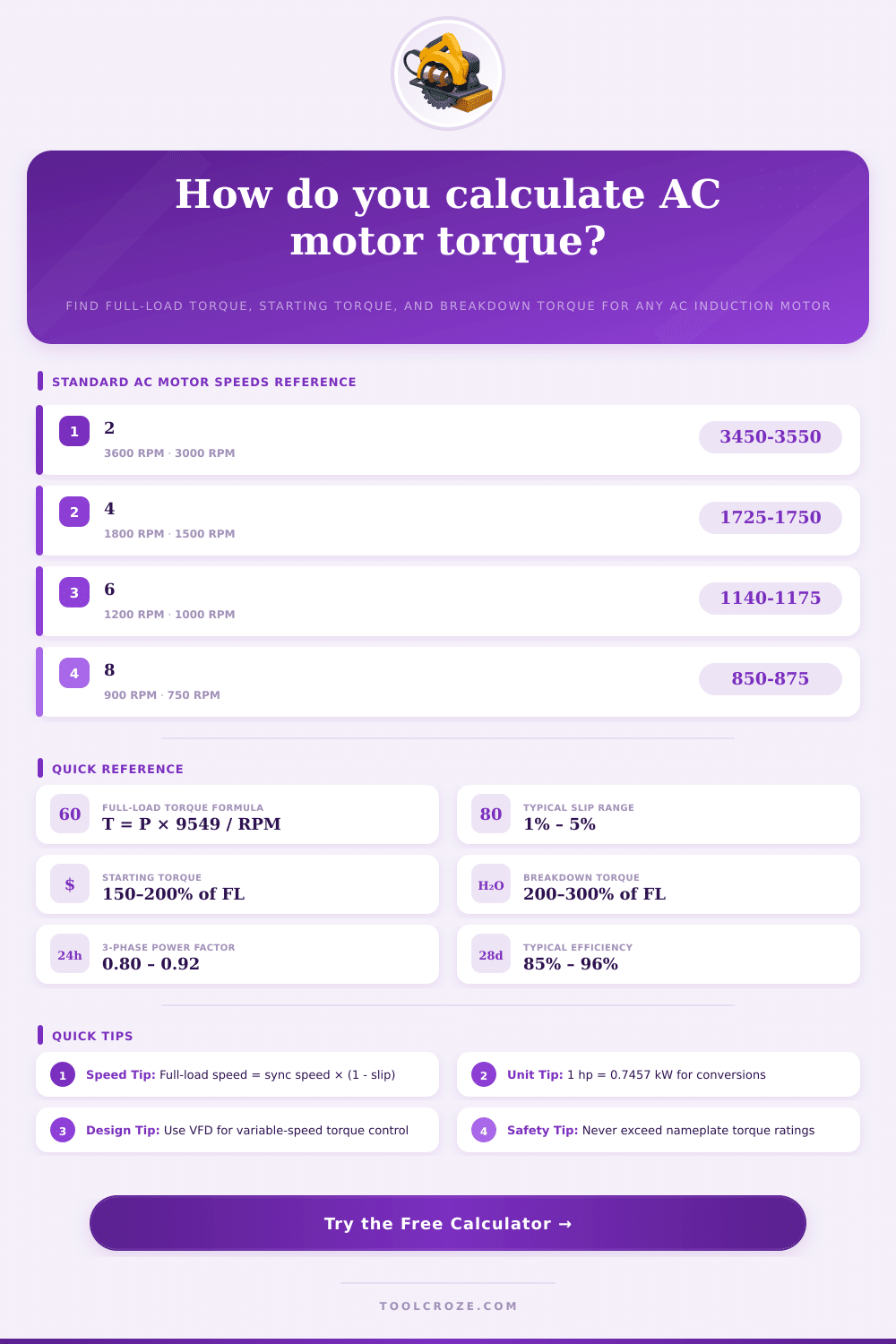
| Poles | Sync Speed (60Hz) | Sync Speed (50Hz) | Typical FL RPM (60Hz) | Typical FL RPM (50Hz) |
|---|---|---|---|---|
| 2 | 3600 RPM | 3000 RPM | 3450 – 3550 | 2850 – 2950 |
| 4 | 1800 RPM | 1500 RPM | 1725 – 1750 | 1425 – 1450 |
| 6 | 1200 RPM | 1000 RPM | 1140 – 1175 | 940 – 975 |
| 8 | 900 RPM | 750 RPM | 855 – 875 | 710 – 735 |
| 10 | 720 RPM | 600 RPM | 680 – 700 | 565 – 585 |
| 12 | 600 RPM | 500 RPM | 565 – 585 | 468 – 488 |
| Rating | 1800 RPM | 1200 RPM | 900 RPM | Metric Equiv. |
|---|---|---|---|---|
| 0.5 hp / 0.37 kW | 1.46 ft-lb / 2.0 Nm | 2.19 ft-lb / 2.97 Nm | 2.92 ft-lb / 3.96 Nm | 0.37 kW |
| 1 hp / 0.75 kW | 2.92 ft-lb / 3.96 Nm | 4.38 ft-lb / 5.94 Nm | 5.84 ft-lb / 7.92 Nm | 0.75 kW |
| 5 hp / 3.73 kW | 14.6 ft-lb / 19.8 Nm | 21.9 ft-lb / 29.7 Nm | 29.2 ft-lb / 39.6 Nm | 3.73 kW |
| 10 hp / 7.46 kW | 29.2 ft-lb / 39.6 Nm | 43.8 ft-lb / 59.4 Nm | 58.4 ft-lb / 79.2 Nm | 7.46 kW |
| 50 hp / 37.3 kW | 146 ft-lb / 198 Nm | 219 ft-lb / 297 Nm | 292 ft-lb / 396 Nm | 37.3 kW |
| 100 hp / 74.6 kW | 292 ft-lb / 396 Nm | 438 ft-lb / 594 Nm | 583 ft-lb / 791 Nm | 74.6 kW |
| Motor Size | Typical Slip (%) | Typical Efficiency | Notes |
|---|---|---|---|
| Fractional (< 1 hp) | 5% – 10% | 60% – 75% | Single-phase, high slip |
| 1 – 5 hp | 3% – 5% | 80% – 87% | Common NEMA design B |
| 5 – 20 hp | 2% – 4% | 87% – 92% | 3-phase preferred |
| 20 – 100 hp | 1% – 3% | 92% – 95% | Premium efficiency |
| > 100 hp | 0.5% – 2% | 95% – 97% | Ultra-premium, low slip |
The Torque of an AC Motor is simply the twisting force that causes the spinning of the motor. It works from 0% until full speed. If you understand how it acts, that helps to feel why those motors act like this, as they do in various situations.
Interesting everything about electric motors are that they reach the biggest Torque at 0 rotations per minute. When the motor spins more quickly, it creates a force against the power source. Because of that the pure voltage, the current flows and the Torque drops also.
How Torque Works in AC Motors
Like this the Torque is the strongest, when the motor stands still, and the weakest at maximum speed. Truly, electric motors are strong, one can get around 200% until 300% of peak Torque from AC Motors.
Motors for Torque are built specially for that use. They provide high starting Torque and have a character, where the Torque always drops, during the speed grows. Those motors can work through a broad range of speeds and stay without trouble, specially at low speeds or even at a standstill.
Some AC Motors for Torque are protected against overload, which means that they can stay at a standstill without overheating. It makes them good for works with tension, for instance for line gear or roll cable.
Sometimes motors must stop something at the wrong speed. Think about holding of weights below, setting of keys or the first and final steps of cable-fold. The motor necessarily must hold Torque, although the rotor does not twist at all.
A useful formula links between Torque, power and speed. Torque is equal too steady power divided by speed. For instance, a 10-horsepower motor, that runs at 1750 rotations per minute, gives around 30 foot-pounds of Torque.
A slower motor with same power produces more Torque. A motor at 800 rotations per minute with 200 horsepowers reaches more than 1300 foot-pounds, which is more than double than that, which a 1750-rotation motor with same power would give.
A four-pole motor has almost double the Torque than a two-pole. But it spins at half of the speed. When you use pulleys to increase the speed, the Torque drops again by means of two.
The Torque of an induction motor depends on the resistance of the rotor and is tied to the square of the applied voltage. The Torque for starting is the smallest that the motors give during their boost from zero until full load. After that minimum, the Torque again grows until it reaches peak Torque, which is the maximum that an AC Motor can reach.
Peak Torque is the highest spot on the curve of Torque against speed. Dropping the voltage on a single-phase motor to slow it also drops the Torque, so use of a pulley system sometimes is the better answer. One can not slow, while one keeps the same power, unlessthe Torque grows equally.