🧪 Epoxy Coverage Calculator
Calculate exact gallons, Part A & Part B volumes, and mix ratios for any epoxy project
| Epoxy Type | Viscosity | Max Pour Depth | Cure Time | Typical Use |
|---|---|---|---|---|
| Casting / Deep Pour | Very Low | Up to 2" | 24–72 hrs | River tables, castings, encapsulations |
| Table Top / Flood Coat | Medium | 1/8"–1/4" | 12–24 hrs | Bar tops, countertops, artwork |
| Marine Laminating | Low | N/A (surface) | 4–8 hrs | Fiberglass lay-up, boat hulls |
| Floor Coating (100% Solids) | High | 4–20 mils/coat | 8–16 hrs | Garage floors, industrial floors |
| Structural / Adhesive | Paste / Gel | Small volumes | 1–6 hrs | Bonding, gap-filling, repairs |
| Application | Thickness (mils) | Thickness (inches) | Notes |
|---|---|---|---|
| Seal / Prime Coat | 4–8 mils | 0.004"–0.008" | Seals porous substrates first |
| Flood / Table Top Coat | 125 mils | 1/8" (0.125") | Standard glass-like finish |
| Garage Floor Thin | 4–8 mils | ~0.006" | Single decorative coat |
| Garage Floor Standard | 10–20 mils | 0.010"–0.020" | High-build, durable finish |
| Shallow Pour / Accent | 250 mils | 1/4" (0.25") | Decorative pours with pigment |
| Deep Pour (single pass) | 500–2000 mils | 1/2"–2" | Casting; check heat limits |
| Marine Laminating | 10–30 mils | 0.010"–0.030" | Per fiberglass cloth layer |
| Mix Ratio (A:B) | Part A Fraction | Part B Fraction | Typical Epoxy Systems |
|---|---|---|---|
| 1:1 by volume | 50% | 50% | Most casting resins, many table top systems |
| 2:1 by volume | 67% | 33% | Many marine and laminating epoxies |
| 3:1 by volume | 75% | 25% | Some floor coatings, high-solids systems |
| 4:1 by volume | 80% | 20% | Structural and adhesive epoxies |
| Temperature | Working / Pot Time | Demold / Recoat | Full Cure |
|---|---|---|---|
| 60°F (16°C) | 45–60 min | 24–48 hrs | 7–10 days |
| 70°F (21°C) | 30–45 min | 16–24 hrs | 5–7 days |
| 75°F (24°C) | 20–35 min | 12–18 hrs | 3–5 days |
| 80°F (27°C) | 15–25 min | 8–14 hrs | 2–4 days |
| 85°F+ (29°C+) | 10–18 min | 6–10 hrs | 1–3 days |
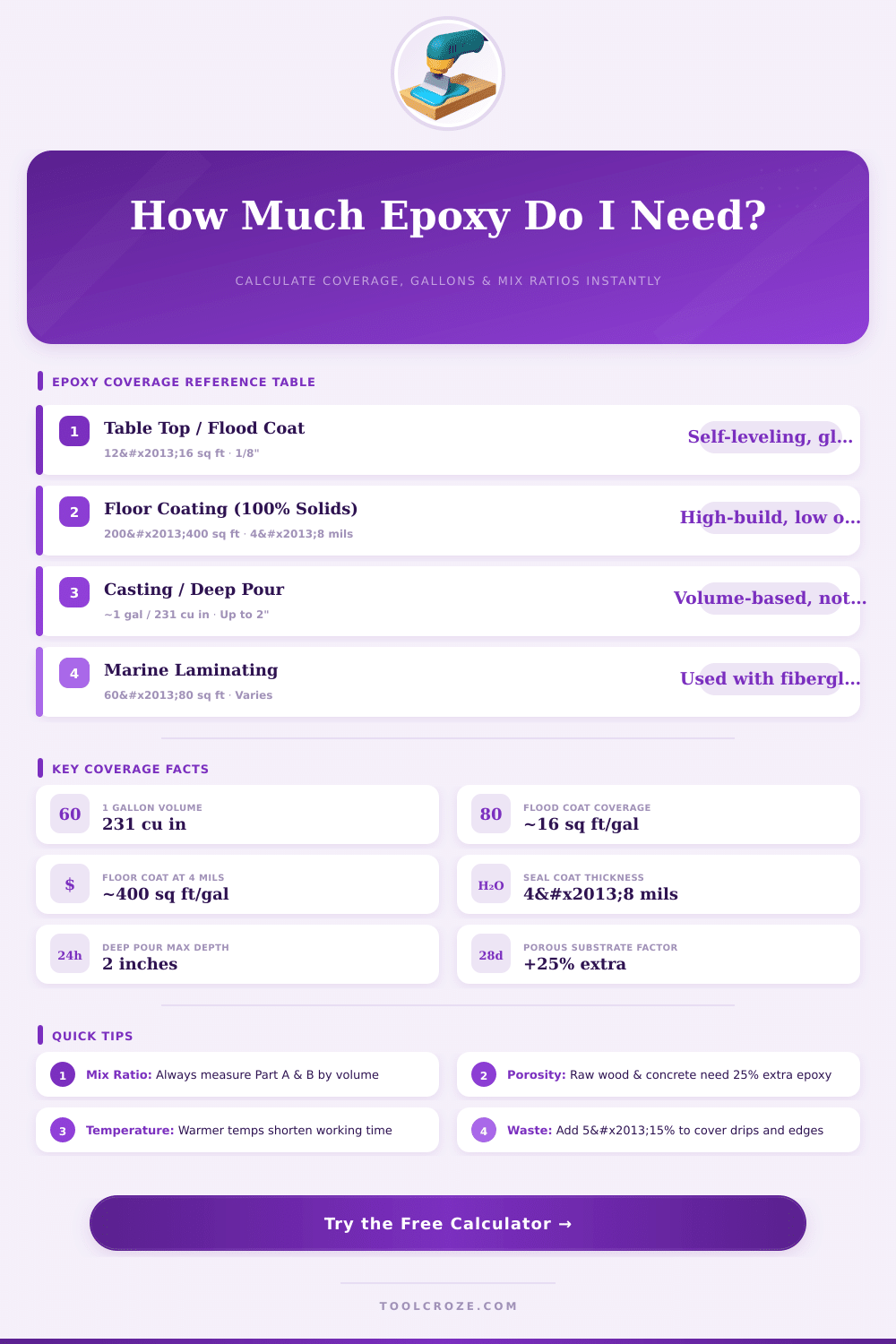
Figuring out how many Epoxy you really need is not easy. Good reference is that most Epoxy for table- and bar tops cover around 12 square feet per gallon for self-leveling covering, when one applies it in one-eighth thickness. If you are not sure, take a bit more material is the best choice.
And no, it is not a trick to sell you resin that you will not use.
How Much Epoxy Do You Need
Here everywhere it becomes a bit more hard. You have two different coverings, that work together, but they do not cover the same area. The seal covering and the flood covering both depend on Epoxy, although they spread over entirely different surfaces.
A gallon can suffice for 16 square feet during flood covering or for 48 square feet during seal covering; but not for both at once. One applies the seal covering first with a normal paint brush. Later one pours the flood covering on and lets it self-level in one-eighth thickness.
These numbers are only rough values. The amount that you really must use depends on factors like your method of application and the kind of surface material that you cover.
Different kits of Epoxy come in various sizes, and the coverage adjusts accordingly. 3-gallon kits usually cover between 380 and 480 square feet. The 1.5-gallon version reaches around 190 to 240 square feet.
For small repairs you can count with about 8 to 10 square feet from a smaller package. One maker lists his coverage at 16 sqaure feet per gallon in one-eighth thickness.
Porous surfaces throw everything into confusion. Take for instance plywood… It absorbs much more of Epoxy than one wood think.
An early thin brushed covering helps, and honestly, you commonly need a second covering too before one can continue. After those brushed coverings dried, you can pour your colored flood covering with clear conscience.
Especially with tiling, the solid content shows the real life of the stories. Tables with around 90-percent solid content give thicker and stronger layers. Big box stores sell Epoxy with 50-percent solid content at only 25 percent of the price, but you get much thinner layers.
It is a recipe for covering only half of your garage, because you did not buy enough material from the start. Cheaper kits lie about their coverage claims, lower solid content results in thinner coverings, sometimes only one-quarter to one-eighth thickness compared to professional-grade products.
Epoxy calculator removes the guessing during planning. Simply measure the length of your project, width and depth in inches, and enter them in the program. It will show exactly how much you need for the seal covering, flood covering, edges and your wanted depth.
The coverage depends too much on how strongly you press the roller, the temperature of the Epoxy and the porousness of the surface.
Adding pools to the coverage for floors really helps to plan, a real benefit, because mixed Epoxy can harden quickly. Using the right tools like scrapers, rollers and T-shaped spreaders helps to spread everything evenly much more easily and helpsagainst buildup or trapped bubbles.