🌳 Deck Stain Coverage Calculator
Estimate gallons needed for deck floor, railings, steps & fascia boards
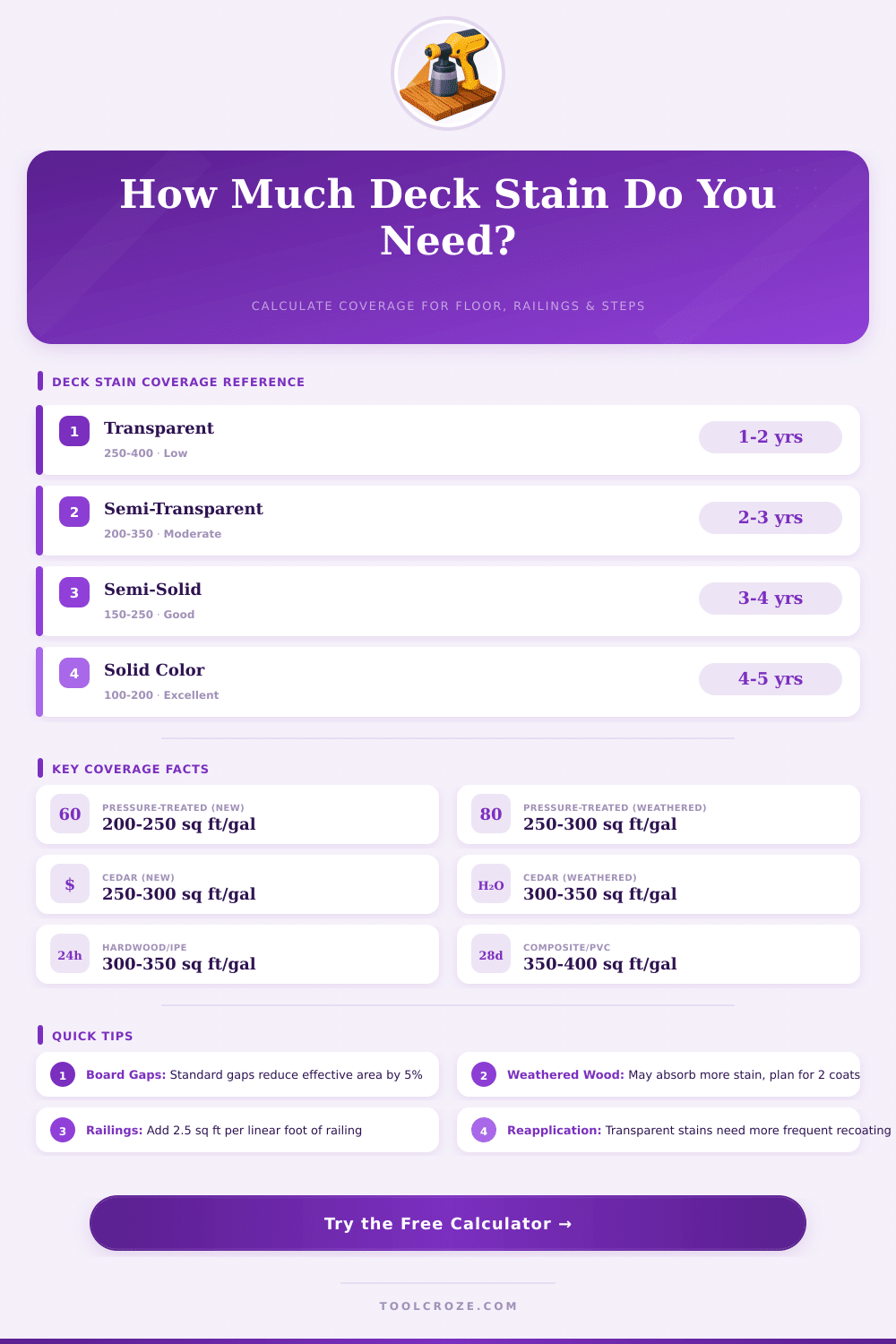
| Wood Species | Coverage (New) | Coverage (Weathered) | Recommended Opacity |
|---|---|---|---|
| Pressure-Treated Pine | 200–250 sq ft/gal | 250–300 sq ft/gal | Semi-transparent to solid |
| Cedar | 250–300 sq ft/gal | 300–350 sq ft/gal | Transparent to semi-solid |
| Redwood | 250–300 sq ft/gal | 300–350 sq ft/gal | Transparent to semi-transparent |
| Composite / PVC | 350–400 sq ft/gal | N/A | Semi-transparent only |
| Hardwood / Ipe | 300–350 sq ft/gal | 300–350 sq ft/gal | Transparent to semi-transparent |
| Stain Type | Coverage Rate | UV Protection | Typical Lifespan | Hides Grain? |
|---|---|---|---|---|
| Transparent | 250–400 sq ft/gal | Low | 1–2 years | No — shows full grain |
| Semi-Transparent | 200–350 sq ft/gal | Moderate | 2–3 years | Partial grain visible |
| Semi-Solid | 150–250 sq ft/gal | Good | 3–4 years | Mostly hidden |
| Solid Color | 100–200 sq ft/gal | Excellent | 4–5 years | Yes — fully hidden |
| Deck Size | Floor Area | Typical Railing Area | Steps (8 steps) | Total Est. Area |
|---|---|---|---|---|
| 10 × 12 ft (small) | 120 sq ft | ~88 sq ft | ~24 sq ft | ~232 sq ft |
| 12 × 16 ft (medium) | 192 sq ft | ~105 sq ft | ~24 sq ft | ~321 sq ft |
| 16 × 20 ft (large) | 320 sq ft | ~135 sq ft | ~30 sq ft | ~485 sq ft |
| 16 × 24 ft (XL) | 384 sq ft | ~155 sq ft | ~30 sq ft | ~569 sq ft |
| 20 × 30 ft (wrap-around) | 600 sq ft | ~200 sq ft | ~36 sq ft | ~836 sq ft |
| Stain Type | Mild Climate | Hot/Sunny Climate | Wet/Humid Climate |
|---|---|---|---|
| Transparent | 1–2 years | 1 year | 1–2 years |
| Semi-Transparent | 2–3 years | 1–2 years | 2 years |
| Semi-Solid | 3–4 years | 2–3 years | 2–3 years |
| Solid Color | 4–5 years | 3–4 years | 3–4 years |
The provision of deck stain for covers is really difficult cause. It looks easy at first but under the surface lies a more complex way. Most deck stain for covers cover between 150 and 300 square feet per gallon, and yes, that is a vast range.
The kind of wood, the particular brand of deck stain and the state of your deck surface all seriously affect the calculations.
How to Measure, Choose and Apply Deck Stain
Start with the measurement of the whole area in square feet of your cover. When you have that number, divide it by the coverage info from the label of the deck stain. Then multiply that result by the number of coats, that you plan to use.
Like this you receive a rough guess in gallons. Many calculators for deck stain raise the number a bit to ensure, that you will not end without enough amount. For instance, if the label says 100 square feet per gallon and your cover has from 101 to 199 square feet, the calculator will advise two gallons for safety.
Add 10 to 20 percent more than the suggested amount on the label simply is wise prepration.
The rates of coverage differ a lot between different brands. Some products cover only around 125 square feet per gallon, what makes them fairly expensive. Others reach almost 200 square feet per gallon.
For instance, deck stain from TWP usually covers 150 to 200 square feet during the first coat. For smaller covers or decks, everything up to around 175 square feet, one gallon commonly works, regardless of the grade of thickness, that you choose.
The type of deck stain itself matters more then only the numbers of coverage. Semi-clear deck stain allows, that the grain of the wood shows through them, what works perfectly if you want to keep the natural look. Full deck stain hides the grain outright, so it is ideal for old covers, that need strong protection and uniform colour.
Semi-solid deck stain lies between the two, good colour without entirely covering the texture of the wood.
The tools for applying make a big difference about the equal spread of the deck stain. A good brush of 4 inches well handles grooves and edges. A roller works above big flat areas, but it better suits full deck stain, because thin ones can splatter.
Broad pads for covers with cushions give fast and smooth coverage above vast surfaces. Sprayers deliver uniform coat on big covers, although they risk overspraying and commonly waste product compared to brush or roller.
Your cover must be fully dry before the deck stain will touch it. Usually 48 to 72 hours after rain or wash. Direct sunshine during the application does not help, because the deck stain does not soak into the wood correctly.
Work in parts and leave a wet edge to escape strips. Move from one corner to the other in long, steady strokes sothat everything looks smooth.
Vertical surfaces accept deck stain more well than horizontal. I noticed vertical parts, that looked fresh after four years, while the floor started to lose colour already in the second year and needed a refresh in the third year.