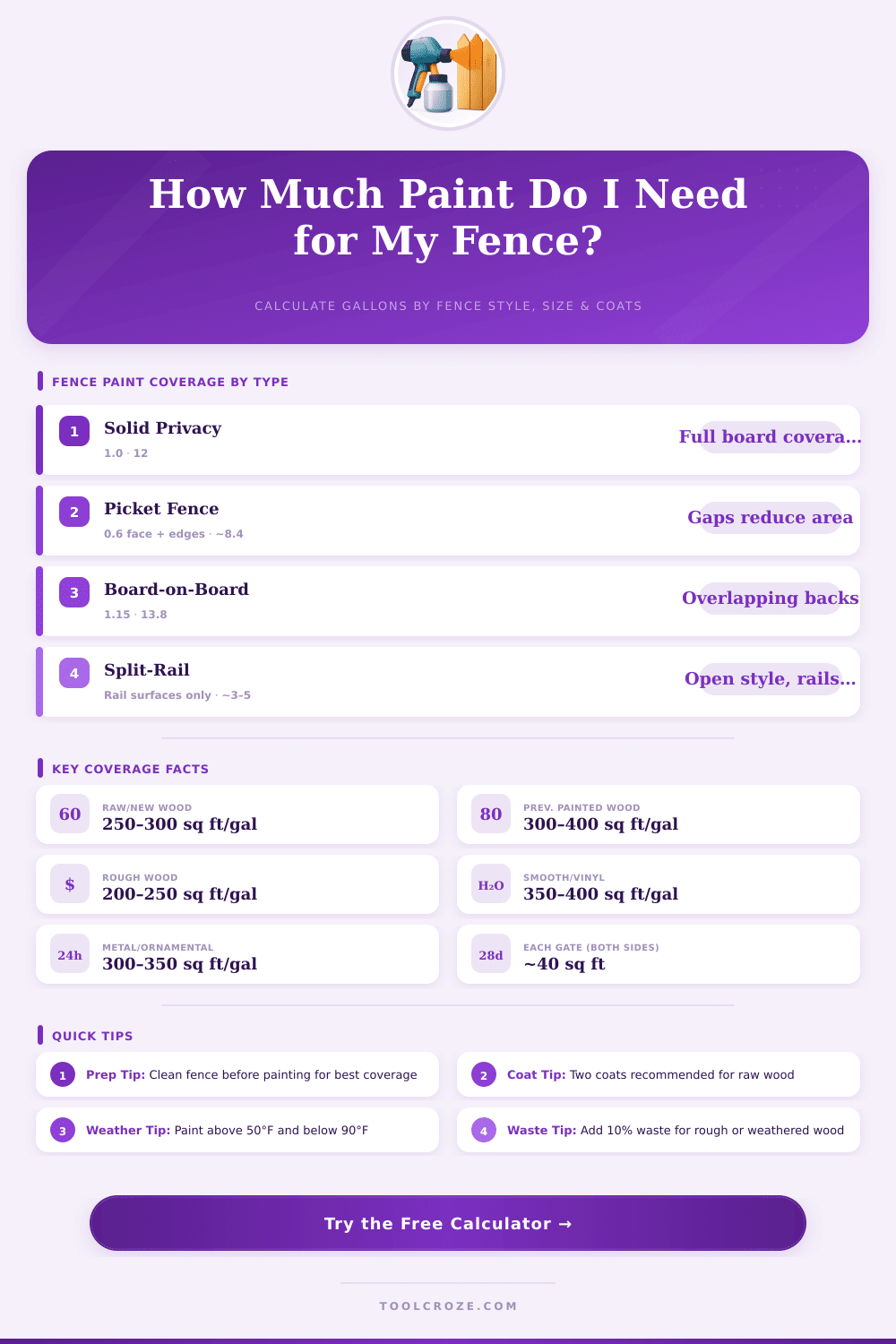
🚧 Fence Paint Coverage Calculator
Calculate exactly how much paint or stain you need for any fence style
| Fence Style | Exposure Factor | Eff. Sq Ft / Lin Ft (6ft H) | Notes |
|---|---|---|---|
| Solid Privacy | ×1.0 | 12 sq ft | Full board surface, no gaps |
| Board-on-Board | ×1.15 | 13.8 sq ft | Overlap adds rear board exposure |
| Picket Fence | ×1.4 eff. | ~8.4 sq ft | ~60% solid; edge area included |
| Split-Rail | Rail surfaces only | ~3–5 sq ft | Open style; only rail cylinders |
| Stockade / Dog-Ear | ×1.0 | 12 sq ft | Similar to solid privacy |
| Chain-Link w/ Slats | ~80% coverage | ~9.6 sq ft | Slat area only, no chain links |
| Material / Surface | Coverage (sq ft/gal) | Recommended Coats | Notes |
|---|---|---|---|
| Raw / New Wood | 250–300 | 2–3 | Very porous; absorbs more product |
| Previously Painted Wood | 300–400 | 2 | Existing coat seals surface |
| Rough / Weathered Wood | 200–250 | 2–3 | Texture increases absorption |
| Smooth / Vinyl | 350–400 | 1–2 | Non-porous; great coverage |
| Metal / Ornamental Iron | 300–350 | 2 | Prime bare metal first |
| Coating Type | Finish | Life Expectancy | Best For |
|---|---|---|---|
| Exterior Paint | Opaque | 5–10 years | All wood, vinyl, metal |
| Solid Stain | Opaque | 4–7 years | Aged or rough wood |
| Semi-Transparent Stain | Shows grain | 2–5 years | New, quality wood |
| Primer | Flat | N/A (topcoat required) | Bare/new wood, metal |
| Fence & Deck Paint | Satin/gloss | 5–8 years | High-traffic or exposed fences |
| Fence Length | 3 ft Height | 4 ft Height | 6 ft Height | 8 ft Height |
|---|---|---|---|---|
| 50 linear ft | 150 sq ft | 200 sq ft | 300 sq ft | 400 sq ft |
| 100 linear ft | 300 sq ft | 400 sq ft | 600 sq ft | 800 sq ft |
| 150 linear ft | 450 sq ft | 600 sq ft | 900 sq ft | 1,200 sq ft |
| 200 linear ft | 600 sq ft | 800 sq ft | 1,200 sq ft | 1,600 sq ft |
| 300 linear ft | 900 sq ft | 1,200 sq ft | 1,800 sq ft | 2,400 sq ft |
| 500 linear ft | 1,500 sq ft | 2,000 sq ft | 3,000 sq ft | 4,000 sq ft |
The most tins of Paint for Fence covers around 250 to 350 square feet, when one applies it to fencing. But the real cover? It changes a lot based on various things.
The kind of wood affects that. Also the age and the state of wear. Moreover, the style of the Fence matters.
How Much Paint Do You Need for a Fence
For new wood that is freshly cut, one needs a bit more Paint… Around 250 to 300 square feet each gallon. Here the cause with picket Fence: they have bigger surface area, than many folks think at first.
Plan to use at least two coats, to reach good protection and wanted colour.
Usage of spray cans alter those figures. With spray, the cover drops clearly, between 150 and 250 square feet each gallon, more or less. The wind plays a role.
Also your personal experience and the technique. The speed, where you move the gun of the spray above teh boards, does a big difference. In one test, that I followed, it ended at around 225 square feet each gallon by means of spray.
That is not even near that, what good brush can reach.
To count, how many product to buy, simple math is enough. Multiply the length of the Fence by the height in feet, and there, here you have the whole surface area. For little Fence under 175 square feet, one gallon of Paint should be enough.
For bigger tasks up to around 550 square feet, you need two gallons. The most many online calculators allow to enter the length, the height, the type of Fence, the number of coats and the price each gallon, too give loud guess.
When you apply, every horizontal board does need at least two coats. Once down, later one back. The tops of the posts and those tiny upper edges of the boards?
Walk them from both sides. After it drips, brushing again does improve the cover a lot. Use two or three thin coats beats one thick always, one ends with better result and protection, that lasts more long.
The right choice of tool decides everything. Brush works for edges, corners and final details. Roller with thick fiber allows to cover the area of boards more well and cost less than spray system.
Spray guns for Paint work most quickly on big surfaces and give equal finish. If some lack patience to mask or clean the tools later, rollers are the good middle.
The choice of Paint is just as important as the way to apply it. Formulas on base of oil give strong cover and deep reach in the wood with good strength outside, although drying takes more long and cleaning needs solvents. Products on water base dry quickly and wash easily.
Versions from latex keep their colour well on newer wood. Solid Paint helps, when two parts of Fence are built in different times; it hides how different old wood absorbs the product. Paint of good quality forms a surface that ages nice, whilecheap Paint for Fence starts to seem used surprisingly soon.