🔧 Non-Shrink Grout Calculator
Calculate volume, bags, and water needed for machine bases, column base plates, anchor bolts & more
Zero-slump stiff
Best: Tight voids
Flowable mix
Best: General use
Self-leveling
Best: Complex forms
Highest fluidity
Best: Anchor bolts
| Bag Size | Placement Method | Water Per Bag | Yield (ft³) | Yield (liters) |
|---|---|---|---|---|
| 50 lb | Dry Pack | ~0.35 gal | 0.38 | 10.76 |
| 50 lb | Plastic (Flowable) | ~0.44 gal | 0.40 | 11.33 |
| 50 lb | Fluid | ~0.55 gal | 0.43 | 12.17 |
| 55 lb | Dry Pack | ~0.39 gal | 0.42 | 11.89 |
| 55 lb | Plastic (Flowable) | ~0.48 gal | 0.44 | 12.46 |
| 55 lb | Fluid | ~0.60 gal | 0.47 | 13.31 |
| 25 kg | Dry Pack | ~1.4 L | 0.40 | 11.00 |
| 25 kg | Plastic (Flowable) | ~1.8 L | 0.43 | 11.75 |
| 25 kg | Fluid | ~2.2 L | 0.46 | 12.50 |
| Application | Typical L x W | Depth Range | Recommended Method | Target Strength |
|---|---|---|---|---|
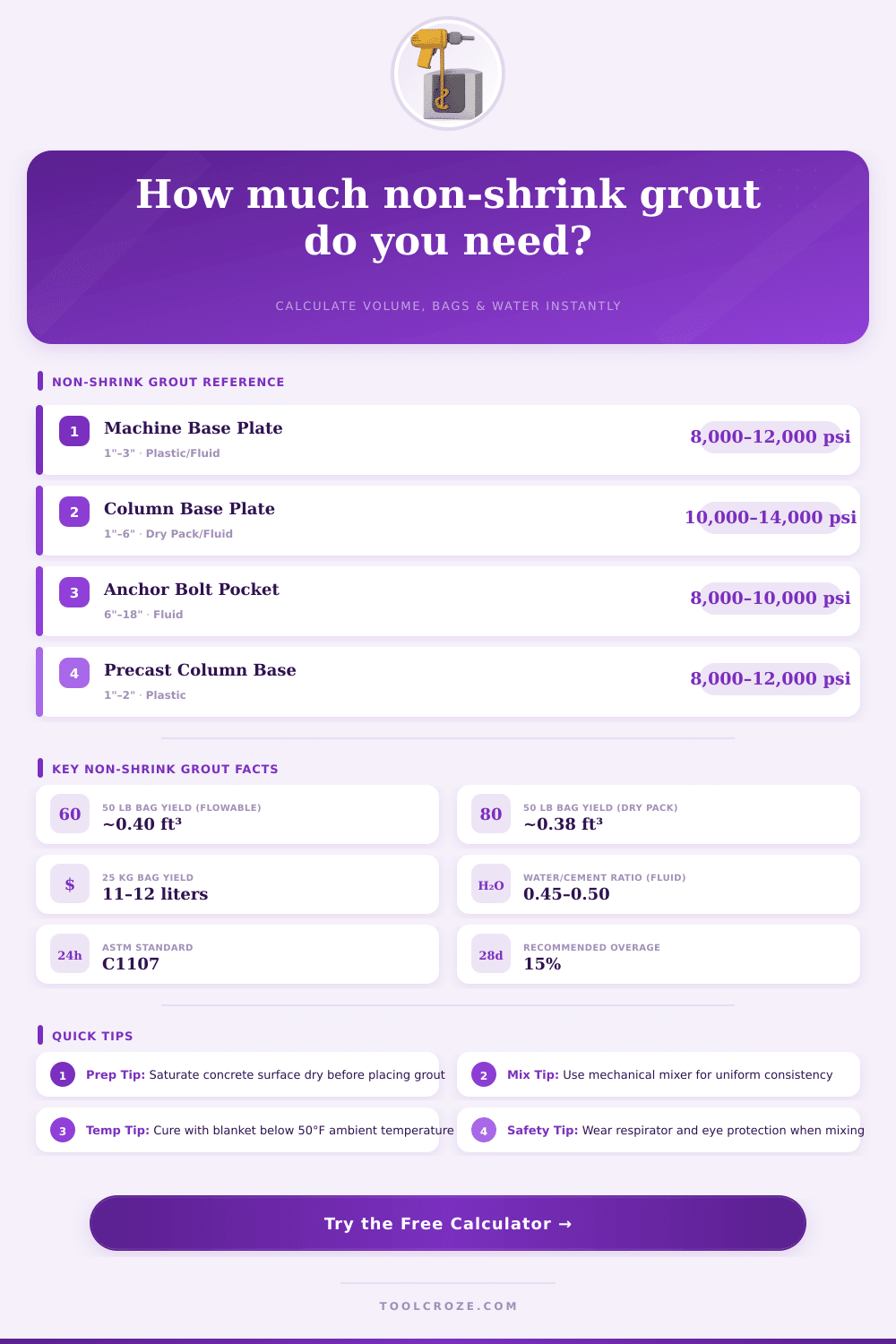
| Machine Base Plate | 12"x18" to 48"x72" | 1" – 3" | Plastic / Fluid | 8,000–12,000 psi |
| Column Base Plate | 12"x12" to 24"x24" | 1" – 6" | Dry Pack / Fluid | 10,000–14,000 psi |
| Anchor Bolt Pocket | 3"–6" dia | 6" – 18" | Fluid / Self-Leveling | 8,000–10,000 psi |
| Precast Column Base | 18"x18" to 30"x30" | 1" – 2" | Plastic | 8,000–12,000 psi |
| HVAC / Chiller Base | 48"x72" to 72"x120" | 1.5" – 3" | Fluid | 8,000–10,000 psi |
| Repair Fill | Varies | 0.5" – 4" | Plastic / Fluid | 6,000–10,000 psi |
| Placement Method | 3-Day Strength | 28-Day Strength | ASTM C1107 Class |
|---|---|---|---|
| Dry Pack (Stiff) | 5,000–7,000 psi | 10,000–14,000 psi | A / B |
| Plastic (Flowable) | 4,000–6,000 psi | 8,000–12,000 psi | B |
| Fluid (Self-Leveling) | 3,000–5,000 psi | 8,000–10,000 psi | C |
No-shrink grout is a kind of material that does not shrink in volume during hardening, unlike average concretes. It is made up of cement or epoxy-based mix, that one uses to fill spaces between support elements, base plates and foundations or other supporting parts. Quite interesting is the way it works.
First the concrete strongly expands, later it a bit shrinks so that the final result almost does not have shrinkage. Because of that one calls it “no-shrink”. It keeps any size or form, that it has while wet, when it hardens.
No-Shrink Grout: What It Is and How It Works
This grout commonly applies in steel buildings, to fill spaces under wooden base plates, under machine cushions and tools. One uses it also to set machine bases, generators, grinders, presses and compressors. Other common uses are structural grouting of ready-made columns, steel columns and anchoring of signal poles, anchor screws and rolls.
It is popular for clay rail beds, machine beds, rails, bridge support cushions and round poles in framed steel buildings.
No-shrink grout is prepared for blending in liquid form. That allows to place it by means of simply pouring. You just add water to reach a flowing mix with high strength.
So it hardens and reaches strong stability without volume loss, keeping whole contact with the botom surface. There are tools that help to estimate the needed amount of material for grouting tasks, where minimal shrinkage problems matter.
Many brands produce this type of stuff. Quikrete No-Shrink Precision grout is a rugged, non-metallic grout, designed for precise grouting and general construction. It comes in 50-pound bags and works four grouting of front-rolling concretes, steel columns and anchoring tasks.
Sika 212 is another commonly chosen, available also at home stores. Sikagrout 428 FS is made up of non-metallic, cement precision grout, that reaches high early strength grade in liquid form. Red Diamond No-Shrink grout is meant for commercial building works.
Hold Construction grout is a non-metallic, Portland-cement base from hydraulic cement, fillers and additives for general structural grouting.
Some products meet ASTM C 1107, the standard for packed hydraulic cement grout. No-chloride makeup ensures that it does not cause rust on steel. Those grout mixes usually are non-metallic, non-staining and gray colored.
One can tamp it after filling by means of a stick for specific tasks, like grouting around pole bases. If the mix is quite rigid, the shapes form without extras. It flows quite well to stream in hollow blocks, when anchor screws need to beinstalled.
Quite handy for various situations on a job site.