🏍 Dirt Bike Sprocket Ratio Calculator
Calculate final drive ratio, gear-by-gear speed, and estimated top speed for any dirt bike
| Gear | Trans Ratio | Total Drive Ratio | Wheel RPM | Speed (3/4 RPM) | Speed (Peak RPM) |
|---|
| Change | Sprocket Ratio | Effect on Speed | Effect on Power Delivery |
|---|---|---|---|
| Front +1T (e.g. 13→14) | Ratio decreases | +5-8% top speed | Slightly less torque, smoother power |
| Front -1T (e.g. 13→12) | Ratio increases | -5-8% top speed | More low-end grunt, snappier feel |
| Rear +2T (e.g. 48→50) | Ratio increases | -4-6% top speed | Better traction, more torque |
| Rear -2T (e.g. 50→48) | Ratio decreases | +4-6% top speed | Higher top end, harder to wheelie |
| Terrain | Front Sprocket | Rear Sprocket | Overall Effect |
|---|---|---|---|
| MX / Supercross | 14T | 48T | Higher top speed, fast lap times |
| Hard-pack / Sprint | 13T | 48T | Balanced power delivery |
| General Enduro | 13T | 50T | Stock-like, versatile |
| Tight Trails / GNCC | 12T | 52T | Maximum low-end traction |
| Sand / Open Desert | 14T | 49T | Better high-speed control |
| Rocky / Hill Climb | 12T | 54T | Maximum torque for climbing |
Choosing the right sprocket for a dirt bike really matters, so that the ride is fast, fun and safe. Knowing how those parts work can raise the riding experience to a whole new height. So, do not leave that to chance.
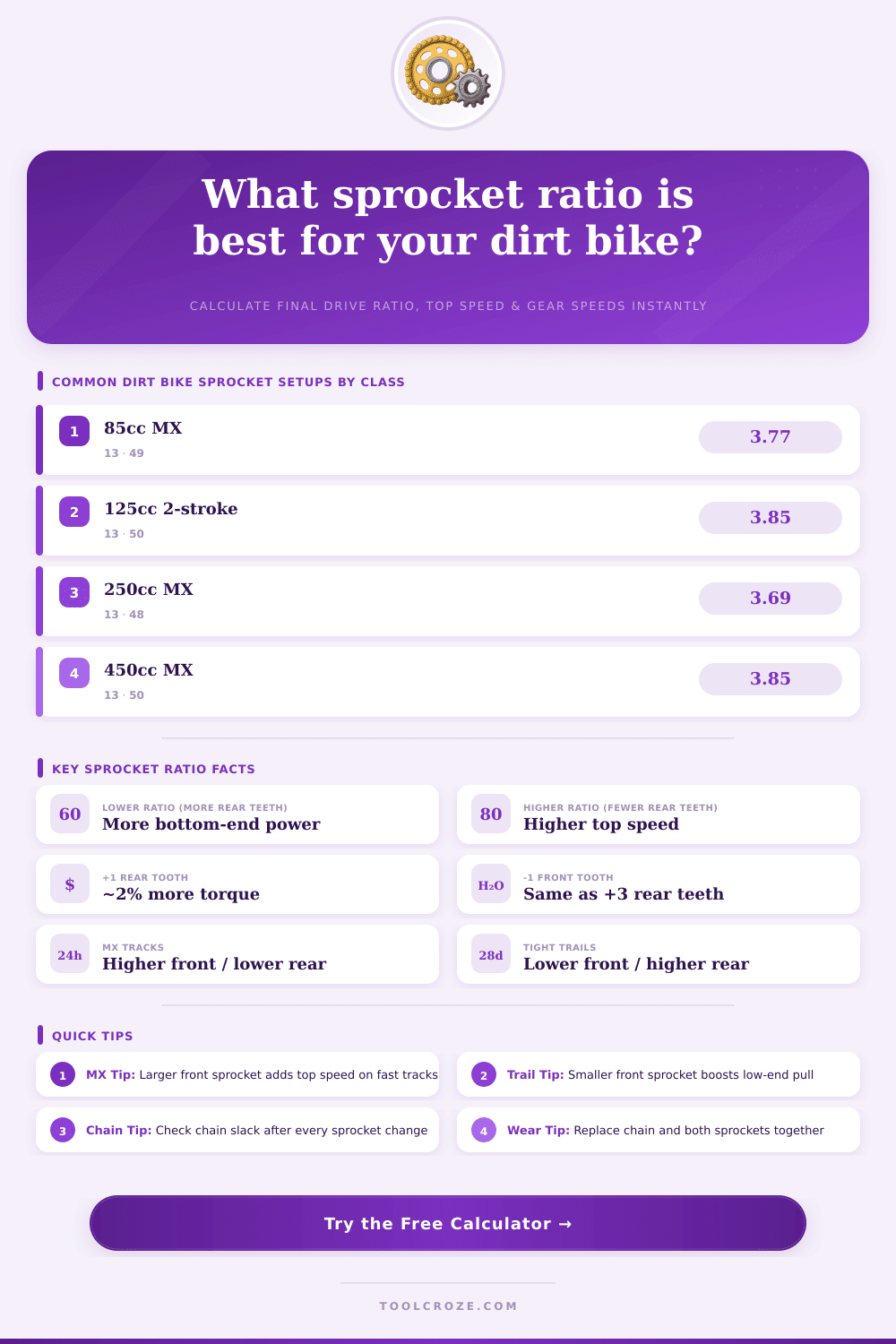
The ratio of gears one counts by sharing the number of the back sprocket by that of the front sprocket. This shows how far the front sprocket must twist, so that the back wheel turns almost once. Charts about sprocket ratios or gear guides help to understand how changes in the size of sprockets affect the ride.
How to Pick the Right Sprocket for Your Dirt Bike
Many riders use such tools to foresee how even one or two teeth will alter the feeling of the dirt bike.
Lowering the gears of a dirt bike gives more boost, but limits the top speed. One reaches that by using a smaller front sprocket or bigger back sprocket. Rather, raising the gears means to use a bigger front sprocket or smaller back, which gives bigger peak of pace.
A higher gear ratio works for fast sports, like desert riding, sand motocross or places without many sharp turns.
Here is something that is worth recalling. Every one-tooth change at the front sprocket equals around three to four teeth at the back. Some reckon that the proportion is nearer to two and half or three teeth at the back for every front tooth.
Either way, changes in front are more effective than in back. A mild change could be one tooth up or below at the front. A bigger change would be one tooth in front and two in the other direction in back.
The front sprocket one usually can alter by at least one tooth without needing a new chain, if it has the write link count and one installs it correctly. Combinations with bigger sprockets, like a 17-tooth front and 45-tooth back, will certainly need more chain links.
Gearing is really a compromise. When the riding conditions adjust, new changes could be needed. For road riding, going up two teeth in back from the default setup forms a good starting point.
Lowering the gears quite a lot, so that the second and third become normal, leaves the first as a slow crawler for hard parts. It ultimately depends on the riders style and the particular dirt bike gear ratios.
Before changing anything, always check the owners manual for safe tips and exact advice. Testing during open practice is a wise step. Sometimes the impact surprises; one thinks that one tooth up settles it, but the dirt bike actually feels better with two below.
It is not a simple guessing game. Writing notes afterall attempts helps to figure out what works best.