⚙️ Stepper Motor Torque Calculator
Calculate required load torque, safety margin, and steps per revolution for NEMA stepper motors
✅ Calculation Results
📋 Calculation Breakdown
| Frame | Torque Range | Typical Current | Common Uses |
|---|---|---|---|
| NEMA 8 | 2–10 oz-in | 0.2–0.5A | Miniature instruments, medical |
| NEMA 11 | 10–30 oz-in | 0.5–1A | Small robots, security cameras |
| NEMA 14 | 14–40 oz-in | 0.8–1.5A | Camera sliders, pen plotters |
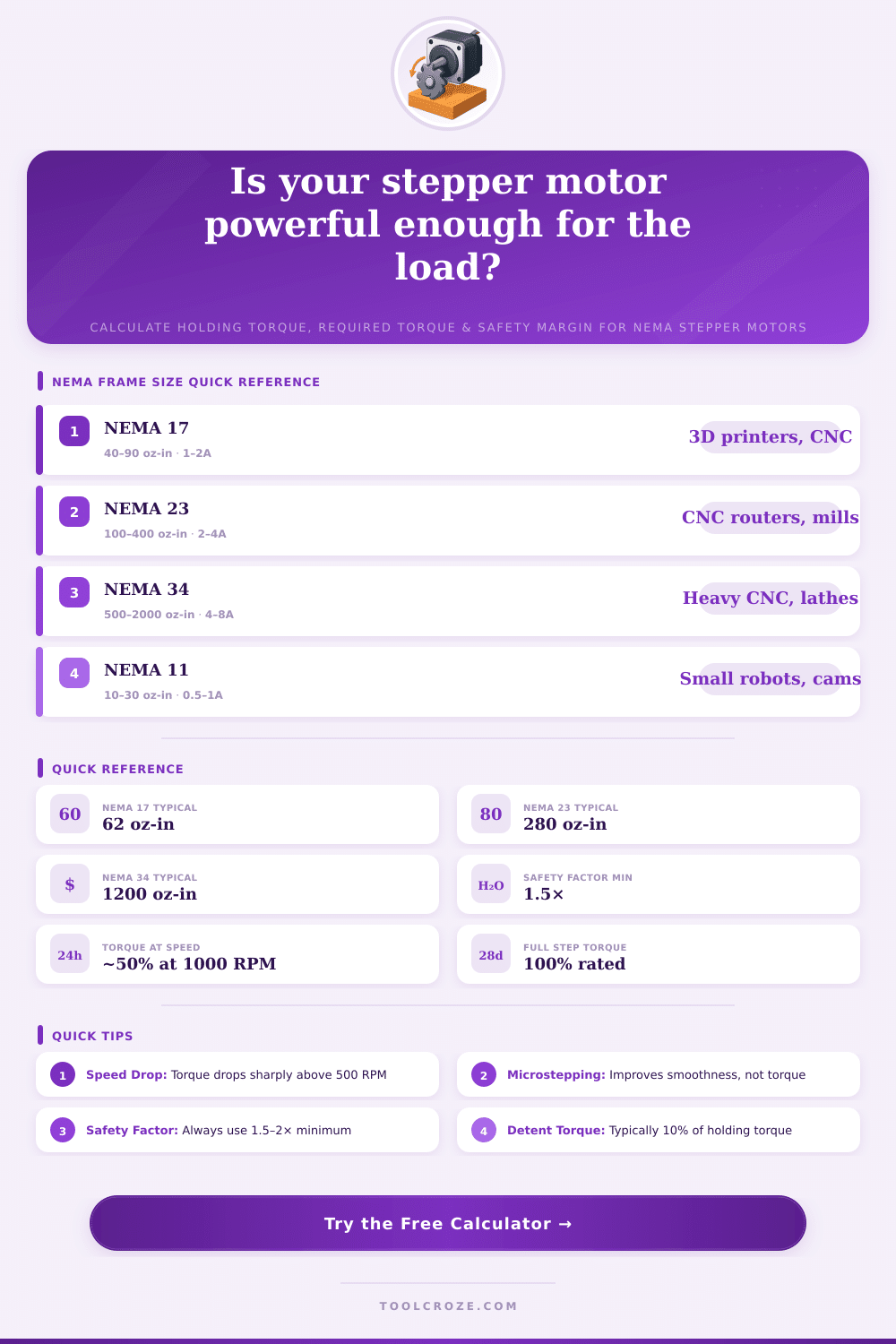
| NEMA 17 | 40–90 oz-in | 1–2A | 3D printers, light CNC, laser cutters |
| NEMA 23 | 100–400 oz-in | 2–4A | CNC routers, mills, engravers |
| NEMA 24 | 60–170 oz-in | 1.5–3A | Extruders, compact automation |
| NEMA 34 | 500–2000 oz-in | 4–8A | Heavy CNC, lathes, plasma cutters |
| Mode | Steps/Rev | Torque % | Resolution | Best Use |
|---|---|---|---|---|
| Full Step | 200 | 100% | 1.8° | Max torque, low noise apps |
| Half Step | 400 | ~70% | 0.9° | Good balance of torque/smoothness |
| 1/4 Step | 800 | ~38% | 0.45° | Smoother motion, hobby CNC |
| 1/8 Step | 1600 | ~19% | 0.225° | 3D printing standard |
| 1/16 Step | 3200 | ~10% | 0.1125° | High resolution positioning |
| 1/32 Step | 6400 | ~5% | 0.05625° | Ultra-smooth, low-torque only |
| Step Mode | At 200 RPM | At 500 RPM | At 1000 RPM | At 2000 RPM |
|---|---|---|---|---|
| Full Step | ~85% | ~65% | ~45% | ~20% |
| Half Step | ~75% | ~55% | ~35% | ~15% |
| 1/8 Step | ~60% | ~40% | ~25% | ~10% |
| 1/16 Step | ~45% | ~25% | ~12% | ~5% |
stepper motor genuinely perform well in delivery of torque at low speeds. That is one of their main advantages. Even so, to well understand how the torque works in those engines, we need to dig into their behavior at various speeds and with different setups.
Curves of speed and torque show how much torque a stepper motor is able to give at a certain speed, when it connects to a particular driver. Different combinations of engine and driver cause different results. At low speeds stepper motors create strong torque, because the inductance helps that more current passes through the coils.
How Stepper Motor Torque Changes with Speed
In the intermediate speed range there is a bit of decrease of torque because of changes in frequencies.
stepper motors usually ensure steady power. When the RPM doubles, torque halves. Reduction of speed by means of adapter can expand the accuracy and commonly reduce the noise, but because the engine must spin more quickly to keep the same RPM at the shaft, torque does not genuinely grow only by means of adaptation.
An efficient way too reach more torque is to expand the current, and that one does by means of higher voltage. The torque of a stepper motor is directly tied to the steady coil current. Double the current doubles also the torque.
In stepper motors there exist two main kinds of torque: static and dynamic. Static torque is that which the engine creates when it stands without motion. Holding torque and detent-torque both belong to static.
Holding torque is the maximum torque that a stepper motor can create at zero speed. Pull-out torque, or also called running torque or dynamic torque, shows the biggest load that the engine carries during rotation without losing steps.
Very important is choosing the right size of engine. If the required torque is less than 0.8 Nm, then Nema 8 until Nema 17 engines work well. For 1 until 3 Nm Nema 23 fits more.
Above 3 Nm one chooses Nema 34 or Nema 42. Usually one picks a stepper motor with more torque than genuinely needed, just to ensure that it does not lose steps.
stepper motors obey the law of Newton about rotation, where torque is tied to the inertia of rotor and load multiplied by angular boost. Increasing the speed requires more force, just as a car requires more gas to boost a heavy object. When the inductance is too high, the engines limit in the torque that they give during movement.
So holding torque alone does not describe everything. One can check the overall torque by means of turning the engine so that its shaft freely spins, with a fixed lever to the shaft and linkage of the lever end to a spring scale.
Some downsides include risk of skipping at high speeds and big size compared to brushless DC-engines. Servomotors offer strong torque through a broad speed range withclosing-loop feedback, which makes them more fitting for some tasks.