⚙ Motor Torque Calculator
Calculate motor torque from power & speed, force & radius, or power output from torque & RPM
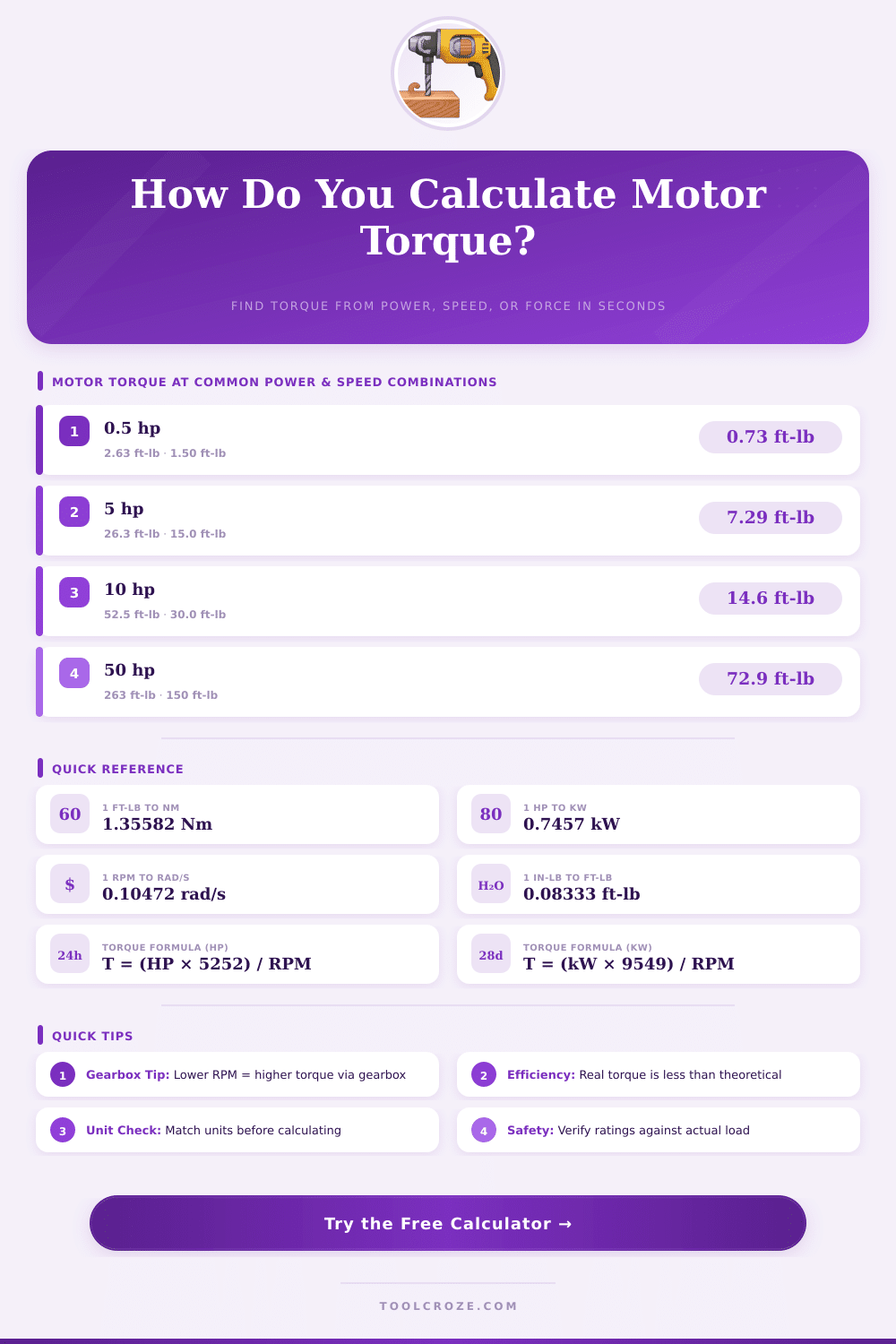
| Power | 1000 RPM | 1750 RPM | 3000 RPM | 3600 RPM |
|---|---|---|---|---|
| 0.5 hp | 2.63 ft-lb | 1.50 ft-lb | 0.88 ft-lb | 0.73 ft-lb |
| 1 hp | 5.25 ft-lb | 3.00 ft-lb | 1.75 ft-lb | 1.46 ft-lb |
| 5 hp | 26.3 ft-lb | 15.0 ft-lb | 8.75 ft-lb | 7.29 ft-lb |
| 10 hp | 52.5 ft-lb | 30.0 ft-lb | 17.5 ft-lb | 14.6 ft-lb |
| 25 hp | 131 ft-lb | 75.0 ft-lb | 43.8 ft-lb | 36.5 ft-lb |
| 50 hp | 263 ft-lb | 150 ft-lb | 87.5 ft-lb | 72.9 ft-lb |
| Motor Type | Typical Torque Range | Typical RPM Range | Efficiency Range |
|---|---|---|---|
| AC Induction | 1 – 500 ft-lb | 900 – 3600 RPM | 85% – 96% |
| DC Brush | 0.5 – 200 ft-lb | 500 – 5000 RPM | 75% – 90% |
| BLDC / Servo | 0.1 – 100 Nm | 1000 – 10000 RPM | 90% – 97% |
| Stepper | 0.01 – 30 Nm | 0 – 1200 RPM | 70% – 80% |
| Gearmotor | 10 – 2000 ft-lb | 1 – 200 RPM | 80% – 92% |
| Synchronous | 2 – 600 ft-lb | 600 – 3600 RPM | 88% – 96% |
| HP / kW | @ 1000 RPM | @ 1750 RPM | @ 3600 RPM |
|---|---|---|---|
| 1 hp / 0.75 kW | 5.25 ft-lb / 7.12 Nm | 3.00 ft-lb / 4.07 Nm | 1.46 ft-lb / 1.98 Nm |
| 5 hp / 3.73 kW | 26.3 ft-lb / 35.6 Nm | 15.0 ft-lb / 20.3 Nm | 7.29 ft-lb / 9.88 Nm |
| 10 hp / 7.46 kW | 52.5 ft-lb / 71.2 Nm | 30.0 ft-lb / 40.7 Nm | 14.6 ft-lb / 19.8 Nm |
| 50 hp / 37.3 kW | 263 ft-lb / 356 Nm | 150 ft-lb / 203 Nm | 72.9 ft-lb / 98.8 Nm |
Torque of a motor simply is the rotary force that it makes. Think about force that pushes something to turn, well, that you have before you. The interesting cause is that torque stays even if the motor does not move, while something pushes back with the same strength.
One measures it by means of newton-metres or pound-feet, because it is force applied in turning.
What Is Torque and Torque Motors
A torque motor forms a special type of DC electrical motor that operates without pause even when it is fully stopped without risk to burn itself. In a stopped state, it only delivers stable rotary force to something to what it is bound. They are direct running motors with permanent magnets, that twist around an axis and are built to give strong torque at middle speeds, even when they stand still.
One big advantage of torque motors is that they can handle uses directly, without needing parts like worm gears, belts or gearboxes. Their build naturally gives much rotary force, although that limits the maximum RPM. One also can install a closing brake to them, much like that in average servo motors, but the whole setup and form looks entirely different.
Choosing a torque motor, mind the torque, not only power. The peak torque points to the maximum rotary force that the motor can give physically. Continuous torque says what it is able to keep forever.
Maximum torque, commonly the peak (is used in calculations about boost).
Here is a mistake that folks commonly make. The real activity in an electrical motor comes from torque, not form power. Power only guesses how quickly work happens through time, in watts or horsepowers.
Torque on the other hand captures the current rotary energy that the motor puts out now. It moves things from full stop, while horsepower helps to keep the speed.
Most motors reach maximum torque at base speed, that drops as the turns expand. That happens because of drag and air resistance at the rotor. Resistance in the rotor circuit matters a lot for starting torque, for the rate of torque and for slip in normal use.
A torque motor is at its base a motor designed specially with higher rotor resistance to reach the ideal rate and physical traits.
torque decides how much weight or load the motor can bear, while RPM sets the speed. In heavy industrial uses, torque almost always matters more than speed. The formula is: torque matches Kt times flow.
Motors one rates by means of their voltage value Kv, that is RPM divided by voltage. The value Kt of torque relates to it. Giving the motor a set voltage, it willtwist at a speed from Kv multiplied by that input.
In DC motors, torque develops when a current carrying wire rests in a magnetic field, which creates force turning the rotor.