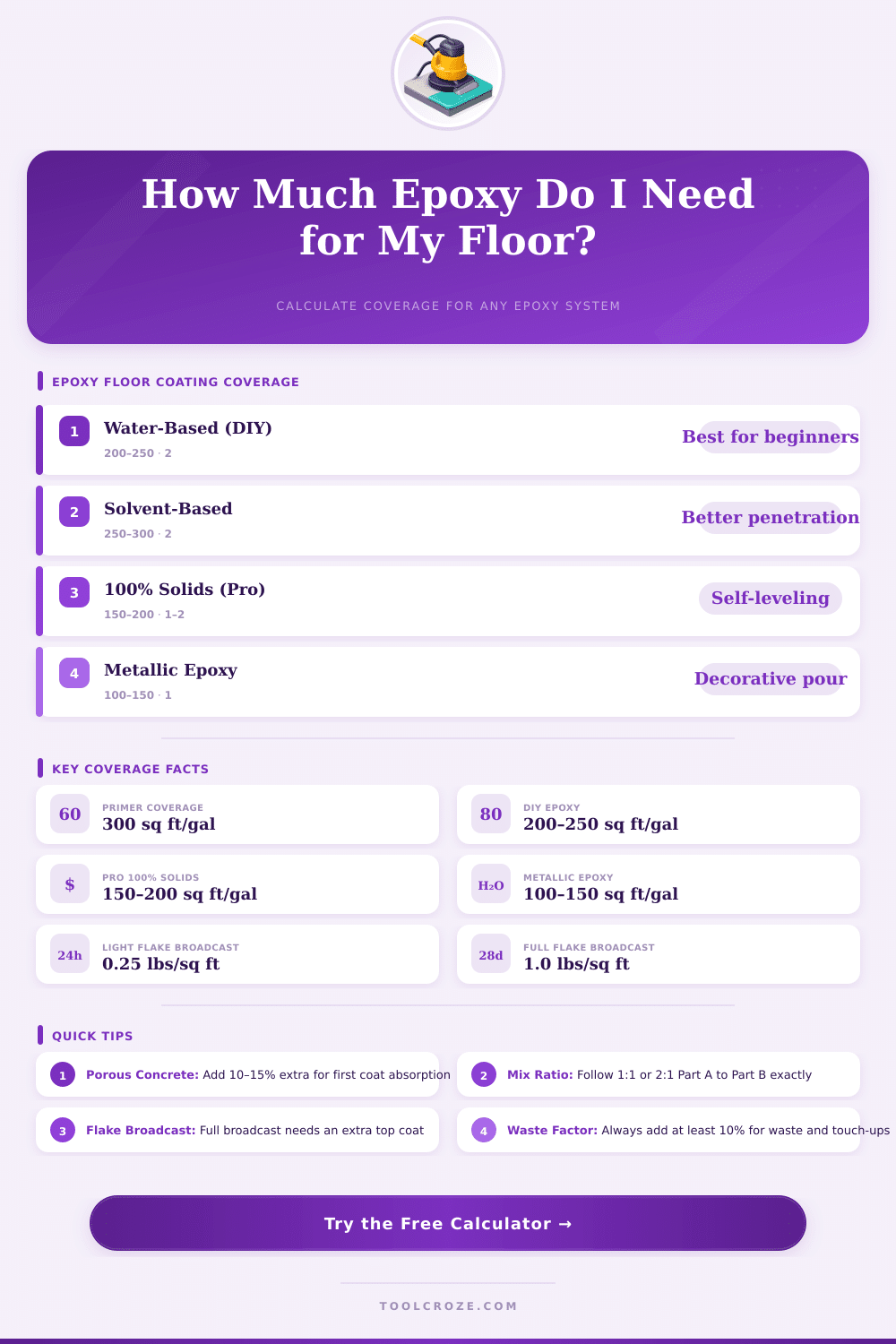
🏭 Epoxy Floor Coverage Calculator
Calculate primer, base coat, top coat, and decorative flake quantities for any epoxy floor system.
| System Type | Coverage (sq ft/gal) | Coats | Dry Film Thickness | Best Use | VOC Level |
|---|---|---|---|---|---|
| Water-Based Epoxy (DIY) | 200–250 | 2 | 2–4 mils | Residential garage, basement | Low |
| Solvent-Based Epoxy | 250–300 | 2 | 3–5 mils | Garage, workshop, light industrial | Medium |
| 100% Solids Epoxy (Pro) | 150–200 | 1–2 | 6–12 mils | Commercial, industrial floors | None |
| Polyaspartic Coating | 250–300 | 1–2 | 3–6 mils | UV-exposed areas, exterior | Low |
| Polyurethane Top Coat | 300–400 | 1 | 2–3 mils | Top coat over epoxy base | Low–Med |
| Metallic Epoxy | 100–150 | 1 | 10–20 mils | Decorative showroom, retail | None |
| Condition | Prep Required | Primer Needed | Notes |
|---|---|---|---|
| New / Smooth | Light acid etch or shot blast | Optional | Ensure pH 6–8 and dry |
| Porous / Rough | Grind, fill cracks, acid etch | Recommended | Extra base coat absorbs into pores |
| Contaminated / Oily | Degreaser + mechanical prep | Required | Bond failure likely without full prep |
| Previously Coated | Adhesion test, sand or grind | Recommended | Check existing coat compatibility |
| Cracked / Damaged | Fill cracks with epoxy filler | Required | Repair before base coat application |
| Coverage Level | Rate (lbs/sq ft) | Appearance | Top Coats Needed |
|---|---|---|---|
| Light Broadcast | 0.25 | Sparse, concrete shows through | 1 top coat |
| Medium Broadcast | 0.50 | Balanced, partial coverage | 1 top coat |
| Full Broadcast | 1.00 | Full chip coverage, no base visible | 2 top coats |
| System | Layers | Typical Application | Total Thickness |
|---|---|---|---|
| DIY 2-Coat | Base coat ×2 | Residential garage | 4–8 mils |
| Pro 3-Coat | Primer + Base ×2 + Top | Commercial, industrial | 10–18 mils |
| Flake System | Primer + Base + Flakes + Top ×2 | Garage, showroom | 8–14 mils |
| Metallic Pour | Primer + Metallic pour | Decorative showroom | 15–25 mils |
| UV-Stable System | Base + Polyaspartic top | Exterior, sun-exposed | 6–10 mils |
A gallon of epoxy floor depends on several factors. The kind of epoxy, the thickness it receives, and the state of the concrete below all affects the result. Standard gear for epoxy floor cover around 380 to 480 square feet of smooth concrete if one spreads and rolls it well.
Even so, if the concrete is very porous or has many unfilled expansion joints, the coverage can shrink.
How Much Floor Does One Gallon of Epoxy Cover?
One gallon of 100-percent solids epoxy floor will cover 1600 square feet on perfectly flat surface at 1 mil thickness. This amount changes quickly when one applies thick layers. A gallon of epoxy, that is made up of half a gallon of resin and half a gallon of hardener, will cover around 16 square feet at an eighth of an inch for flood coat.
As a seal coat, the same gallon covers almost 48 square feet.
Various products have different guidelines for coverage. Moisture seal coat can cover 150 to 200 square feet per gallon. Thick floor top coat will cover only 100 to 120 square feet per gallon.
Moisture thinned epoxy coat covers between 94 and 100 square feet per gallon, while basic epoxy coats cover 100 to 150 sqaure feet per gallon. Polyaspartic top coat reaches 130 to 200 square feet per gallon. For full coverage of a 450-square-foot flat garage floor, one would need around 4.5 gallons of moisture thinned coat.
Some water-based epoxy kits from stores offer only 250 square feet of coverage. Running out of product midway is a real risk. Buying extra gear is a wise idea, so that the floor does not stay covered only too 75 percent.
The coverage depends also on the tools used. Squeegees spread the epoxy evenly over the floor, ensuring steady thickness. Rollers remove air bubbles and spread the epoxy evenly.
Notched squeegees, rollers and mixing paddles form the main tools for the task. A 14-inch notched squeegee can spread epoxy evenly at 10 mils thickness before rolling.
Using coat can help more. Preparing the floor can stretch the coverage of epoxy up to 30 percent. Thinned 100-percent solid oil-resistant epoxy mix covers around 80 to 150 square feet per gallon, depending on the surface area.
Preparation of the surface matters a lot. Grinders and sanders even out the floor, remove old layers and roughen the concrete, so that epoxy attaches well.
Heavy and even coverage, when one rolls on color coats and epoxy coats, does abig difference in the final look.