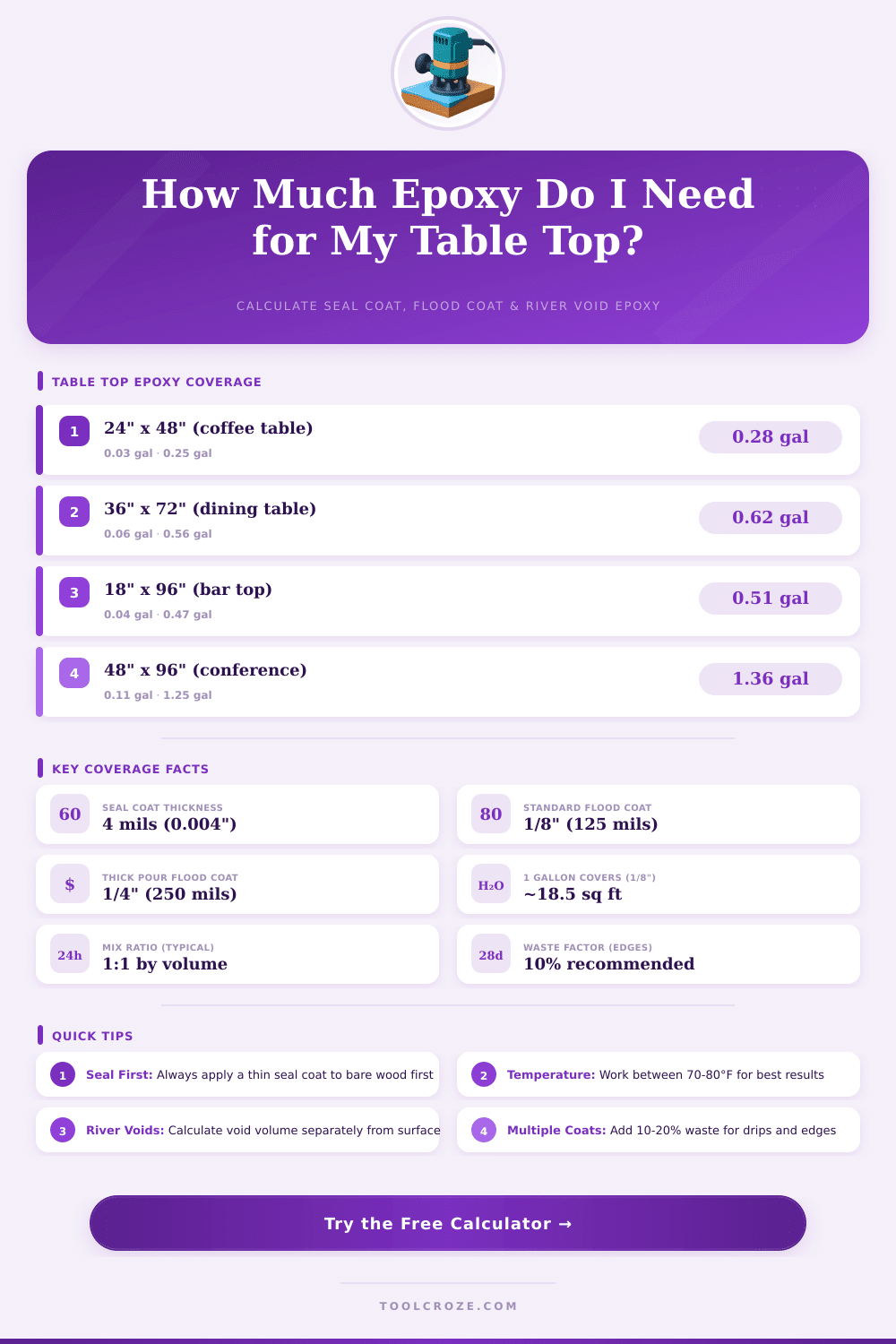
🧪 Table Top Epoxy Coverage Calculator
Calculate exact epoxy amounts for seal coats, flood coats, and river voids — Part A & Part B included.
| Table Size | Sq Ft | Seal Coat | 1 Flood Coat | 2 Flood Coats | Surface Type |
|---|---|---|---|---|---|
| Small Coffee Table 24×48" | 8 sq ft | 0.03 gal | 0.25 gal | 0.50 gal | Bare wood |
| Dining Table 36×72" | 18 sq ft | 0.06 gal | 0.56 gal | 1.12 gal | Bare wood |
| Bar Top 18×96" | 12 sq ft | 0.04 gal | 0.47 gal | 0.94 gal | Bare wood |
| Kitchen Island 36×60" | 15 sq ft | — | 0.46 gal | 0.93 gal | Sealed |
| Desk 30×60" | 12.5 sq ft | 0.04 gal | 0.39 gal | 0.78 gal | Bare wood |
| River Table 30×84" | 17.5 sq ft | 0.12 gal | 0.54 gal | 1.08 gal | Live edge |
| Serving Board 12×24" | 2 sq ft | 0.007 gal | 0.06 gal | 0.12 gal | Bare wood |
| Conference Table 48×96" | 32 sq ft | — | 1.00 gal | 2.00 gal | Sealed |
| Coat Type | Mils | Inches | mm | Best For |
|---|---|---|---|---|
| Seal Coat | 4 mils | 0.004" | 0.1 mm | Sealing bare wood pores before flood coat |
| Thin Flood Coat | 62 mils | 1/16" | 1.6 mm | Thin protective coating, countertops |
| Standard Flood Coat | 125 mils | 1/8" | 3 mm | Most table tops, bar tops, desks |
| Medium Pour | 188 mils | 3/16" | 4.8 mm | Embedding thin items, extra depth |
| Thick Pour | 250 mils | 1/4" | 6 mm | Embedding objects, river tables surface |
| Temp (°F / °C) | Pot Life | Demold Time | Full Cure | Notes |
|---|---|---|---|---|
| 60°F / 16°C | 35–45 min | 36–48 hrs | 5–7 days | Slower cure, watch for blush |
| 65°F / 18°C | 30–40 min | 28–36 hrs | 4–6 days | Acceptable low end |
| 70°F / 21°C | 25–35 min | 20–24 hrs | 72 hrs | Ideal low range |
| 75°F / 24°C | 20–30 min | 16–20 hrs | 60–72 hrs | Optimal working temp |
| 80°F / 27°C | 15–25 min | 12–16 hrs | 48–60 hrs | Ideal high range |
| 85°F / 29°C | 10–18 min | 8–12 hrs | 36–48 hrs | Fast cure, work quickly |
| 90°F+ / 32°C+ | 6–12 min | 6–10 hrs | 24–36 hrs | Risk of exotherm / yellowing |
| Surface Type | Seal Coats Needed | Porosity Factor | Key Tips |
|---|---|---|---|
| Bare / Sanded Wood | 1 seal coat | ×1.0 | Sand to 120 grit, clean dust before applying |
| Live Edge / Highly Porous | 2 seal coats | ×1.5–2.0 | Apply thin first coat, var cure 4–6 hrs before second |
| Previously Sealed Wood | 0 seal coats | ×0 | Scuff sand for adhesion, clean thoroughly |
| Painted Surface | 0 seal coats | ×0 | Check paint adhesion, scuff with 220 grit |
| Reclaimed / Barn Wood | 2 seal coats | ×2.0 | May need extra seal coats, check for outgassing |
Most Epoxy makers offer free online calculators on their pages. Enter the sizes of your table and the type of use, and it gives numbers for seal and flood coats, including edges and sides. After mixing, Table Top Epoxy feels thick, almost like honey.
If you plan deep work like a river table, use deep-pour Epoxy. For only surface uses on the other hand, stay with standard Table Top Epoxy. Make the surface level before you start, back it from below, lay flat stone below and paint Epoxy on all edges after mixing.
How to Measure, Mix and Pour Table Top Epoxy
That helps everything stay good.
It is hard to figure out how much Epoxy you really need for a Table Top project harder than it seems. If you count the amount wrong, you risk having too much left over or suddenly need to add more during the pour. Understanding the basics really helps a lot.
Most Epoxy for tables and bars covers around 12 square feet with one gallon, when you pour at a thickness of 1/8 inch. If you want more thickness. For example 1/4 inch, that same gallon only covers 6 square feet.
Even so, not all brands follow the same rules. Some makers promise coverage close to 16 square feet at the thinner thickness. The main point is to check what your specific product says, and then consider the real sizes of your table and the wanted thickness of the pour.
Mixing Table Top Epoxy is surprisingly easy, because it uses a 1:1 ratio. So, equal parts of resin and hardener, which makes measuring simple. Most kits include plastic spreaders, to help you spread the Epoxy evenly across the surface.
When applying the material, you must follow two clearly separate steps. First apply the seal coat, you paint it with regular brushes to cover the wood. Then comes the flood coat, that pours itself and self-levels to around 1/8 inch thickness.
This flood coat gives the typical glassy, crystal clear look. It reaches wonderful clarity, which is why it is ideal for bar tops, river tables and work tables.
Here is where the thickness matters: never pour more than 1/4 inch in one application. Thicker pours cause a fast chemical reaction, that heats the Epoxy too soon. Such heat causes problems, it yellows the surface, warps it or causes cracks.
If you want more thickness, do several coats. Simply make sure that every coat cools to 70 to 80 degrees Fahrenheit, before adding the next.
Buy more then the calculations show. This is not a sales trick. It simply protects against running out in the middle of the pour.
For example, for a table of 40 by 96 inches with a thin pour, you will probably use almost two gallons.
Most Epoxy makers offer free online calculators on their pages. Enter the sizes of your table and the tpye of use, and it gives numbers for seal and flood coats, including edges and sides. After mixing, Table Top Epoxy feels thick, almost like honey.
If you plan deep work like a river table, use deep-pour Epoxy. For only surface uses on the other hand, stay with standard Table Top Epoxy. Make the surface level before you start, back it from below, lay flat stone below and paint Epoxy on all edges aftermixing.
That helps everything stay good.