🎨 Floor Paint Coverage Calculator
Estimate gallons needed for any floor coating — epoxy, concrete paint, deck coating & more.
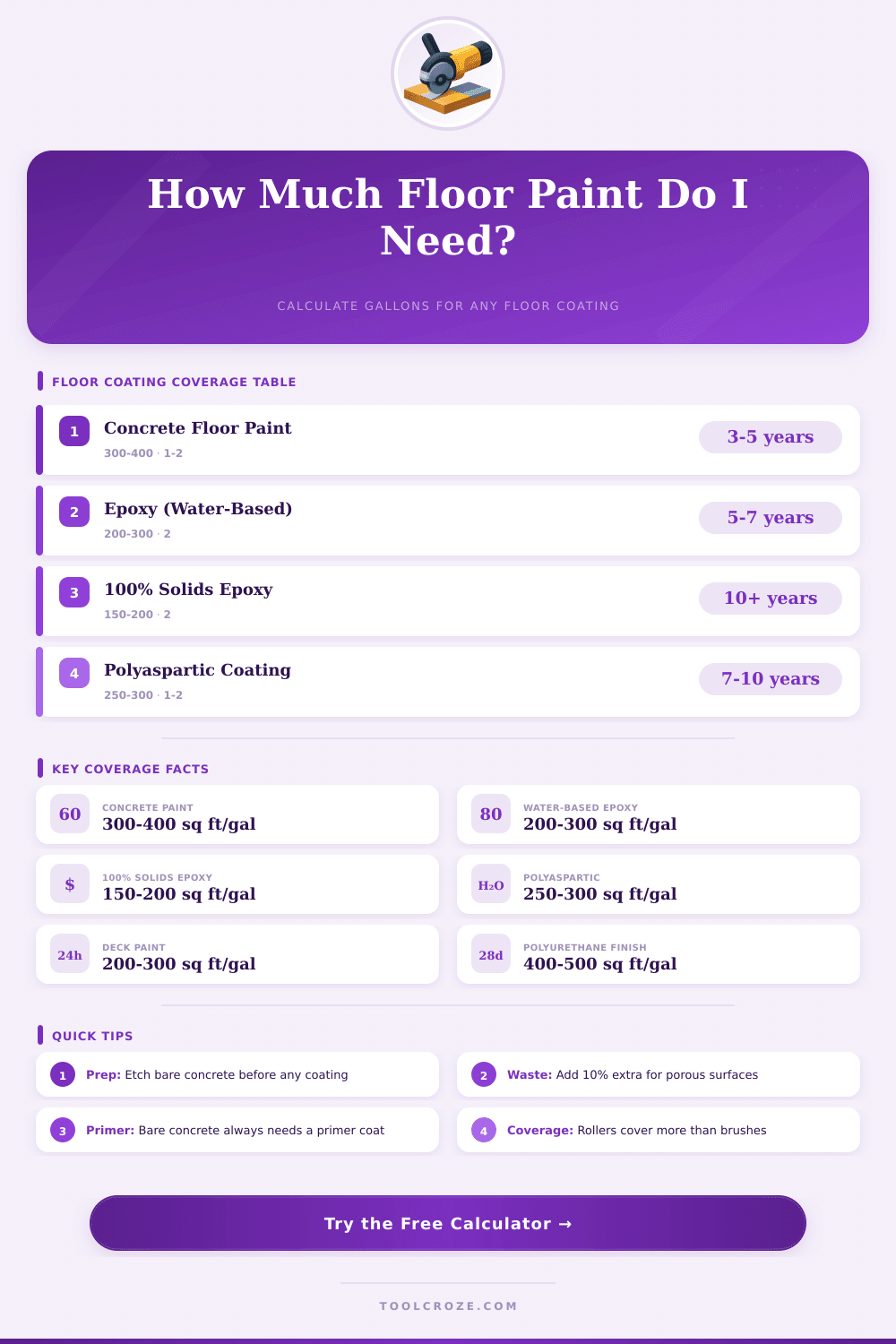
| Coating Type | Sq Ft / Gal | Typical Coats | Drying Time | Durability |
|---|---|---|---|---|
| Concrete Floor Paint (latex) | 300–400 | 1–2 | 2–4 hrs recoat | 3–5 years |
| Epoxy Floor Coating (water-based) | 200–300 | 2 | 12–24 hrs recoat | 5–7 years |
| 100% Solids Epoxy | 150–200 | 2 | 8–16 hrs recoat | 10+ years |
| Polyaspartic Floor Coating | 250–300 | 1–2 | 1–3 hrs recoat | 7–10 years |
| Concrete Sealer (penetrating) | 200–400 | 1 | 2–4 hrs | 3–5 years |
| Polyurethane Floor Finish | 400–500 | 2–3 | 2–4 hrs recoat | 5–10 years |
| Deck Paint | 200–300 | 2 | 4–6 hrs recoat | 3–5 years |
| Wood Floor Paint / Stain | 300–400 | 1–2 | 2–4 hrs recoat | 2–5 years |
| Floor Condition | Prep Steps | Acid Etch Needed | Primer Needed |
|---|---|---|---|
| New / Bare Concrete | Clean, degrease, acid etch, neutralize, dry | Yes | Yes — strongly recommended |
| Previously Coated (Good) | Clean, light sand / scuff, degrease | No | Optional |
| Previously Coated (Worn/Peeling) | Strip old coating, grind or shot-blast, repair cracks | Maybe | Yes |
| Bare Wood | Sand smooth, remove dust, seal knots | No | Yes — wood primer |
| Previously Painted Wood | Scrape loose paint, light sand, clean | No | If bare spots exposed |
| Method | Best For | Coverage Adjustment | Notes |
|---|---|---|---|
| 9–18" Roller | Large open floor areas | Baseline rate | Most common for floor coating |
| Brush (edges) | Perimeter, corners, tight spots | –10% efficiency | Use for cut-in before rolling |
| Squeegee / Notched | Self-leveling epoxies | +5% efficiency | Ensures uniform coat thickness |
| Airless Sprayer | Large warehouses, sealers | +10–15% efficiency | Higher overspray waste outdoors |
| Space Type | Typical Size | Approx. Sq Ft | Coating Notes |
|---|---|---|---|
| 1-Car Garage | 12 × 22 ft | ~264 sq ft | 1 gal water-based epoxy per coat |
| 2-Car Garage | 20 × 22 ft | ~440 sq ft | 2 gal per coat typical |
| 3-Car Garage | 30 × 22 ft | ~660 sq ft | 3 gal per coat typical |
| Warehouse Bay | 40 × 60 ft | ~2,400 sq ft | 10 gal per coat typical |
| Standard Basement | 20 × 30 ft | ~600 sq ft | 2–3 gal per coat typical |
| 10×10 Room | 10 × 10 ft | 100 sq ft | 1 qt per coat typical |
| Basketball Half-Court | 47 × 50 ft | ~2,350 sq ft | Polyurethane recommended |
| Residential Deck | 12 × 16 ft | ~192 sq ft | 1 gal deck paint per coat |
Whether you want to count exactly the right amount of Floor Paint? The cause is harder than it looks. The amount depends on many factors, and a wrong guess can mean either having to buy extra tins during the work, or sitting before new piles of leftover paint.
Before jumping into the painting of floors, here are some useful tips that are worth keeping in mind.
How Much Floor Paint Do You Need
The amount of paint is measured in square feet, what seems quite easy. On a perfectly flat surface one gallon of 100-percent solids Floor Paint covers around 1600 square feet, when one applies it in one millimeter thickness. Everything else differs from that base (the thicker the coat), the less area one gallon will cover.
It is a simple change, nothing more.
Average Floor Paint gives between 380 and 480 square feet on smooth concrete. But here is where it gets hard: rough concrete or many unfilled crack lines dip a lot into that number quickly. That counts especially for garage floors and basement floors.
A standard garage for two cars has around 450 square feet. One gallon at four millimeters thickness gives you around 400 sqaure feet, more or less. Consider two coats, and you need between two and three gallons total.
If you go down to three millimeters, the amount jumps to around 500 square feet each gallon instead.
Also bigger packages are available. Some paint kits for garage floors come in 4.5-gallon tins and cover up to 900 square feet with one coat. There are also other products that reach around 500 square feet, designed to protect garages, basements and other indoor concrete surfaces with a finish that guards against damages and marks.
Most usual paint covers between 300 and 400 square feet each gallon. The math is quite simple: divide your whole square area buy the coverage number (say 350 square feet each gallon), and that shows how many gallons you need. Then multiply by the number of coats that you plan, and round upward.
Done.
The thickness directly affects how far the paint will stretch. Different Floor Paint types work differently, and the same happens with various finishes, everything turns on the kind and brand that you choose. The surface itself matters a lot too.
Whether you spray, brush or roll does make a difference, also the condition of the floor, whether it is rough, smooth or porous. The number of coats adds yet one morefactor to the whole.
Rolling works best for covering big flat spaces evenly. Before starting on the whole floor, always test the grip on a little bit first. Applying paint too thin is one of those mistakes that will come back to haunt you, the finish will not hold up as it should.