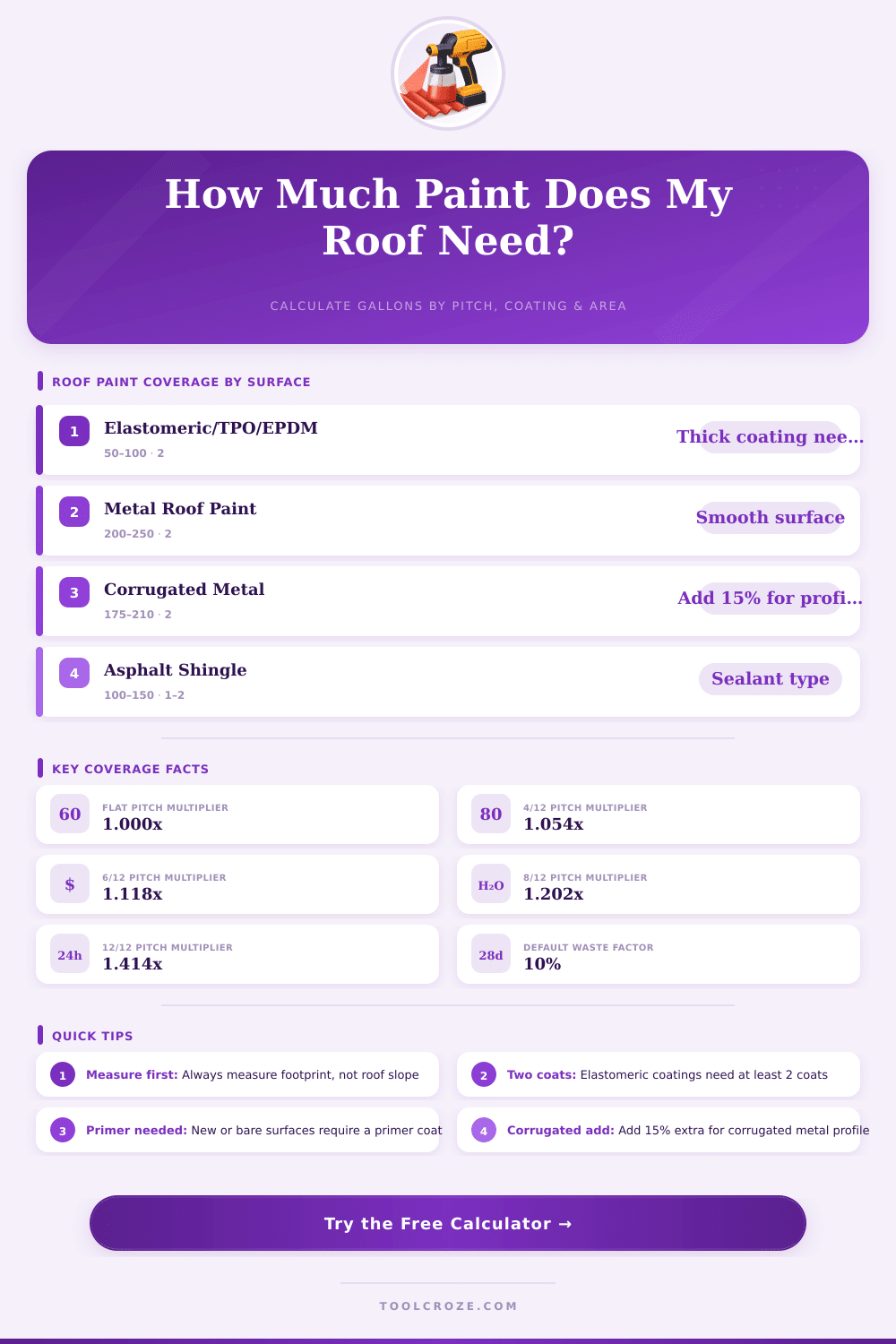
🏠 Roof Paint Coverage Calculator
Calculate exactly how many gallons of roof paint or coating you need — accounts for pitch, coating type, number of coats, and waste.
| Pitch | Rise/Run | Multiplier | Notes |
|---|---|---|---|
| Flat | 1/12 or less | 1.000 | Membrane / TPO / EPDM recommended |
| 2/12 | 2 in / 12 in | 1.014 | Low slope — good drainage |
| 3/12 | 3 in / 12 in | 1.031 | Minimum for asphalt shingles |
| 4/12 | 4 in / 12 in | 1.054 | Common residential |
| 5/12 | 5 in / 12 in | 1.083 | Moderate pitch |
| 6/12 | 6 in / 12 in | 1.118 | Standard residential |
| 7/12 | 7 in / 12 in | 1.158 | Steep — use safety harness |
| 8/12 | 8 in / 12 in | 1.202 | Steep — requires safety gear |
| 9/12 | 9 in / 12 in | 1.250 | Very steep |
| 10/12 | 10 in / 12 in | 1.302 | Extreme pitch |
| 12/12 | 12 in / 12 in | 1.414 | 45° angle — professional only |
| Coating / Roof Type | Sq Ft / Gal | Typical Coats | Recoat Time |
|---|---|---|---|
| Elastomeric / Flat / TPO / EPDM | 50–100 | 2 | 4–8 hours |
| Metal Roof Paint | 200–250 | 2 | 2–4 hours |
| Corrugated Metal | 175–210 | 2 | 2–4 hours |
| Asphalt Shingle Paint | 100–150 | 1–2 | 24 hours |
| Concrete Tile | 75–100 | 2 | 4–6 hours |
| Wood Shake | 100–125 | 2 | 24–48 hours |
| Torch-Down / Built-Up | 50–75 | 1–2 | 24 hours |
| Roof Style | Pitch Range | Recommended Coating | Key Consideration |
|---|---|---|---|
| Flat / Low-Slope | 0–2/12 | Elastomeric, TPO, EPDM membrane | Waterproofing is priority |
| Gently Pitched | 3–5/12 | Elastomeric or asphalt sealant | Drainage & UV resistance |
| Standard Pitched | 6–9/12 | Asphalt shingle paint, tile sealer | Adhesion on slopes |
| Steep Pitched | 10/12+ | Penetrating sealers, tile paint | Fall protection required |
| Metal — Flat/Low | 0–4/12 | Metal roof paint (rust-inhibiting) | Primer critical on bare metal |
| Corrugated Metal | Any | Metal roof paint — add 15% | Profile increases surface area |
| Building Footprint | Flat (1.000x) | 4/12 (1.054x) | 6/12 (1.118x) | 8/12 (1.202x) |
|---|---|---|---|---|
| 20 × 30 ft (600 sq ft) | 600 sq ft | 632 sq ft | 671 sq ft | 721 sq ft |
| 30 × 40 ft (1,200 sq ft) | 1,200 sq ft | 1,265 sq ft | 1,342 sq ft | 1,442 sq ft |
| 40 × 50 ft (2,000 sq ft) | 2,000 sq ft | 2,108 sq ft | 2,236 sq ft | 2,404 sq ft |
| 50 × 60 ft (3,000 sq ft) | 3,000 sq ft | 3,162 sq ft | 3,354 sq ft | 3,606 sq ft |
| 60 × 80 ft (4,800 sq ft) | 4,800 sq ft | 5,059 sq ft | 5,366 sq ft | 5,770 sq ft |
Whether you bid to exactly count, how many roof paint requires your roof? That seems simple but are much more hard. Usually the best first step is use calculator for amount; those programs help you receive reliable rating about that, with what you must work.
Some of them limit to basic elements: square feet and buckets of roof paint. Even so, do not take those figures as absolute truth. They are only rough values, simple and clear.
How to Figure Out How Much Roof Paint You Need
To go more deeply, use more detailed access with calculators for roof coverings. Those allow you to consider thickness of the covering and its reliability, to reach more precise notion about involved materials. Enter the thickness of your covering (measured in thousands or mils) together with square feet, and the calculator shows the protective indication and how many material you will use for bucket.
Here is how the math works in practice. Assume, that your flat area is 1,344 square feet with 4/12-pitch, the sloping factor brings it to around 1,054. Cut 50 square feet for exclusions, and your paintable area reaches about 1,367 square feet.
Now consider amount of roof paint in 250 square feet for bucket, apply two coats and add 12-percent waste. The math? Total amount of roof paint match roof area times coats divided by amount for bucket.
It grows quickly.
Most roof coverings cover between 50 and 100 square feet for bucket in real amounts. More prime coverings? They do not reach those values.
Makers promise different. You can expect of 350 square feet at the bottom finish until 500 at the upper. According too field experiences, around 300 square feet for bucket seem the average, where most products land.
But here the main spot… What the maker promises and what really happens on your roof commonly differ a lot. Rough or porous surfaces absorb more covering, what lowers your protective numbers.
Smooth and clean surfaces? They reach the higher finish of the range. Dusty or split parts then bring everything down.
The kind of covering itself does big difference. Acrylic requires more material, because it does not have the same waterblock force. Silicone usually covers around 2.5 buckets per square, while acrylic requires almost 5 buckets per square.
That happens because silicone keeps its thickness more well, acrylic thins in almost 1 thousand per year.
Also the application method affects the amount of the roof paint. Spray tools are one of the most efficient modes for roof work. It covers big areas much more quickly than brushes and rollers.
Some favor the technique shed-spread-roll for elastic coverings, that works as normal painting. If energyefficiency interests you, choose the right rate of Sun Reflective Index for your climate.