🧱 Masonry Paint Coverage Calculator
Calculate exact gallons needed for brick, concrete block, stucco & poured concrete surfaces
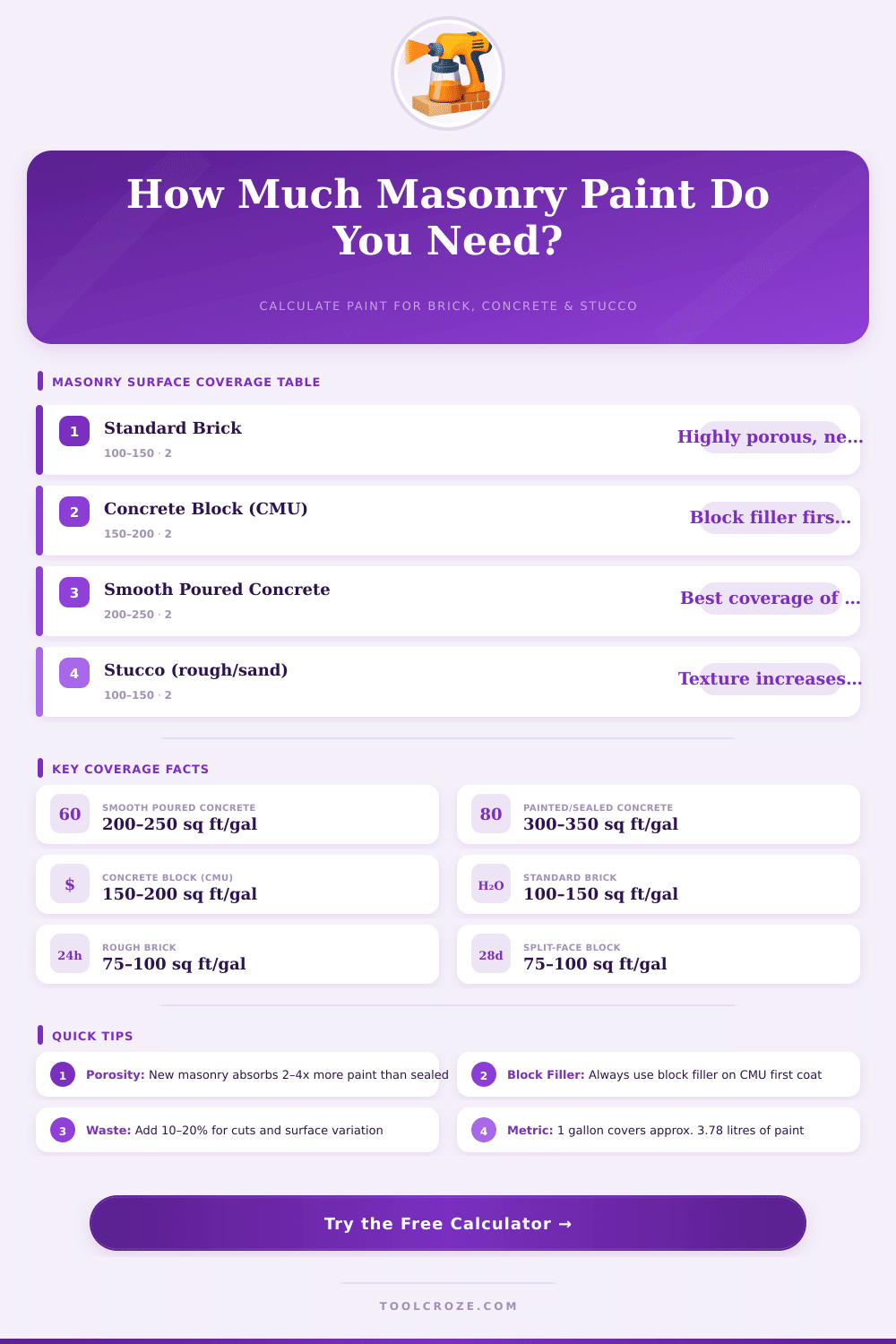
| Surface Type | 1st Coat (sq ft/gal) | Subsequent Coats | Recommended Coats |
|---|---|---|---|
| Smooth Poured Concrete | 150–200 | 200–250 | 2 |
| Painted / Sealed Concrete | 250–300 | 300–350 | 1–2 |
| Concrete Block (CMU) | 75–100* | 150–200 | 2 |
| Standard Brick | 75–100 | 100–150 | 2 |
| Rough Brick | 50–75 | 75–100 | 2–3 |
| Stucco Smooth | 100–150 | 150–200 | 2 |
| Stucco Rough / Sand | 75–100 | 100–150 | 2–3 |
| Split-Face Block | 50–75 | 75–100 | 3 |
*Block filler or high-build primer strongly recommended as first coat on CMU.
| Paint Type | Coverage Modifier | Best For | Notes |
|---|---|---|---|
| Masonry Paint / Elastomeric | Standard | Exterior brick, stucco, concrete | Bridges hairline cracks, flexible film |
| Concrete & Masonry Paint | Standard | General masonry surfaces | Good all-round choice, interior or exterior |
| Block Filler | −30–40% (thicker) | CMU / concrete block first coat | High-build, fills voids, reduces subsequent coats |
| Sealer / Primer | −20–30% | New / unsealed surfaces | Reduces porosity, improves topcoat adhesion |
| Waterproofing Paint | −10–20% | Basements, retaining walls | Hydrostatic pressure resistance, thick film |
| Condition | Prep Steps Required | Primer / Sealer |
|---|---|---|
| New / Unsealed | Wire brush, power wash, allow to cure 28+ days | Required — masonry sealer or block filler |
| Previously Painted (good) | Clean, light sand loose areas, wash | Spot prime peeling areas only |
| Previously Painted (peeling) | Remove all loose paint, wire brush, wash | Full prime coat recommended |
| Bare / Worn / Weathered | Wire brush, clean efflorescence, degrease | Required — masonry primer |
| Efflorescence Present | Treat with efflorescence remover, neutralize | Required — before any topcoat |
| Surface | Absorption Factor | Extra Paint vs Smooth Wall | Impact |
|---|---|---|---|
| Smooth Poured Concrete | 1.0× (baseline) | None | Lowest absorption |
| Painted / Sealed Concrete | 0.8× | −20% paint needed | Reduced porosity |
| Concrete Block (CMU) | 1.5–2.0× | +50–100% more paint | High porosity, voids |
| Standard Brick | 1.8–2.2× | +80–120% more paint | High absorption |
| Rough Brick | 2.5–3.0× | +150–200% more paint | Very high absorption |
| Stucco Rough/Sand | 2.0–2.5× | +100–150% more paint | Texture multiplies use |
| Split-Face Block | 3.0–4.0× | +200–300% more paint | Extreme absorption |
The coverage of masonry paint is commonly shown in square metres per liter. Paint for smooth or even ultra-smooth surface covers much more area compared to that with texture. Most paints show the coverage as a range instead of precise value.
Like this one considers differences because of different porous levels of surfaces and also because of the used painting method.
How Much Masonry Paint Covers
Average masonry paint usually covers around 10 square metres per liter. For a typical mid-terrace house with about 40 square metres, the calculation becomes easy. Some exterior masonry paint reaches even only 8 square metres per liter for one coat.
Waterproof masonry paint, for instance Emperor masonry paint, aims to offer coverage between 5 and 6 square metres per liter, because they must form solid protection on the wall.
A tin with 5 liters of exterior masonry paint usually covers 20 to 25 square metres with two coats on prepared surfaces. It is worth recalling this number wehn buying paint.
The texture of the surface plays a big role. On rough walls the coverage drops to around 250 to 300 square feet per unit, on the other hand on smooth it reaches almost 400 square feet. Use dry angled tools to avoid circular traces, and the paint should not need to reopen or repeatedly mix after application.
Almost all masonry walls require two coats of paint for full coverage and lasting strength. This matters especially during big colour change or painting of a new wall. The first coat works as a base, that seals the porous surface and strengthens the grip.
Some users dilute the first coat with water so that it soaks in more well. Later you would apply two more full coats on top.
Also the times four drying deserve attention. Professional masonry paint dries to touch after 2 to 4 hours. The second coat is possible after 8 to 12 hours in normal conditions, around 70 degrees Fahrenheit and 50 percent humidity.
Even so weather, sunlight and winds can change all times.
Sandtex is a well tested masonry paint that ensures good coverage. Two coats on bare brick tend to last around seven years and still look nice. One noted that it covers a bit more than Weathershield.
If you first use PVA seal and later apply Sandtex masonry paint, the results for coverage become even better. Some masonry paint offers 10 years of protection for surfaces like bricks, stones, concrete, pebbledash and roughcast.
Even so masonry paint does not last long on floors. Diluting floor paint down can stretch the coverage and reduce the shine, but itdoes not match proper masonry paint.