⚙ Compound Sprocket Ratio Calculator
Calculate total drive ratio, output RPM, and jackshaft speed for 2 or 3-stage chain systems
| Stage 1 \ Stage 2 | 2.0:1 | 3.0:1 | 4.0:1 | 5.0:1 | 7.0:1 |
|---|---|---|---|---|---|
| 2.0:1 | 4.0:1 | 6.0:1 | 8.0:1 | 10.0:1 | 14.0:1 |
| 3.0:1 | 6.0:1 | 9.0:1 | 12.0:1 | 15.0:1 | 21.0:1 |
| 4.0:1 | 8.0:1 | 12.0:1 | 16.0:1 | 20.0:1 | 28.0:1 |
| 5.0:1 | 10.0:1 | 15.0:1 | 20.0:1 | 25.0:1 | 35.0:1 |
| 7.0:1 | 14.0:1 | 21.0:1 | 28.0:1 | 35.0:1 | 49.0:1 |
| Setup | Input RPM | Jackshaft RPM | Output RPM | Total Ratio |
|---|---|---|---|---|
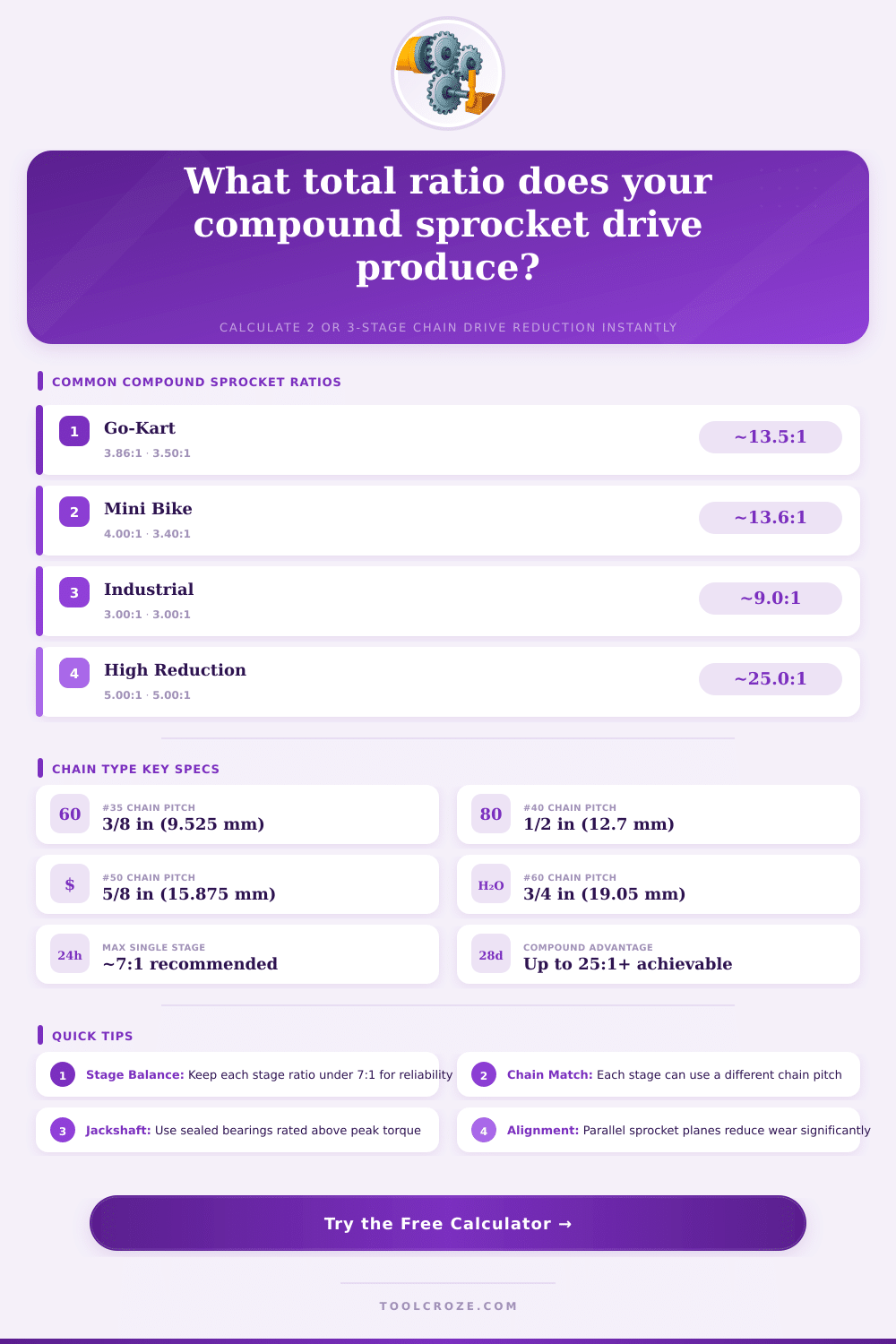
| Go-Kart (14T/54T + 10T/35T) | 3,600 | 933 | 266 | ~13.5:1 |
| Mini Bike (11T/44T + 10T/34T) | 3,200 | 800 | 235 | ~13.6:1 |
| Electric Kart (16T/48T + 12T/42T) | 5,000 | 1,667 | 476 | ~10.5:1 |
| Industrial (17T/51T + 15T/45T) | 1,800 | 600 | 200 | 9.0:1 |
| High Reduction (10T/50T + 10T/50T) | 4,000 | 800 | 160 | 25.0:1 |
| Application | Stage 1 | Stage 2 | Total Ratio | Output RPM |
|---|---|---|---|---|
| Go-Kart (3600 RPM engine) | 14T/54T = 3.86:1 | 10T/35T = 3.50:1 | ~13.5:1 | ~267 RPM |
| Mini Bike (3200 RPM engine) | 11T/44T = 4.00:1 | 10T/34T = 3.40:1 | ~13.6:1 | ~235 RPM |
| Industrial Light (1800 RPM) | 17T/51T = 3.00:1 | 15T/45T = 3.00:1 | 9.0:1 | 200 RPM |
| Industrial Heavy (1200 RPM) | 15T/60T = 4.00:1 | 15T/60T = 4.00:1 | 16.0:1 | 75 RPM |
| 3-Stage Jackshaft (5000 RPM) | 13T/50T = 3.85:1 | 12T/44T = 3.67:1 | ~54.7:1 (×S3) | Varies |
| Workshop Tool (1800 RPM) | 14T/56T = 4.00:1 | 16T/48T = 3.00:1 | 12.0:1 | 150 RPM |
A compound sprocket is useful when one simple pair of stars does not work to reach the wanted gear ratio. For instance, the ratio between the smallest and the biggest available star could be around 64:16 what results in 4-times reduction. For bigger reduction, one can add several reduction levels in one same system.
One calls that a compound sprocket. Other case shows ratio of 54:15 between the smallest and biggest star, what gives 3.6-times reduction. If needed even more, then compound levels would solve the problem.
Compound Sprockets and Gear Ratios
The whole gear ratio in such system is found by means of multiplying the separate level ratios. Their values, as 1.62 multiplied by means of 2, result roughly 3.23 for the final compound ratio.
Counting basic gear ratio is fairly easy work. One counts the teeth on the front and rear stars, then divides the rear by means of the front. For instance, if the front star has 15 teeth and the rear 45, the ratio becomes 3:1.
This means, that the front star turns thrice for every one turn of the rear. A pair with 13-tooth front star and 49-tooth rear gives a raito of around 3.77. The counter-shaft star turns then 3.77 times during the rear wheel does one whole rotation.
Interesting this is, as even big change cause little changes at the stars. Shrinking the front star by means of one tooth has almost the same impact as adding two or three teeth to the rear. In a setup of 15 and 45, removing one tooth in front does match adding three teeth in back, almost.
Hence changes at the front star feel more effective then those in back.
Less high gear ratios provide bigger top speed, but less strong torque and slower boost. On the other hand, higher ratios give better boost and torque, even so less high top speed. Around 10-percent change in the gear ratio commonly causes similar change in the engine turns per minute during normal riding.
Some drivers change the stars to find good balance between speed and torque according to the needs of the road.
Here something, what commonly surprises the folks. With combos as 14/42, 15/45 or 16/48, each of them results in exactly same 3.00 ratio. The gear ratio relates only to the number of teeth, not to the actual size of the stars.
Change the chain type and use bigger stars, but keep the tooth ratio, even so gives the same gear ratio. Calculators for gear ratios help to figure the mechanical gain of any combo. It shows, how the gear boosts or slows the move, and how it adjusts the torque in the whole system.
The gear ratio is set alone by means of thenumber of teeth on every star.
Counting the teeth on front and rear stars, together with checking of benchmark tables for speeds, is a practical way to guess, if the bike works for high top speed or for low end power.