⚙ Sprocket Ratio Calculator
Calculate output RPM, chain speed, and top speed for motorcycles, go-karts, bicycles & industrial drives.
⚡ Quick Presets
📊 Detailed Breakdown
Break: 2,100 lbs
Break: 3,700 lbs
Break: 6,100 lbs
Break: 8,500 lbs
| Driver (T) | Driven (T) | Ratio | Typical Use |
|---|
| Vehicle | Front (T) | Rear (T) | Chain | Ratio | Est. Top Speed |
|---|---|---|---|---|---|
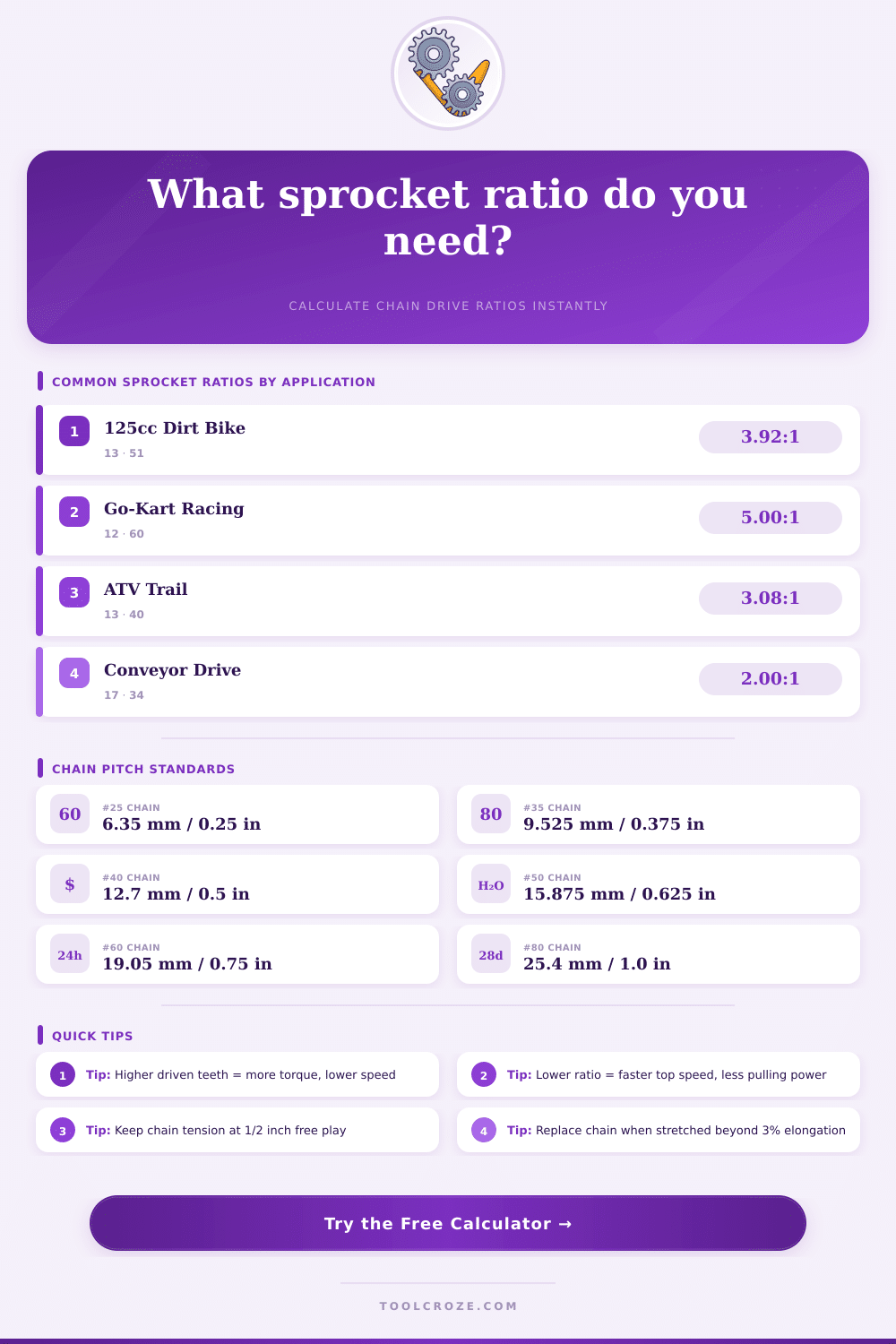
| 125cc Dirt Bike | 13 | 51 | #428 | 3.92:1 | ~55 mph |
| 250cc Motocross | 13 | 48 | #520 | 3.69:1 | ~75 mph |
| ATV Trail | 13 | 40 | #520 | 3.08:1 | ~45 mph |
| Go-Kart Racing | 12 | 60 | #35 | 5.00:1 | ~55 mph |
| Electric Motorcycle | 14 | 42 | #530 | 3.00:1 | ~80 mph |
| Mini Bike / Trail 70 | 11 | 41 | #35 | 3.73:1 | ~25 mph |
| Bicycle Single Speed | 44 | 16 | 1/2in | 0.36:1 | ~20 mph |
| Conveyor Drive | 17 | 34 | #40 | 2.00:1 | Industrial |
| Input RPM | #35 (9.525mm) | #40 (12.7mm) | #50 (15.875mm) | #60 (19.05mm) |
|---|---|---|---|---|
| 500 RPM | 787 | 1,050 | 1,312 | 1,575 |
| 1000 RPM | 1,575 | 2,100 | 2,625 | 3,150 |
| 1800 RPM | 2,835 | 3,780 | 4,725 | 5,670 |
| 3000 RPM | 4,724 | 6,300 | 7,875 | 9,450 |
| 6000 RPM | 9,449 | 12,600 | 15,750 | 18,900 |
The report of sprocket deal about the relation between the prior and final sprocket on bike. The relation between the size of the driving sprocket and the driven sprocket determine if the output will be faster but with less torque, or stronger yet more slow. Here the main change that one must understand about the reports of sprocket.
Sprocket one measures according to the number of teeth, that they have. To count the final gear report, one shares the size of the final sprocket by that of the prior sprocket. For instance, if the final sprocket have 49 teeth and the prior 13, one receives report of around 3.77.
How Sprocket Size Changes Bike Speed and Power
That wants to say, that the prior sprocket twist 3.77 times, before the final wheel ends one whole turn.
One commonly finds sample with 15-tooth prior sprocket paired to 45-tooth final. It results in about 3:1 report. In such case, remove one tooth of the prior sprocket have almost same impact as add three teeth to the final sprocket.
So, tiny change in the prior part causes bigger change in the whole report. Also, add tooth to the fianl sprocket do only less strong impact.
Here something nice. Different sizes of sprocket can cause exactly the same report. 14/42, 15/45 and 16/48 all match 3.00.
The same happen with 12/36 and 15/45. The report stays the same. What changes is the force of the pressure on the chain and its move.
Modify the sizes of sprocket, while one keeps the same report, maybe no truly improve the boost, because the move of the chain forms only little chip of the whole system.
If one wants higher top speed, modify the report of sprocket can useful be. For instance, passing of 16-tooth prior to 17-tooth prior lowers the RPM of the engine during cruising speed. About 10% change in the report of sprocket can mean around 10% drop in RPM.
On the other hand, setup as 11/53 deliver stronger boost, although the RPM will be higher during the top speed.
There is also something called the hunting tooth advantage. Use even-number report, as 20/40, cause, that the same link of the chain strikes the same tooth of the sprocket every cycle. That boosts the where of the teeth, what does not help for the life.
There are online sprocket calculators, that help to find the best sizes of sprocket for different styles of riding. They count the teeth of the prior and final sprocket, check standard data about speeds and show, if the bike answers for high finish or low finish. Start with thefactory report is good guess.
If it seems too slow, one can add tooth to the final sprocket or remove one of the prior and go from here.