⚙ Gear Pitch Diameter Calculator
Calculate pitch diameter, outside diameter, root diameter, and center distance for spur gears
| Teeth (N) | DP 8 | DP 12 | DP 16 | DP 20 | DP 32 | DP 48 |
|---|
| Teeth (N) | Mod 1 | Mod 1.5 | Mod 2 | Mod 2.5 | Mod 3 | Mod 4 |
|---|
| Module | Addendum (mm) | Dedendum (mm) | Whole Depth (mm) | Clearance (mm) |
|---|
| Gear 1 (N1) | Gear 2 (N2) | DP / Module | PD1 | PD2 | Center Dist. |
|---|
Imagine a circle that neither shows nor runs directly through the centre of the teeth of gear, here your pitch diameter. One calls this line pitch circle, and it simply serves as base for spacing all those teeth regularly. It helps to think like this: picture first a bare wheel, later add to it teeth.
And that pitch circle? It meets exactly with the outer edge of that made-up bare wheel.
What Is the Pitch Diameter in Gears
When two gears meet and mesh, something remarkable happens, they touch each other at the pitch diameters at exactly one place. The pitch circles of both gears touch right here where the teeth rest. Like this, in many ways, the pitch diameter is the real “size” of your gear for work.
Everything else, for example the thickness of teeth, depends counted from that main circle.
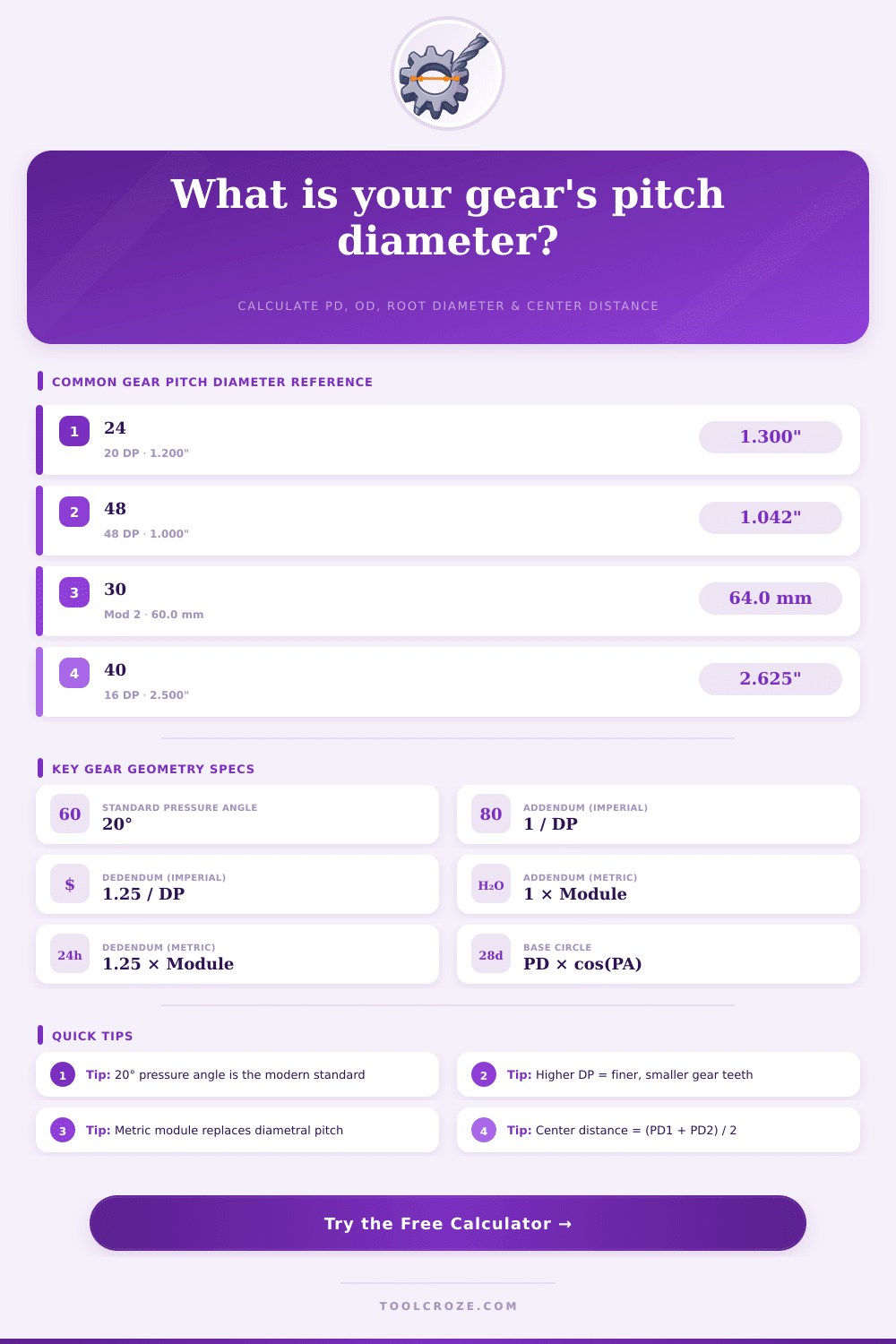
To count the pitch diameter, you do not need anything hard. You only divide the number of teeth by the diametral pitch. The value DP, short form for diametral pitch.
Shows the relation between the number of teeth and the diameter of pitch circle. In short, it shows how many teeth rest in every inch of pitch diameter. Lands with imperial units, like United States or United Kingdom, use this method.
In the metric world things change. Here one uses module instead. Module simply matches to pitch diameter divided by the number of teeth, what makes the math really simple.
Here a clear sample: gear with module 3 and 25 teeth has pitch diameter of 75 mm. Just multiply the module by the tooth count. Take gear with 2 mm module and 32 teeth, that gives pitch circle of 64 mm.
If you lined those teeth, they wood space themselves in 2 mm gaps, times Pi.
To switch between the two systems? Divide your DP-number by 25.4 to get module.
Here something really useful to explain, the pitch diameter does not match the outside diameter. The outside diameter (or tip diameter) reaches until the peaks of teeth, while the pitch diameter rests more below, around the centre of the tooth height. That upper height, that you see above the pitch diameter, one calls addendum, usually equal to one divided by DP.
There is also the pressure angle to consider, it forms the slope of the tooth itself and gives form to the teeth. Most commonly one meets 20 degrees or 14.5 degrees.
Two gears work smooth together, if they match by pitch. A small pinion with 15 teeth and module 1 meshes well with a big gear that has 45 teeth and module 1. Here a remarkable spot, if you grow the module, while the number of teeth stays same, you indeed grow the pitch diameter, what strengthens the teeth and increases the power that the gear can handle, all without changing the ratio of gears.
Engineers, when they figure torque and other forces, rely on pitch diameter more than any other size. The pitch diameter stayspermanent, unless basic changes happen; either the tooth count moves or the module adjusts.