⚙ Planetary Gear Ratio Calculator
Calculate gear ratio, output RPM, and torque for any planetary gear configuration
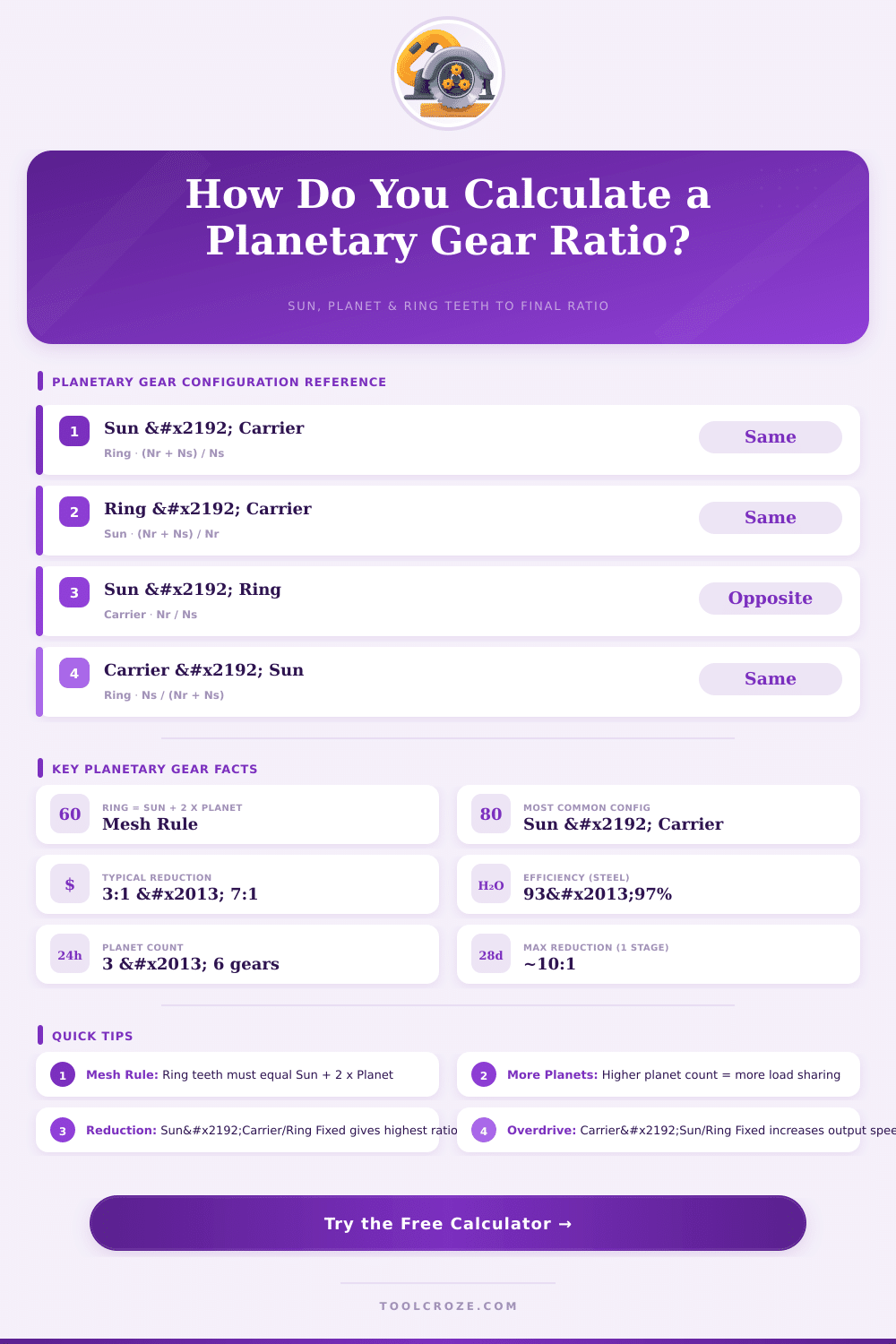
| Input → Output | Fixed Element | Gear Ratio Formula | Direction | Drive Type | Typical Use |
|---|---|---|---|---|---|
| Sun → Carrier | Ring | (Nr + Ns) / Ns | Same | Reduction | Power tools, most common |
| Ring → Carrier | Sun | (Nr + Ns) / Nr | Same | Mild Reduction | Automotive 2nd gear |
| Sun → Ring | Carrier | Nr / Ns | Opposite | Reduction | Reverse gear |
| Ring → Sun | Carrier | Ns / Nr | Opposite | Overdrive | Speed increase |
| Carrier → Sun | Ring | Ns / (Nr + Ns) | Same | Overdrive | Wind turbine, bicycle |
| Carrier → Ring | Sun | Nr / (Nr + Ns) | Same | Overdrive | Bicycle hub high gear |
| Sun (Ns) | Planet (Np) | Ring (Nr) | Sun→Carrier Ratio | Ring→Carrier Ratio | Typical Application |
|---|---|---|---|---|---|
| 12 | 18 | 48 | 5.00:1 | 1.25:1 | High-reduction drill |
| 16 | 22 | 60 | 4.75:1 | 1.27:1 | Power tool standard |
| 20 | 20 | 60 | 4.00:1 | 1.33:1 | Common 4:1 reduction |
| 24 | 18 | 60 | 3.50:1 | 1.40:1 | Drill high-speed mode |
| 20 | 25 | 70 | 4.50:1 | 1.29:1 | Automotive mild |
| 24 | 24 | 72 | 4.00:1 | 1.33:1 | 4:1 larger gearset |
| 30 | 20 | 70 | 3.33:1 | 1.43:1 | Automotive 1st gear |
| 30 | 30 | 90 | 4.00:1 | 1.33:1 | Industrial 4:1 large |
| 36 | 24 | 84 | 3.33:1 | 1.43:1 | Industrial standard |
| 40 | 30 | 100 | 3.50:1 | 1.40:1 | Large industrial box |
| Application | Sun / Planet / Ring | Configuration | Gear Ratio | Output RPM @ 3,000 | Notes |
|---|---|---|---|---|---|
| Power Drill High | 24 / 18 / 60 | Sun → Carrier | 3.50:1 | 857 RPM | High speed mode |
| Power Drill Low | 16 / 22 / 60 | Sun → Carrier | 4.75:1 | 632 RPM | High torque mode |
| Impact Driver | 14 / 17 / 48 | Sun → Carrier | 4.43:1 | 677 RPM | Maximum torque |
| Auto Trans 1st Gear | 30 / 20 / 70 | Sun → Carrier | 3.33:1 | 901 RPM | Maximum torque |
| Auto Trans 2nd Gear | 30 / 20 / 70 | Ring → Carrier | 1.43:1 | 2,098 RPM | Mild reduction |
| Auto Reverse | 30 / 20 / 70 | Sun → Ring | 2.33:1 | 1,286 RPM | Direction reversal |
| Robotic Joint | 20 / 20 / 60 | Sun → Carrier | 4.00:1 | 750 RPM | Balanced precision |
| Industrial 5:1 | 12 / 18 / 48 | Sun → Carrier | 5.00:1 | 600 RPM | Heavy reduction |
Planetary gear mechanisms are made up of three main elements: the solar gear, the planetary gears and the ring gear. The planetary carrier is the structure that holds the planetary gears, that twists freely on its own axes. In essence those planetary gears work as idle wheels, that move the solar gear.
Except the carrier, the ring gear and the solar gear, usually one of them stays fixed, another serves as input and the third as output. Setting one of those parts so that it does not rotate, one can count the gear ratio between input and output.
Planetary Gears: Parts and How to Find the Gear Ratio
To estimate the basic ratio in planetary gear, first notice the amount of teeth on the solar and ring gears. Add those two amounts. Later divide by the number of teeth on the moving part.
For instance, if the ring gear owns 280 teeth and the solar gear 70, the amount reaches 350. Dividing by the 70 teeth of the solar gear, the raito results 5:1. The rule for typical gear ratio means to divide the teeth of the driven by those of the driving, while the output speed matches the input speed divided by the ratio.
In planetary gear the output ratio always passes 1, what shows that the speed drops. Single-stage planetary gears usually offer ratios between around 3:1 and 12:1. One can not reach much more than 10:1 in one alone stage, because the pinion gears simply can not be this small.
About 6:1 is the maximum for average single-stage systems with standard gear forms, because big planetary gears hardly fit in the ring and the solar gear becomes too small. If the ratio passes 10:1, you need to add another planetary stage.
Combined setups of planetary gears help too reach much higher gear ratio in compact format compared to basic systems. Two or more planetary stages can share solar gear, ring gear or carrier. Even the planetary gears can be combined, with two sections of gears that have different amounts of teeth to mesh with various parts.
If one chooses direct motion, the solar gear meshes with the ring gear and they both twist equally quickly. The planetary gears do not move relatively, so that the ratio becomes 1:1. Otherwise to get exact 1:1 ratio, the solar and ring gears would need the same amount of teeth, what would make them equally big without space for planets between them.
Planetary gears also spread oil well for lubrication. If the solar gear binds directly to the hub, it locks, so one uses ratios like 3:1 or 5:1 to escape that. Setting the carrier and rotating the solar gear, one gets another result than setting the planets and turning the ring.
The available torque grows according to the amount of planets in the mechanism, while the gears must be very precise. The gear ratio can seem a bit confusing, because manysteps convert the input turn into output turn.