⚡ 3 Phase Motor HP Calculator
Calculate horsepower, kilowatts, current draw, and efficiency for three-phase AC motors
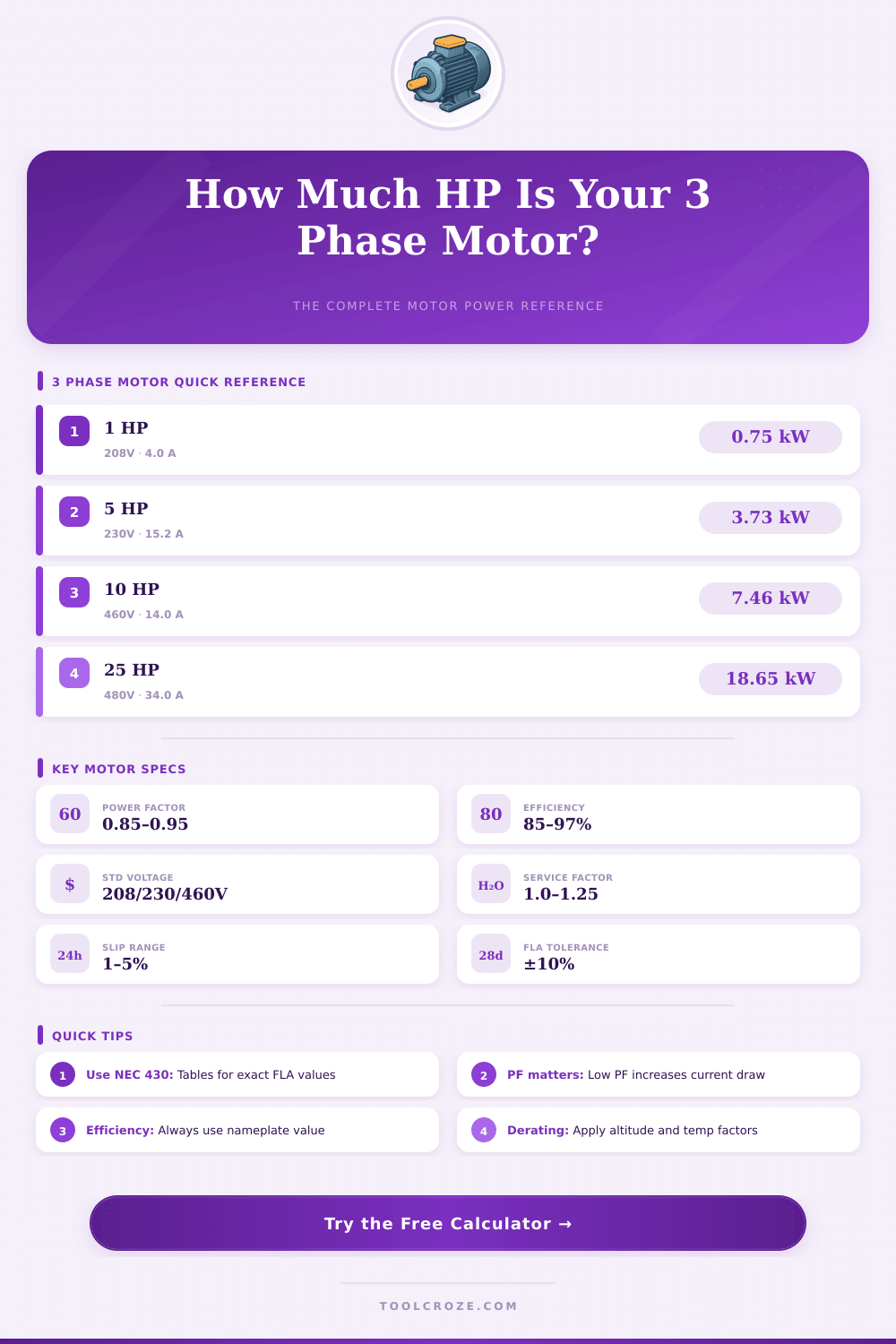
| Motor HP | FLA @ 208V | FLA @ 230V | FLA @ 460V | FLA @ 480V | FLA @ 575V | Output kW |
|---|---|---|---|---|---|---|
| 0.5 HP | 2.2 A | 2.0 A | 1.0 A | 1.0 A | 0.8 A | 0.37 kW |
| 1 HP | 4.0 A | 3.6 A | 1.8 A | 1.8 A | 1.4 A | 0.75 kW |
| 2 HP | 6.8 A | 6.2 A | 3.1 A | 3.0 A | 2.5 A | 1.49 kW |
| 3 HP | 9.6 A | 8.8 A | 4.4 A | 4.2 A | 3.5 A | 2.24 kW |
| 5 HP | 15.2 A | 13.8 A | 6.9 A | 6.6 A | 5.5 A | 3.73 kW |
| 7.5 HP | 22.0 A | 20.0 A | 10.0 A | 9.6 A | 8.0 A | 5.59 kW |
| 10 HP | 28.0 A | 25.6 A | 12.8 A | 12.2 A | 10.2 A | 7.46 kW |
| 15 HP | 42.0 A | 38.4 A | 19.2 A | 18.4 A | 15.2 A | 11.19 kW |
| 20 HP | 54.0 A | 49.6 A | 24.8 A | 23.8 A | 19.6 A | 14.92 kW |
| 25 HP | 68.0 A | 62.4 A | 31.2 A | 29.8 A | 24.8 A | 18.65 kW |
| 30 HP | 80.0 A | 72.8 A | 36.4 A | 34.8 A | 28.8 A | 22.38 kW |
| 40 HP | 104 A | 96.0 A | 48.0 A | 46.0 A | 38.0 A | 29.84 kW |
| 50 HP | 130 A | 120 A | 60.0 A | 57.2 A | 47.6 A | 37.30 kW |
| 75 HP | 192 A | 176 A | 88.0 A | 84.0 A | 70.0 A | 55.95 kW |
| 100 HP | 248 A | 226 A | 113 A | 108 A | 90.0 A | 74.60 kW |
| HP Range | IE1 / Standard (%) | IE2 / High Eff (%) | IE3 / Premium (%) | IE4 / Super Prem (%) | Approx Power Factor | Typical Application |
|---|---|---|---|---|---|---|
| 1 HP | 77% | 82% | 85.5% | 88% | 0.84 | Small pumps, fans |
| 2–3 HP | 80% | 85% | 87% | 90% | 0.85 | Conveyors, mixers |
| 5 HP | 83% | 87% | 89.5% | 91.5% | 0.86 | Compressors, pumps |
| 10 HP | 86% | 89.5% | 91.7% | 93% | 0.87 | HVAC, industrial |
| 15–20 HP | 87% | 90.2% | 92.4% | 94% | 0.88 | Heavy machinery |
| 25–50 HP | 88% | 91.7% | 93.0% | 94.5% | 0.89 | Pumps, fans, mills |
| 75–100 HP | 89.5% | 93% | 94.1% | 95% | 0.90 | Large industrial |
| Application | Typical HP | Voltage | Approx FLA | Power Factor | Efficiency Class | Notes |
|---|---|---|---|---|---|---|
| Small water pump | 1–3 HP | 230V | 3.6–8.8A | 0.82 | IE2 | Centrifugal type |
| HVAC fan motor | 5–15 HP | 460V | 6.9–19.2A | 0.85 | IE3 | Belt or direct drive |
| Air compressor | 5–25 HP | 460V | 6.9–31.2A | 0.86 | IE3 | VFD compatible |
| Conveyor belt | 3–10 HP | 460V | 4.4–12.8A | 0.84 | IE2 | High starting torque |
| CNC spindle | 5–20 HP | 230/460V | varies | 0.90 | IE4 | Inverter duty |
| Industrial mixer | 3–50 HP | 460V | 4.4–60A | 0.83 | IE2 | High torque startup |
| Crane / hoist | 5–50 HP | 460V | 6.9–60A | 0.85 | IE3 | Duty cycle rated |
| Large centrifugal pump | 25–100 HP | 480V | 29.8–108A | 0.88 | IE3 | Variable load |
| Formula | Expression | Variables | Notes |
|---|---|---|---|
| HP from Amps | HP = (V × I × 1.732 × PF × Eff) / 746 | V=Volts, I=Amps, PF=Power Factor, Eff=Efficiency | Standard 3-phase formula |
| Amps from HP | I = (HP × 746) / (V × 1.732 × PF × Eff) | Used for wire sizing | NEC 430.6 |
| kW Input | kW = (V × I × 1.732 × PF) / 1000 | Electrical input power | Before efficiency loss |
| kW Output | kW = HP × 0.7457 | Mechanical shaft power | 1 HP = 0.7457 kW |
| kVA | kVA = (V × I × 1.732) / 1000 | Apparent power | PF = kW / kVA |
| NEC Wire Size | I_wire = FLA × 1.25 | 125% of FLA for conductors | NEC 430.22 |
| Reactive Power | kVAR = kVA × sin(arccos(PF)) | Reactive component | Power factor correction |
Three-phase engines cover a wide scale of horsepower levels, and knowing how they work in various powers, is important for each person that wants to choose the best gear. One horsepower matches to 746 watts. Hence a 3-horsepower engine gives 2.23 kilowatts of mechanical energy.
For a 5-horsepower 3 phase motor that spins at the usual speed, you need around 3730 watts of input, if one assumes ideal efficiency.
How Three-Phase Motors Work and How Much Power They Need
These engines come in various revolutions per minute, for instance 3600, 1800, 1200 or 900. They use fully closed iron rotors with cooling by means of air or enabled structures in various styles. C- and D-flanges are available for most models.
An average 1.5-horsepower 3 phase motor for general uses spins at around 3450 RPM on 230/460 volts, with flow of about 4.6 or 2.3 amps. It operates at 60 Hz, has a 1.15 service factor, Class F insulation and Class B warming, with a frame from rolled steel.
When the service factor passes 1, the full working flow grows in proportion. For a factor of 1.15, the amp values mount by 15 percent. Also, if one starts the engine more than one time each hour, one must add 20 percent of KVA.
To estimate the full load flow of a 3 phase motor, one requires the horsepower, the voltage level and the RPM. The calculation includes voltage level, amps, efficiency, power factor and the number 1.73 divided by 746. For instance, a 3-horsepower single-phase engine at full load draws 10 amps on 230 volts.
A three-phase version of same power requires less flow for the hole line, because the load spreads across three phases. A 3 kW engine has the same rating for one or three phases, but at 230 volts single-phase it draws around 13.5 amps, while three-phase only 4.5 amps each phase.
The main advantage of 3 phase motor engines is their higher efficiency compared to single-phase. A 3 phase motor usually starts with bigger torque force than a single-phase of same power. Induction engines of three phases offer better general performance, with less noise and vibration.
When three-phase energy is lacking, various solutions are available. A variable frequency drive can convert single-phase input to three-phase output. For engines until 1 horsepower, a kind with a voltage doubler and 120-volt input works well.
Above 1 horsepower, it is better to stay at 230-volt input. Rotary phase converters deserve attention for several 3 phase motor machines. Static phase converters are the most affordable.
One simply can swap a 2-horsepower three-phase engine for a single-phase of same power, if one does not plan more three-phase gear. Even so, when one lowers the horsepower for dust or suction devices, theCFM also shrinks.