🏎️ Go-Kart Gear Ratio Calculator
Calculate gear ratio, top speed, axle RPM, and chain drive specs for any go-kart setup
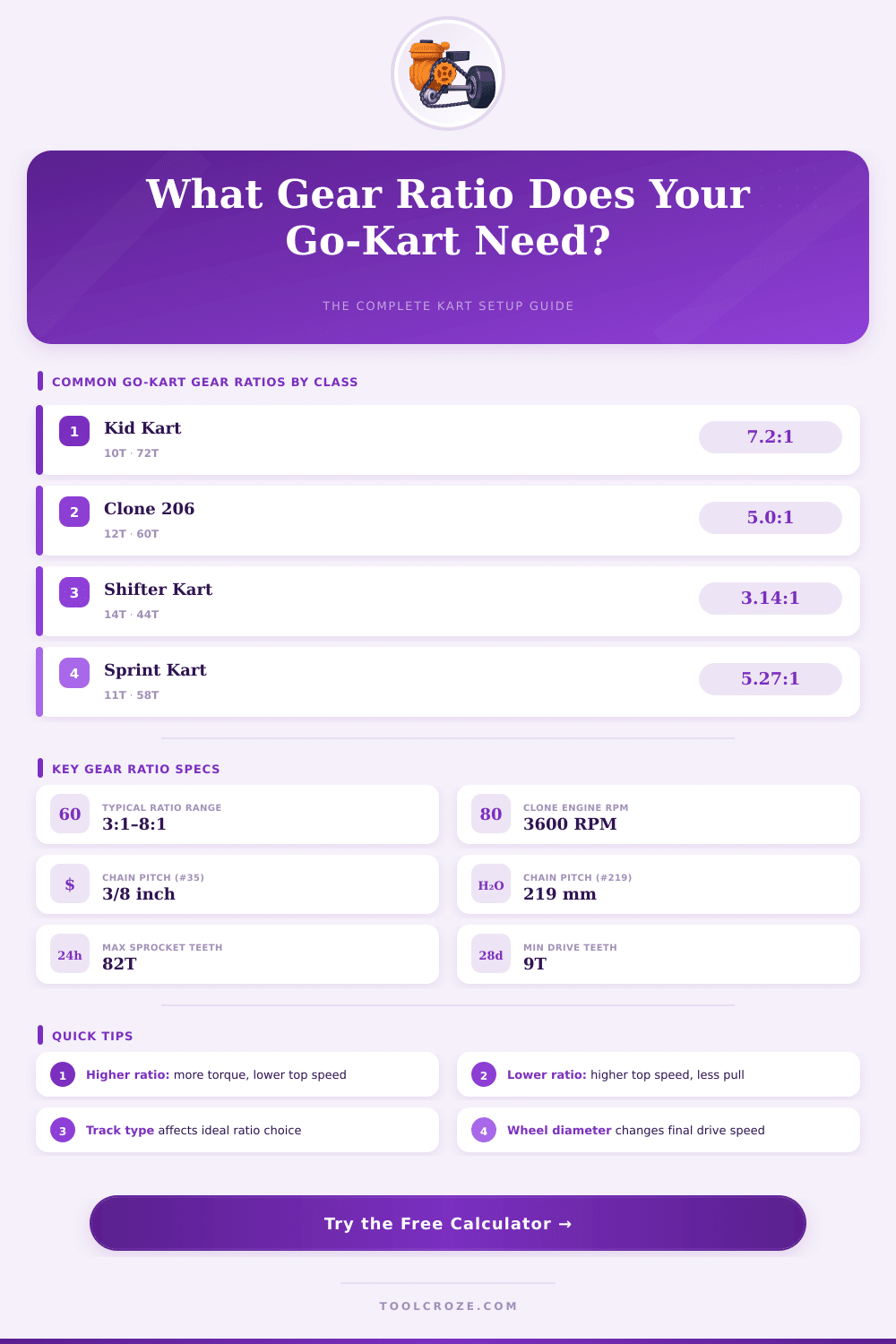
| Kart Class | Drive Sprocket | Driven Sprocket | Ratio | Est. Top Speed | Chain |
|---|---|---|---|---|---|
| Kid Kart (50cc) | 10T | 72T | 7.2:1 | ~35 mph | #35 |
| Clone / LO206 | 12T | 60T | 5.0:1 | ~55 mph | #35 |
| Rotax Max | 11T | 58T | 5.27:1 | ~70 mph | #219 |
| IAME X30 | 11T | 56T | 5.09:1 | ~75 mph | #219 |
| KZ Shifter | 14T | 44T | 3.14:1 | ~90 mph | #219 |
| Rental Kart | 10T | 72T | 7.2:1 | ~45 mph | #420 |
| Superkart | 15T | 42T | 2.8:1 | ~100+ mph | #219 |
| Electric Kart | 12T | 48T | 4.0:1 | ~60 mph | #35 |
| Chain Type | Pitch | Inner Width | Max Tension (lb) | Common Kart Use | Sprocket Range |
|---|---|---|---|---|---|
| #35 Chain | 3/8 in (9.525 mm) | 3/16 in | ~1,500 lb | Clone, LO206, Electric | 9T–82T |
| #219 Chain | 219 pitch (8.636 mm) | 3/32 in | ~800 lb | TaG, Rotax, IAME, KZ | 9T–72T |
| #420 Chain | 1/2 in (12.7 mm) | 1/4 in | ~2,800 lb | Rental, Heavy Duty | 12T–90T |
| #530 Chain | 5/8 in (15.875 mm) | 3/8 in | ~5,000 lb | Off-road, Heavy Karts | 15T–90T |
| Track Type | Characteristic | Ratio Range | Drive Sprocket | Driven Sprocket | Priority |
|---|---|---|---|---|---|
| Sprint (technical) | Many corners, short straights | 5.0–6.0:1 | 11–12T | 56–70T | Acceleration |
| Enduro (fast) | Long straights, fewer corners | 3.5–4.5:1 | 13–15T | 48–60T | Top Speed |
| Oval | Consistent high speed | 3.5–4.0:1 | 14–16T | 50–56T | Top Speed |
| Indoor | Very tight, slow | 6.0–8.0:1 | 9–11T | 62–80T | Torque |
| Mixed Circuit | Balanced layout | 4.5–5.5:1 | 11–13T | 54–66T | Balanced |
The right gear for go-kart does big change in its performance. Many tracks start well with 6:1 gear. It gives good balance between speed and top pace.
However the best gear depends on the track range, the mass of the kart and the driver, and on the wanted speed.
How Gear Ratio Changes Go-Kart Speed and Acceleration
Counting the gear is really easy. Simply divide the tooth count of the rear sprocket by that of the front sprocket. For example if the front sprocket has 12 teeth and the rear 75, you get 6.25:1 gear.
Simple math.
Here is the spot that commonly confuses folks. Big gear causes high top pace, but lowers the torque and slows the boost. Small gear helps better boost, but limits the upper pace.
It is basically a balanced gmae. The right front and back sprocket combo must work for every separate case.
Go-kart riders usually choose back sprockets with 70 to 80 teeth, while front have 10 to 11 teeth. Even tiny changes in the teeth can seriously affect things. For example, 60-tooth back sprocket gives 5:1 gear with top pace of around 24 mph.
Changing to 48-tooth, it becomes 4:1, and the top pace reaches about 31 mph. Different combo with 10-tooth front sprocket can cause 5.3:1 gear and around 32.5 mph upper pace.
With 5:1 gear and 12-inch wheels one can reach around 45 mph from it. 3.6:1 gear on Predator 212cc with first-stage gear and 15-inch tires gives great boost, quite a lot for doing donuts and driving around curves. Around 4.10 gear is commonly preferred, if boost matters more then the top pace.
Online there are fast calculators for gear ratios. Just enter the tooth counts of the front sprocket and rear, then measure the length of the back tire in inches. The program will compute the final gear and pace in mph.
Changing sprockets, you change the pace, so those tools save many guesses.
Charts of gear ratios count for various chains, like 219 for two-stroke, 219 for four-stroke, 35 and 428. Such chart helps to quickly find sprocket combos. For work in small RPM change only of 100 RPM, chart is useful for finding gear between two close sprocket sizes.
High gear stops the kart from speeding up quickly from the start line. It needs more time to turn up the engine to full pace. But it keeps boosting, when you brake for curves.
Start with small changes and note the results is theway to fix everything. For a certain class, mass and track setup there is commonly a good starting number, that does not change a lot, maybe only by one or two teeth on the back sprocket.