⚡ Motor HP to kW Calculator
Convert horsepower to kilowatts with efficiency, service factor & load adjustments
| HP Rating | Exact kW | kW @ 85% Eff. | kW @ 90% Eff. | kW @ 95% Eff. | Watts |
|---|---|---|---|---|---|
| 0.25 HP | 0.187 kW | 0.220 kW | 0.208 kW | 0.196 kW | 186.4 W |
| 0.5 HP | 0.373 kW | 0.439 kW | 0.415 kW | 0.393 kW | 372.9 W |
| 0.75 HP | 0.559 kW | 0.658 kW | 0.621 kW | 0.588 kW | 559.3 W |
| 1 HP | 0.746 kW | 0.877 kW | 0.829 kW | 0.785 kW | 745.7 W |
| 1.5 HP | 1.119 kW | 1.316 kW | 1.243 kW | 1.178 kW | 1118.6 W |
| 2 HP | 1.491 kW | 1.754 kW | 1.657 kW | 1.569 kW | 1491.4 W |
| 3 HP | 2.237 kW | 2.632 kW | 2.486 kW | 2.355 kW | 2237.1 W |
| 5 HP | 3.729 kW | 4.387 kW | 4.143 kW | 3.925 kW | 3728.5 W |
| 7.5 HP | 5.593 kW | 6.580 kW | 6.214 kW | 5.888 kW | 5592.7 W |
| 10 HP | 7.457 kW | 8.773 kW | 8.286 kW | 7.850 kW | 7456.9 W |
| 15 HP | 11.185 kW | 13.159 kW | 12.428 kW | 11.774 kW | 11185.4 W |
| 20 HP | 14.914 kW | 17.546 kW | 16.571 kW | 15.699 kW | 14913.9 W |
| 25 HP | 18.642 kW | 21.932 kW | 20.714 kW | 19.623 kW | 18642.4 W |
| 50 HP | 37.285 kW | 43.865 kW | 41.428 kW | 39.247 kW | 37284.8 W |
| 100 HP | 74.570 kW | 87.729 kW | 82.856 kW | 78.495 kW | 74569.5 W |
| HP Rating | 120V Single Phase | 240V Single Phase | 208V 3-Phase | 240V 3-Phase | 480V 3-Phase |
|---|---|---|---|---|---|
| 0.5 HP | 9.8A | 4.9A | 2.5A | 2.2A | 1.1A |
| 1 HP | 16.0A | 8.0A | 4.0A | 3.5A | 1.8A |
| 2 HP | 24.0A | 12.0A | 6.5A | 5.6A | 2.8A |
| 3 HP | 34.0A | 17.0A | 9.0A | 7.8A | 3.9A |
| 5 HP | 56.0A | 28.0A | 15.2A | 13.2A | 6.6A |
| 7.5 HP | — | 40.0A | 22.0A | 19.0A | 9.5A |
| 10 HP | — | 50.0A | 28.0A | 24.2A | 12.1A |
| 15 HP | — | — | 42.0A | 36.4A | 18.2A |
| 25 HP | — | — | 68.0A | 59.4A | 29.7A |
| 50 HP | — | — | 130.0A | 112.7A | 56.3A |
| Motor HP | Standard Eff. (%) | High Eff. (%) | NEMA Premium (%) | Motor Type | Typical Application |
|---|---|---|---|---|---|
| 0.5 – 1 HP | 72 – 78% | 80 – 84% | 85 – 87% | Single Phase | Small tools, fans |
| 1.5 – 3 HP | 78 – 83% | 84 – 87% | 87 – 89% | Single/3-Phase | Power tools, pumps |
| 5 – 7.5 HP | 83 – 86% | 87 – 90% | 89 – 91% | Three Phase | Compressors, conveyors |
| 10 – 15 HP | 86 – 88% | 89 – 91% | 91 – 92.4% | Three Phase | HVAC, industrial |
| 20 – 30 HP | 88 – 90% | 91 – 92% | 92.4 – 93% | Three Phase | Large machinery |
| 40 – 75 HP | 90 – 92% | 92 – 93.6% | 93.6 – 94.5% | Three Phase | Heavy industrial |
| 100+ HP | 92 – 93% | 93.6 – 94.5% | 95 – 96% | Three Phase | Large drives, mills |
| Application | Typical HP | Equivalent kW | Phase | Notes |
|---|---|---|---|---|
| Bench Grinder | 0.5 – 1 HP | 0.37 – 0.75 kW | Single | 3450 RPM typical |
| Drill Press | 0.5 – 1.5 HP | 0.37 – 1.12 kW | Single | Variable speed |
| Table Saw | 1.5 – 5 HP | 1.12 – 3.73 kW | Single/3-Ph | Cabinet saws: 3-5 HP |
| Band Saw | 1 – 3 HP | 0.75 – 2.24 kW | Single | 1725 or 3450 RPM |
| Air Compressor | 2 – 25 HP | 1.49 – 18.64 kW | Single/3-Ph | SF 1.15 typical |
| Pool Pump | 0.75 – 3 HP | 0.56 – 2.24 kW | Single | Variable speed saves energy |
| HVAC Fan/Blower | 1 – 15 HP | 0.75 – 11.19 kW | 3-Phase | Low SF, continuous duty |
| Conveyor Belt | 1 – 50 HP | 0.75 – 37.3 kW | 3-Phase | Torque-heavy start |
| CNC Spindle | 1 – 10 HP | 0.75 – 7.46 kW | 3-Phase | Variable frequency drive |
| Lathe (Metalworking) | 1 – 20 HP | 0.75 – 14.91 kW | Single/3-Ph | High starting torque |
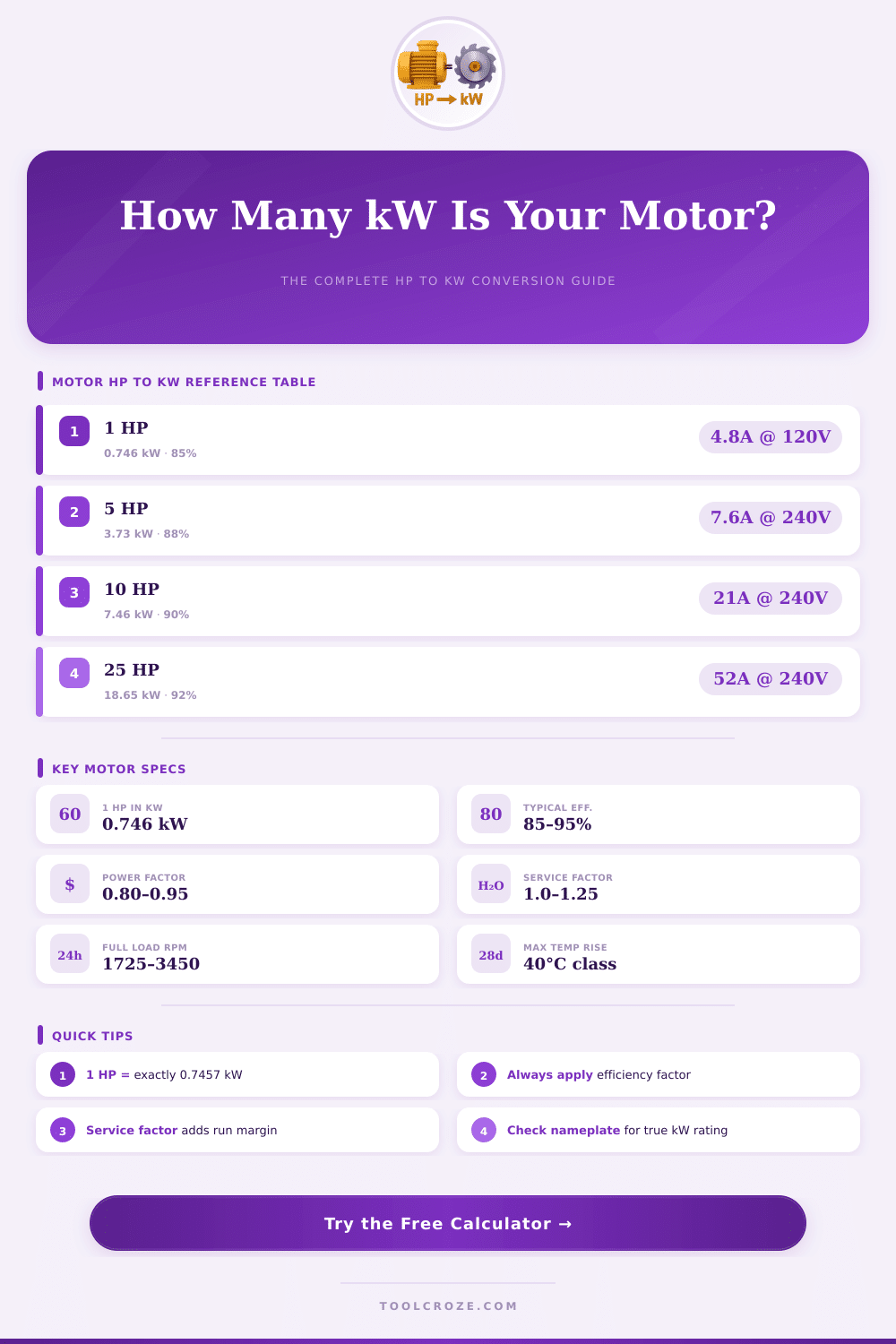
Converting horsepower of engines to kilowatts has a built-in challenge especially when one works with electrical engines. The basic math is quite easy. To get the match of HP to kW, one multiplies the value of HP by 0.7457.
So one HP matches around 0.7457 kW. Rather, one kW matches around 1.34 HP.
How to convert HP to kW
Horsepower is a unit for power, just as is the kilowatt. Power shows the speed of energy use during a set time. Both units measure the same thing, only with different numbers.
It is like miles against kilometers. Simply other ways to measure.
There actually exist various kinds of horsepower, which can cause a bit of confusion. The mechanical horsepower, or also called imperial, matches about 745.7 watts. The metric horsepower is a bit smaller, around 735.5 watts.
Electrical horsepower measures exactly 746 watts. In the United States one tends to use the electrical horsepower, which is the imperial unit for measuring the output of electrical engines.
Here are fast samples. A motor of 2 HP matches 2 times 0.7457, so around 1.49 kW. A motor of 20 HP multiplied by 0.74 gives around 14.8 kW.
And 10 kW turns into about 13.41 HP.
Here comes the hard part. The rated power of a motor always relates to its output power. One rates engines usually during production.
Because no motor reaches 100 percent efficiency, the input electrical power needs to bee more than the rated output in kW. A common simple rule for use is, that a motor of 10 HP needs roughly 10 kW of electrical power to run. That works as a rough rule, where 1000 watts match to 1 HP for input.
Efficiency of engines plays a big role here. When one needs 7.5 kW from the outlet and the motor runs at 92 percent efficiency, the input power comes to around 8.15 kW. Engines with partial HP commonly have only around 50 percent efficiency, so they need even more input power than their name shows.
And kW is the value that ties directly to kilowatt hours on the bill, so knowing these conversions helps to estimate the costs of use. In the United States one prefers HP, while elsewhere one may use kW or PS. It depends on what one is used to.
The conversion itself stays the same, no matter the type of motor or engine. Even so electrical engines differ greatly from engines with internal burning. Electrical engines drop torque when the RPM grows, while burning engines gain torque with higher RPM.
Also RPM matters, since looking at the curves ofengines gives more complete info than only the lone HP or kW figure.