💧 Pressure Washer Nozzle Calculator
Calculate the ideal nozzle size, orifice diameter, flow rate, and cleaning units for any surface or task
| Surface | Rec. PSI | Nozzle Angle | Min GPM | Min Cleaning Units | Notes |
|---|---|---|---|---|---|
| Concrete Driveway | 2500–4000 | 15°–25° | 2.5 | 5000 | Use turbo/rotary for heavy stains |
| Wood Deck | 500–1200 | 25°–40° | 1.5 | 1500 | Never use 0° on wood |
| Vinyl Siding | 1200–1500 | 25°–40° | 1.5 | 2000 | Angle downward to avoid water intrusion |
| Vehicle / Car | 1200–1900 | 25°–40° | 1.4 | 1500 | Keep nozzle 12–18 in from surface |
| Roof (Soft Wash) | 100–500 | 40°–65° | 1.0 | 300 | Soft wash preferred; high PSI damages shingles |
| Brick / Masonry | 1500–3000 | 15°–25° | 2.0 | 4000 | Test small area first |
| Patio Pavers | 2000–3500 | 15°–25° | 2.0 | 4500 | Watch for joint sand erosion |
| Painted Wood Fence | 1200–1500 | 40° | 1.5 | 1800 | Low angle prevents paint stripping |
| Heavy Equipment | 2500–5000 | 0°–15° | 3.0 | 8000 | Use hot water if available |
| Boat Hull | 1500–2500 | 25° | 2.0 | 3500 | Avoid gelcoat damage; test first |
| Orifice # | Dia. (in) | Dia. (mm) | Flow @ 1000 PSI (GPM) | Flow @ 2000 PSI (GPM) | Flow @ 3000 PSI (GPM) | Best Machines |
|---|---|---|---|---|---|---|
| #1.5 | 0.059 | 1.50 | 0.71 | 1.00 | 1.22 | Light home use |
| #2.0 | 0.079 | 2.00 | 1.26 | 1.78 | 2.18 | Home washers 1400–1800 PSI |
| #2.5 | 0.098 | 2.50 | 1.97 | 2.78 | 3.41 | Home/prosumer 1800–2400 |
| #3.0 | 0.118 | 3.00 | 2.83 | 4.00 | 4.90 | Prosumer 2000–3000 PSI |
| #3.5 | 0.138 | 3.50 | 3.85 | 5.44 | 6.67 | Pro 2500–3500 PSI |
| #4.0 | 0.157 | 4.00 | 5.03 | 7.11 | 8.71 | Pro/commercial 3000–4000 |
| #5.0 | 0.197 | 5.00 | 7.85 | 11.10 | 13.60 | Commercial high-volume |
| #6.0 | 0.236 | 6.00 | 11.30 | 16.00 | 19.60 | Industrial washers |
| Nozzle Angle | 6 in (15 cm) | 12 in (30 cm) | 18 in (46 cm) | 24 in (61 cm) | 36 in (91 cm) |
|---|---|---|---|---|---|
| 0° Red | 0.0 in | 0.0 in | 0.0 in | 0.0 in | 0.0 in |
| 15° Yellow | 1.6 in | 3.2 in | 4.8 in | 6.4 in | 9.6 in |
| 25° Green | 2.7 in | 5.4 in | 8.1 in | 10.7 in | 16.1 in |
| 40° White | 4.4 in | 8.7 in | 13.1 in | 17.5 in | 26.2 in |
| 65° Black | 7.3 in | 14.7 in | 22.0 in | 29.3 in | 44.0 in |
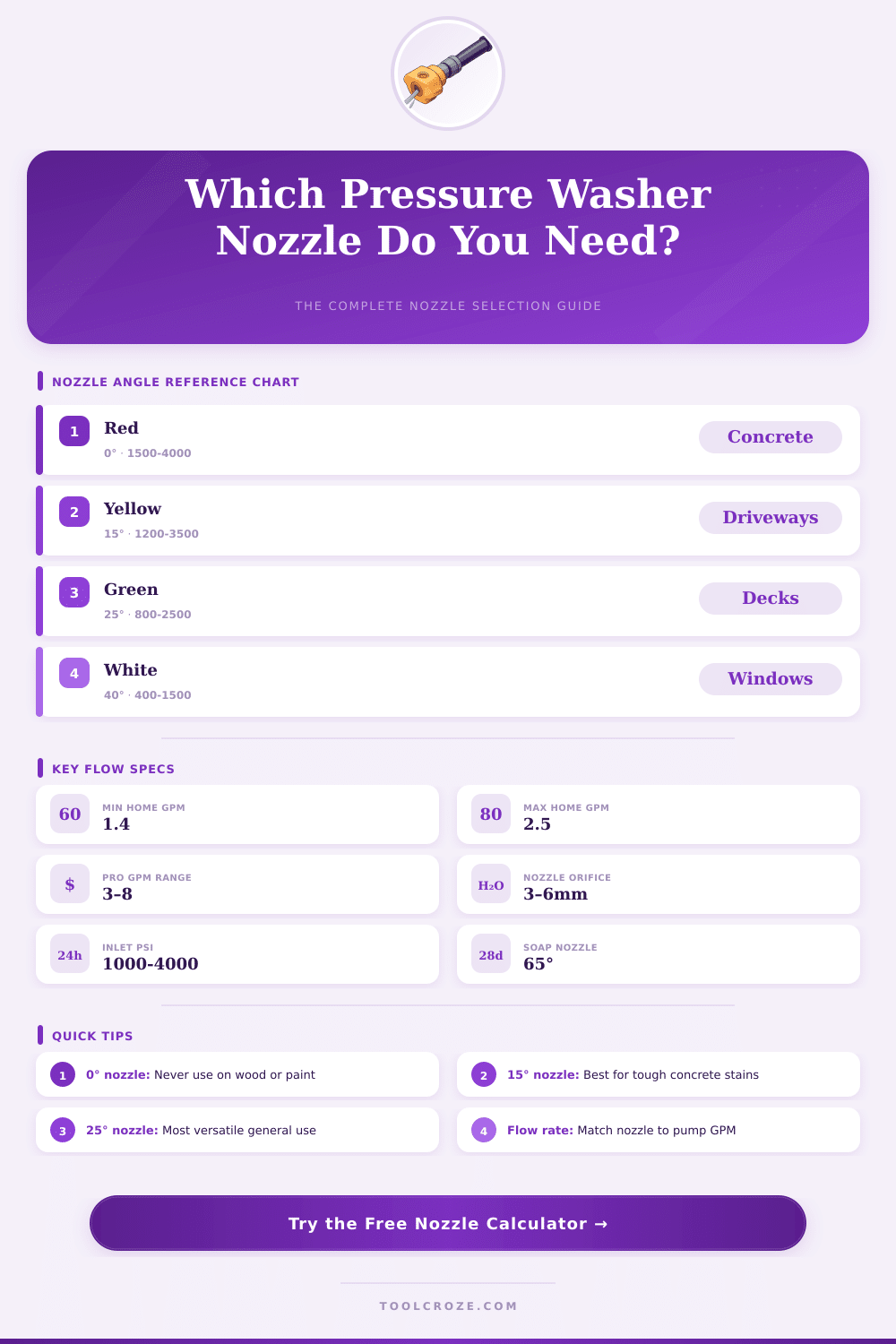
The Pressure washer nozzle is also called a spray nozzle and it matters a lot for the quality of the cleaning. It controls the angle of the spray and the water pressure, so it is key for working with various tasks from tough marks to gentle washes. Choosing the right type is important because wrong choice risks destroying surfaces like the paint of a car or glass windows.
Almost all pressure washers come with a full set of color coded Pressure washer nozzle tips of various degrees. Every degree points the pattern of the spray, that shows the width of the spray and the strength of the water blows. A Pressure washer nozzle of 0 degrees casts a straight water stream, and when it hits a surface the useful zone has a size close to a quarter coin.
How to Choose and Use a Pressure Washer Nozzle
A Pressure washer nozzle of 15 degrees can strip paint and cut into wood. A stream of 0 degrees can drill holes through wood and asphalt. Generally one should start with the widest Pressure washer nozzle with lowest pressure, then increase as needed.
Small angles of sprays provide stronger pressure, less big coverage area and reduced water amount. Big angles do the opposite. Many users do not realize, that Pressure washer nozzle tips also have a rating of PSI.
Pressure washer nozzle tips of 25 and 40 degrees are the most commonly used for cleaning of driveways. The yellow Pressure washer nozzle usually works four concrete.
Turbo nozzle tips form a popular option. A turbo Pressure washer nozzle allows you to clean up to 50 percent faster than average. It spins the water stream in a circle, like this hitting a bigger zone.
On the other hand, turbo nozzle tips can cause damage, if one does not use them carefully.
Pressure washers themselves do not create pressure. The pump simply moves the water. The restriction, that creates the pressure, is the Pressure washer nozzle itself.
A pump with a rating of 2.4 GPM always sends 2.4 GPM. Removing the nozzle, water flows from the gun with almost 0 PSI. Adding several nozzle tips to a steady water supply drops the whole pressure, because the number of open areas grows.
The exit diameter of a Pressure washer nozzle should match the maximum pressure of the washer and the GPM specs. Some nozzle tips have designs with a tipping shape, what helps to reach long distances, useful for edges, barrels and curved surfaces. For instance, one of them handles pressures of 1700 to 6000 PSI and works with systems of 3 to 7 GPM, what helps to keep steady flow of chemicals during soft wash.
There are also adjustable nozzle tips and 5-in-1 models, that twist between different positions. A small O-ring in the mechanism helps to turn between those positions. One grain of sand can block a nozzle, so it matters to keep everything clean.
Back-up nozzle tips and fresh O-rings are easy to find inmost hardware stores.