🪛 Wood Lathe Speed Calculator
Calculate the ideal RPM for any workpiece diameter, material, and turning operation
| Diameter | Roughing RPM | Spindle RPM | Bowl RPM | Finishing RPM | SFM Range |
|---|---|---|---|---|---|
| 1 in (25mm) | 500–800 | 2000–3000 | 1500–2500 | 2500–3000 | 500–800 |
| 2 in (51mm) | 400–600 | 1500–2500 | 1000–1800 | 2000–2800 | 500–800 |
| 3 in (76mm) | 300–500 | 1000–1800 | 700–1200 | 1500–2200 | 500–800 |
| 4 in (102mm) | 250–400 | 750–1400 | 500–900 | 1200–1800 | 500–800 |
| 6 in (152mm) | 200–300 | 500–900 | 350–650 | 800–1200 | 500–800 |
| 8 in (203mm) | 150–250 | 375–700 | 250–500 | 600–900 | 500–800 |
| 10 in (254mm) | 120–200 | 300–550 | 200–400 | 480–720 | 500–800 |
| 12 in (305mm) | 100–160 | 250–450 | 170–320 | 400–600 | 500–800 |
| 14 in (356mm) | 85–135 | 210–390 | 145–275 | 340–510 | 500–800 |
| 16 in (406mm) | 75–115 | 185–340 | 125–240 | 300–450 | 500–800 |
| Tool Type | Operation | Recommended SFM | Notes |
|---|---|---|---|
| Roughing Gouge (3/4") | Initial shaping | 300–500 | Start very slow, check balance |
| Spindle Gouge (1/2") | Cove, bead detail | 500–800 | Increase RPM as diameter reduces |
| Bowl Gouge (1/2") | Bowl interior/exterior | 400–700 | Lower for large diameters |
| Skew Chisel (1") | Smooth cylinders | 600–900 | Higher RPM gives cleaner cut |
| Parting Tool (1/8") | Cut-off, sizing | 400–700 | Moderate speed prevents binding |
| Scraper (1") | Final smoothing | 500–800 | Light cuts, sharp tool only |
| Hollowing Tool | Hollow forms | 300–600 | Slow for deep hollowing |
| Sandpaper (finishing) | Surface finish | 800–1500 | Increase RPM for sanding stage |
| Project | Dia. (in) | Length (in) | Material | Rec. RPM | Notes |
|---|---|---|---|---|---|
| Pen Blank | 0.75 | 5.5 | Any hardwood | 2500–3000 | High speed, small diameter |
| Bottle Stopper | 1.5 | 3 | Exotic/hardwood | 2000–2800 | Check chuck grip |
| Spindle (2") | 2 | 18 | Softwood/hardwood | 1500–2200 | Support with tailstock |
| Table Leg | 3 | 28 | Oak / Maple | 900–1500 | Balance before roughing |
| Baseball Bat | 2.75 | 34 | Ash | 1000–1800 | Use steady rest |
| Small Bowl (6") | 6 | 4 | Walnut / Cherry | 450–800 | Faceplate or chuck mount |
| Medium Bowl (10") | 10 | 5 | Maple / Oak | 280–500 | Check for cracks first |
| Large Platter (14") | 14 | 3 | Cherry / Elm | 200–350 | Very slow, balanced mount |
Find the right speed on a wood lathe is very important. It is not enough to simply choose some speed and stay at it. The ideal speed depends on what one turns, its size and how the bit is balanced.
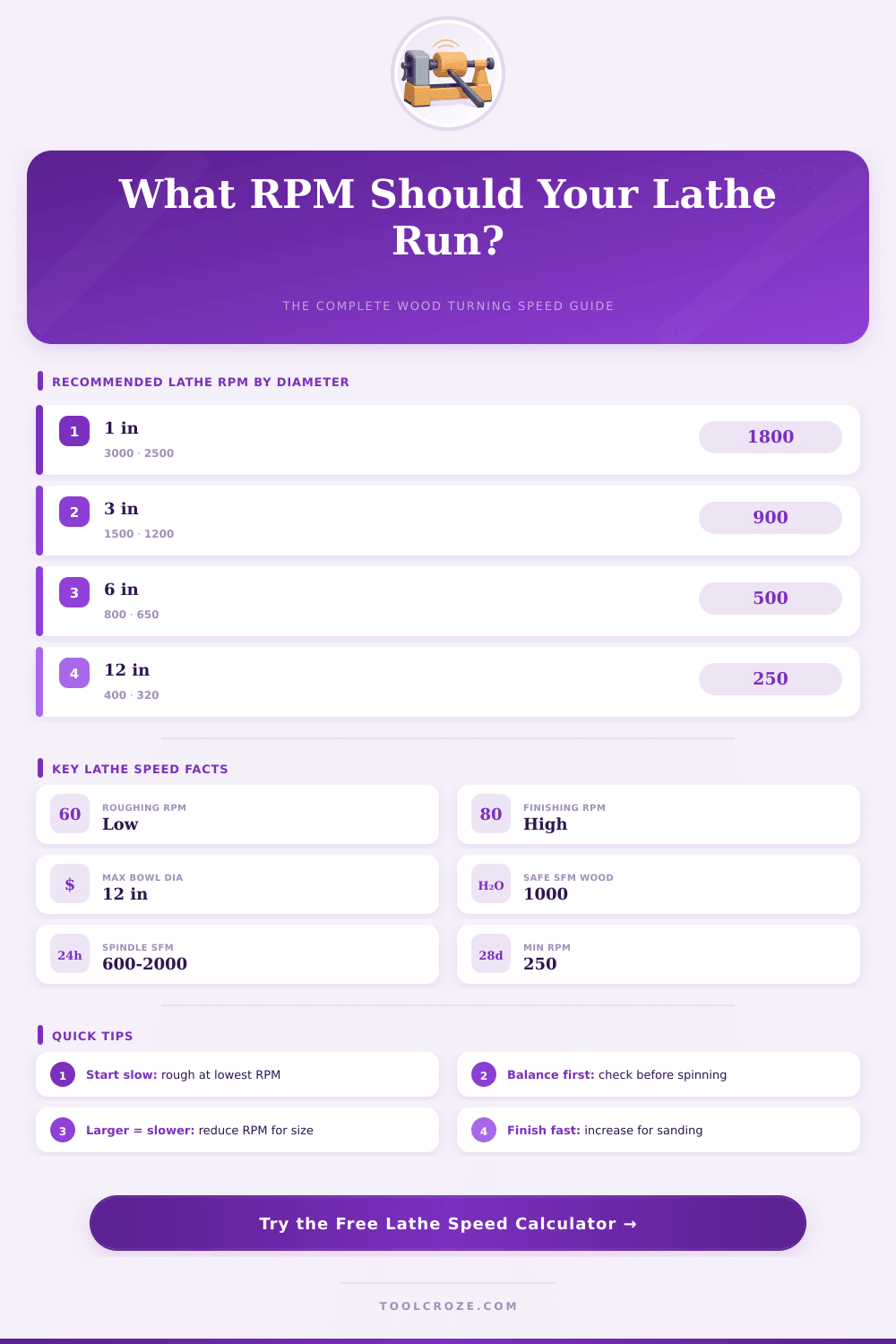
A popular way to estimate the right speed is to multiply the diameter of the bit, measured in inches by the RPM. That result normally falls between 6 000 and 9 000. To find the minimum RPM, divide 6 000 by the diameter; for the maximum, divide 9 000 by it.
How to Pick the Right Speed for a Wood Lathe
For instance, for a 6-inch piece one could use around 1 000 RPM as maximum, while 3-inch would go up to 2 000 RPM. That works well for well balanced bits.
There also exists a practical table that details it. For bits up to 4 inches, 3 500 RPM works. Between 4 and 10 inches, aim for 1 800 to 3 500.
For 10 to 16 inches, think about 1 000 to 1 800. Big bits of 16 to 24 inhces should stay between 400 and 1 000 RPM.
But here is the main point. Thinking that 800 RPM works well for everything can become dangerous. A small 4-inch bowl handles higher speed, but laying an 18-inch bowl on the wood lathe at 800 RPM without care could create serious problems.
One simple rule says that the surface speed should knot go past 40 miles an hour.
Spindles usually are small and already well balanced before one starts to turn. Bowls on the other hand are bigger and commonly less stable at first. So one must use slower speed for bowls in the early phase.
It helps to slowly raise the speed until tired vibration appears, then slow only that much that the vibration goes away. The speed becomes most critical when the shape becomes more precise, the bit gets close to its final form, especially if it has difficult fibers or empty spots.
For spindle work, like pens or candles, speed above 2 000 RPM works well. Some turners push the pen up to 3 000 RPM. Spindles around 1.5 inches or smaller can spin nicely at 2 200 RPM.
When the bit already is round, one can again speed up.
Lathes with variable speed really make things easier. Some go even down to 50 RPM, and one commonly starts every project at that level. A wood lathe that reaches 250 RPM makes everything safer and more flexible.
Variable speed does not only help big changes. Even small tweaks matter. If one doubles the turning speed, while the tool stays the same, the cutting energy goes up four times, which doesnot deserve the risk.
A heavier wood lathe also absorbs vibrations from uneven bits well.