🏍️ Motorcycle Gear Ratio Calculator
Calculate final drive ratio, top speed, engine RPM at speed, and sprocket recommendations for any motorcycle
| Bike Type | 1st Gear | 2nd Gear | 3rd Gear | 4th Gear | 5th Gear | 6th Gear |
|---|---|---|---|---|---|---|
| Sport 600cc | 2.857 | 2.062 | 1.647 | 1.350 | 1.125 | 0.964 |
| Superbike 1000cc | 2.615 | 1.937 | 1.529 | 1.292 | 1.125 | 0.966 |
| Naked 750cc | 2.750 | 1.944 | 1.600 | 1.368 | 1.185 | 1.045 |
| Cruiser 1200cc | 3.313 | 2.000 | 1.419 | 1.069 | 0.947 | — |
| Dirt Bike 250cc | 2.769 | 2.000 | 1.619 | 1.350 | 1.148 | — |
| Adventure 1100cc | 2.750 | 1.850 | 1.450 | 1.200 | 1.040 | 0.920 |
| Chain Type | Pitch (mm) | Inner Width (mm) | Tensile Strength | Typical Use | Power Capacity |
|---|---|---|---|---|---|
| 415 | 12.70 | 4.88 | 12.0 kN | Mini bikes, <100cc | Up to 10 HP |
| 428 | 12.70 | 7.75 | 16.0 kN | Small bikes, 100–250cc | Up to 30 HP |
| 520 | 15.875 | 6.35 | 24.5 kN | Lightweight race, 250–600cc | Up to 80 HP |
| 525 | 15.875 | 7.85 | 31.8 kN | Mid-size, 600–900cc | Up to 120 HP |
| 530 | 15.875 | 9.53 | 35.0 kN | Large bikes, 600cc–1400cc | Up to 180 HP |
| 532 | 15.875 | 10.16 | 38.0 kN | Heavy cruisers, >1400cc | Up to 220 HP |
| Change | Effect on Acceleration | Effect on Top Speed | Effect on RPM | Typical Use Case |
|---|---|---|---|---|
| +1T Front | ↓ Decreases | ↑ Increases ~3–4% | ↓ Lower at speed | Highway / touring |
| –1T Front | ↑ Increases | ↓ Decreases ~3–4% | ↑ Higher at speed | City / track short circuits |
| +3T Rear | ↑ Increases | ↓ Decreases ~3–4% | ↑ Higher at speed | Off-road / drag start |
| –3T Rear | ↓ Decreases | ↑ Increases ~3–4% | ↓ Lower at speed | Top speed / fuel economy |
| +1T Front ≈ –3T Rear | Equivalent ratio | Equivalent ratio | Same | Interchangeable option |
| Tire Size | Width (mm) | Aspect (%) | Rim (in) | Outer Dia. (in) | Outer Dia. (mm) |
|---|---|---|---|---|---|
| 120/70-17 | 120 | 70 | 17 | 23.67 | 601.2 |
| 160/60-17 | 160 | 60 | 17 | 24.49 | 622.0 |
| 180/55-17 | 180 | 55 | 17 | 24.49 | 622.0 |
| 190/50-17 | 190 | 50 | 17 | 24.49 | 622.0 |
| 150/80-16 | 150 | 80 | 16 | 25.39 | 645.0 |
| 180/65-16 | 180 | 65 | 16 | 25.40 | 645.1 |
| 80/100-21 | 80 | 100 | 21 | 27.15 | 689.6 |
| 110/90-19 | 110 | 90 | 19 | 26.78 | 680.1 |
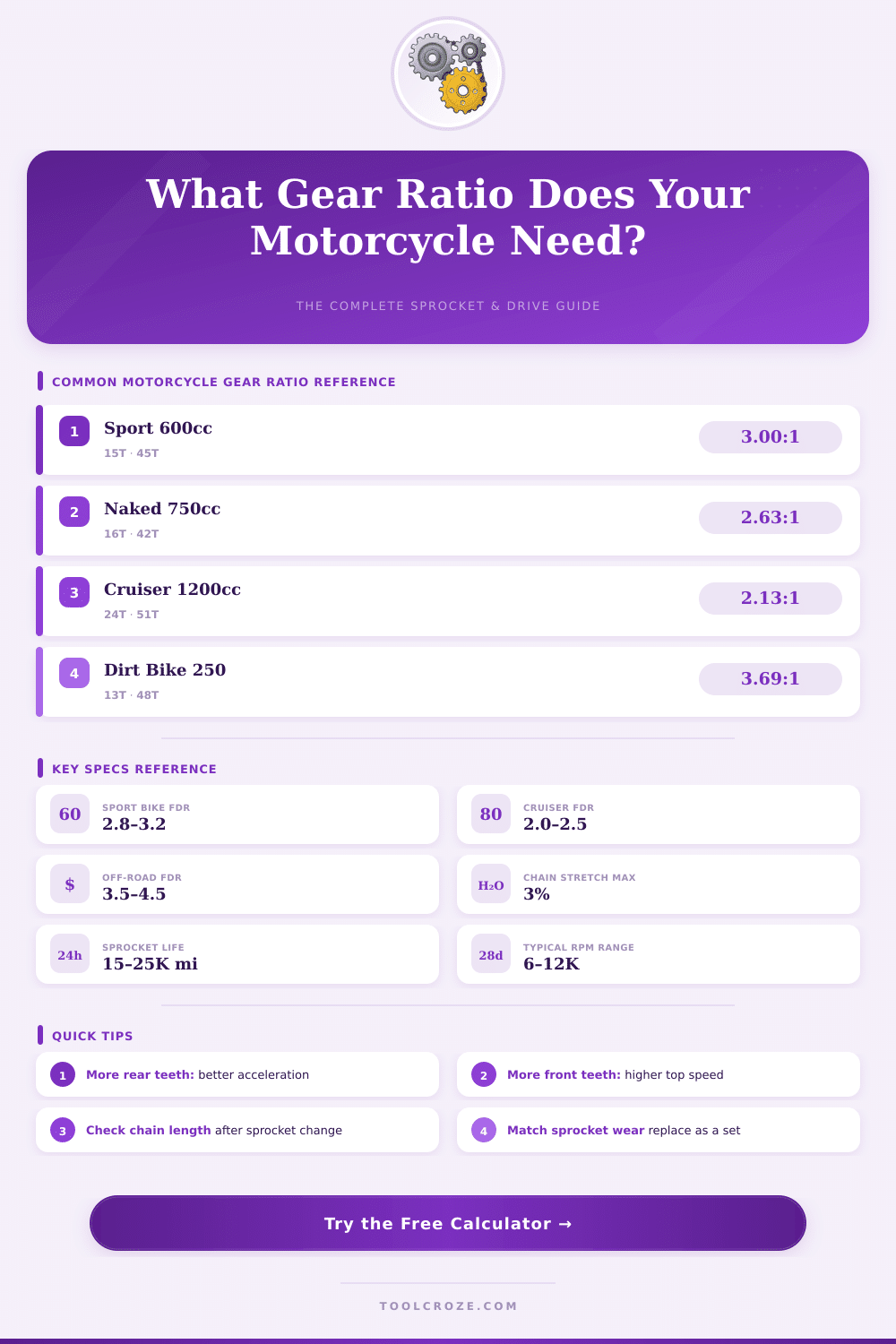
The gear report for motorcycle is pretty easy to understand when one takes it in. One takes the number of teeth of the back sprocket and divides it by the number of teeth of the front sprocket. Like this one gets the report for the gear.
For instance, front sprocket with 5 teeth tied to back with 15 teeth means, that the front must twist thrice so that the back does one full move. That results in report of 3:1. Setup with 15 teeth in the lead and 50 in the back gives 3.33, which means, that the front sprocket twists 3.33 times for one alone spin of the back.
How Motorcycle Gear Ratios Work
For most motorcycles, the final drive report sits between 3 and 5. This value shows how many times the front sprocket must twist so that the back wheel does one full turn. On a typical bike the front sprocket is small, around 16 teeth, while the back is much bigger, around 44 teeth.
Because of that, for every full turn of the front sprocket, the back only moves about a thrid of the circle.
Changing the number of teeth on any sprocket affects the behavior of the bike. It is always a deal about compromise between fast pickup and maximum speed. A higher report allows the bike too reach bigger speeds in every gear, but the traction feels a bit weak.
A lower report provides better boost and force, but limits the upper speed a bit. When the bike makes much torque, trading a bit of that for lower revolutions in a given speed can be useful.
Too low a gear report causes the engine to scream in high revolutions, without reaching its potential maximum speed. Too high a report does that the engine struggles in low revolutions and can not push well through the resistance.
The total report of motorcycle is made up of the basic drive report multiplied by the report of the gearbox and by the final drive report. This total value shows how the engine revolutions drop before they reach the back wheel. A general rule for most motorcycle gearboxes is that the engine RPM drops by around 15 percent each time when one passes from the second to the third, to the fourth and so on.
Passing from the first to the second it drops by around 30 percent.
More teeth on the back sprocket result in a lower report. Fewer teeth on the front sprocket also lowers the report. Changing the chain drive report is the usual method, because changing the gearbox is not simple at all.
During change of sprockets, never mix old chain with new sprocket or the other way, because that shortens thelife of both. Also make sure that the chain fits well without too much slack.
There are online calculators for sprockets with data that covers more than 1900 bikes. This tool helps to estimate how far it will adjust the reports in a given speed, before doing the actual change.