🎨 Spray Paint Coverage Calculator
Calculate exactly how many cans you need for any project — walls, furniture, metal, plastic & more
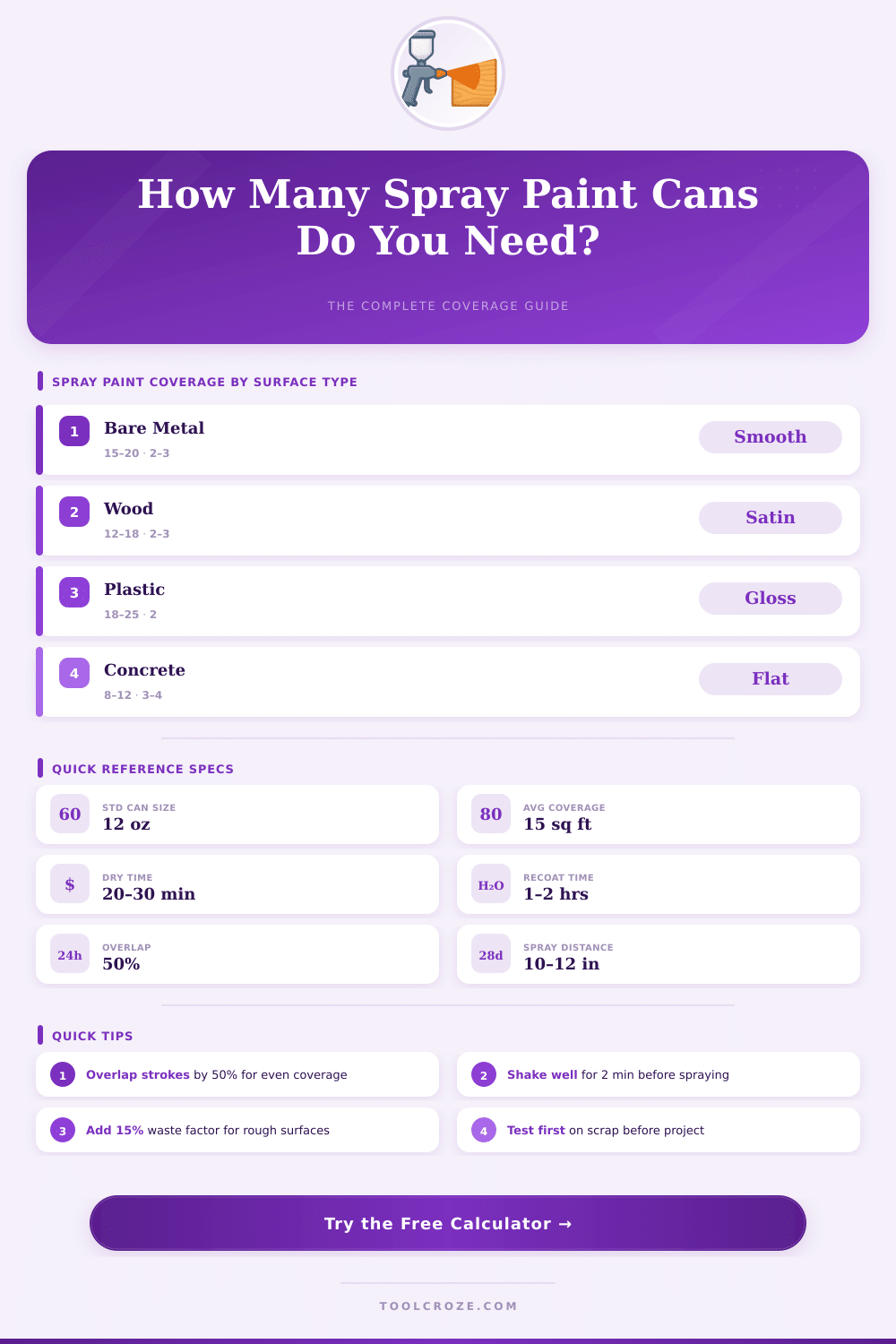
| Finish Type | Sq Ft / Can | M² / Can | Coats Typical | Dry Time | Recoat Time |
|---|---|---|---|---|---|
| Standard / General | 15–20 | 1.4–1.9 | 2 | 20–30 min | 1–2 hrs |
| Primer | 10–15 | 0.9–1.4 | 1 | 30–60 min | 1 hr |
| Enamel / Hard Coat | 12–18 | 1.1–1.7 | 2–3 | 1–2 hrs | 4–8 hrs |
| Chalk / Matte | 16–22 | 1.5–2.0 | 2 | 30–60 min | 1 hr |
| Metallic / Chrome | 10–14 | 0.9–1.3 | 2–3 | 30 min | 1–2 hrs |
| Textured Paint | 8–12 | 0.7–1.1 | 2 | 30–60 min | 2 hrs |
| Can Size | Spray Distance | Stroke Speed | Overlap | Shake Time | Coverage Factor |
|---|---|---|---|---|---|
| 11 oz | 8–10 in (20–25 cm) | Medium | 50% | 2 min | 0.92x standard |
| 12 oz | 10–12 in (25–30 cm) | Medium | 50% | 2 min | 1.0x standard |
| 16 oz | 10–14 in (25–36 cm) | Steady | 50% | 2 min | 1.33x standard |
| 20 oz | 12–16 in (30–40 cm) | Steady | 50% | 3 min | 1.67x standard |
| Project | Est. Area | Material | Coats | Cans Needed | Finish |
|---|---|---|---|---|---|
| Dining Chair | 8–12 sq ft | Wood/Metal | 2 | 2–3 | Satin/Gloss |
| Bike Frame | 4–7 sq ft | Metal | 3 | 2–4 | Gloss |
| 4x8 Plywood Sheet | 32 sq ft | Wood | 2 | 4–6 | Various |
| Mailbox + Post | 3–5 sq ft | Metal | 2 | 1–2 | Gloss |
| 6-Panel Cabinet Set | 30–45 sq ft | Wood | 2–3 | 5–9 | Semi-gloss |
| Deck Railing (20 ft) | 20–30 sq ft | Wood/Metal | 2 | 3–5 | Satin |
| Wicker Chair | 10–15 sq ft | Wicker | 2 | 4–6 | Various |
| Car Bumper | 5–8 sq ft | Plastic | 3 | 2–4 | Gloss |
The amount of surface that spray paint really covers depends on several factors. Whether dealing about size of the can, whatever you spray, choice of colour or thickness of the coats, everything affects the result. For a standard can of 12 ounces and average coat on wet clothing expect covering between 12 and 16 square feet.
If you use high-build or enamel spray paint, the covering drops to 8 to 12 square feet for one can, because the coat ends up more thick.
How Much Area Does a Can of Spray Paint Cover
A 400 mL can deserves comparison. One clear coat on rough surface will cover around 1 to 2 square metres. If you move to smooth surface with thin coats, the same can can reach 4 to 6 square metres.
Texture of the surface really does matter, and a smaller can works by diffreent rules. A can of 4.5 ounces covers about 7 square feet, while one goes to 16 ounces, it reaches almost 30 square feet.
Choice of colour affects more than many folks think. Dark tones require more paint than bright, because of a bigger number of coats. Bright reds, whites and greys reach average covering, usually 5 to 6 square feet for one can.
Blue and red shades are more tricky. They commonly require a whole 5 base coats to properly cover. Even so, usually one can is enough to fully cover an area of 3.5 by 3.5 feat.
Here is something useful to know. A can of 12 ounces of spray paint holds roughly 4 to 5 ounces of real paint. Everything else inside is solvent and additives.
That certainly deserves thought in planning of your project.
Some kinds of spray paint are made to go more efficiently. Certain formulas use technology that almost doubles the covering compared to average spray paint. Fewer coats mean that projects end more quickly.
Those paints dry quickly and give smooth, strong finish on wood, metal, plastic and wicker. The 360-degree spray types are handy too, you can spray in any direction, even upside down.
Spraying widely uses more material than rolling. When you spray indoor walls, overspray reduces the covering to maybe 200 to 250 square feet per gallon. With a spray gun, expect the bottom limit of the claims of the paint.
A base coat helps a lot, especially when you cover a different colour from below. Passing heat above the coats helps to remove air pockets and heating the paint before spraying improves the results, because weather conditions play apart in the work.
Even to reach lasting covering, you need a bit of practice. Masking of protected areas reduces waste. One can of 12 ounces, that covers roughly 12 to 20 square feet for a thin coat, can work for two clear coats.
For thicker, even covering, plan twocanns, which makes more sense.