⚙️ Hydraulic Motor HP Calculator
Calculate hydraulic motor horsepower, torque, flow rate, and efficiency from pressure and flow inputs
| Motor Type | Max PSI | Max RPM | Typical Efficiency | Displacement Range | Best Application |
|---|---|---|---|---|---|
| Gear Motor | 3000 PSI | 4000 RPM | 82–88% | 0.1–10 in³/rev | General industrial, low cost |
| Vane Motor | 2500 PSI | 3000 RPM | 85–91% | 0.5–8 in³/rev | Smooth operation, mid pressure |
| Axial Piston Motor | 6000 PSI | 6000 RPM | 90–95% | 0.5–20 in³/rev | High power, variable speed |
| Orbit / Gerotor | 2000 PSI | 1200 RPM | 75–83% | 1–50 in³/rev | Low speed, high torque |
| Radial Piston | 5000 PSI | 2500 RPM | 88–94% | 2–100 in³/rev | Very high torque, winches |
| Flow (GPM) | 1000 PSI | 2000 PSI | 3000 PSI | 4000 PSI | 5000 PSI |
|---|---|---|---|---|---|
| 5 GPM | 2.5 HP | 5.0 HP | 7.5 HP | 9.9 HP | 12.4 HP |
| 10 GPM | 5.0 HP | 9.9 HP | 14.9 HP | 19.8 HP | 24.8 HP |
| 20 GPM | 9.9 HP | 19.8 HP | 29.8 HP | 39.7 HP | 49.6 HP |
| 30 GPM | 14.9 HP | 29.8 HP | 44.6 HP | 59.5 HP | 74.4 HP |
| 50 GPM | 24.8 HP | 49.6 HP | 74.4 HP | 99.2 HP | 124.0 HP |
| 100 GPM | 49.6 HP | 99.2 HP | 148.8 HP | 198.4 HP | 248.0 HP |
| Displacement (in³/rev) | Displacement (cm³/rev) | Torque @ 1000 PSI | Torque @ 2000 PSI | Torque @ 3000 PSI | Typical Motor Type |
|---|---|---|---|---|---|
| 0.25 in³ | 4.1 cm³ | 38 lb–ft | 77 lb–ft | 115 lb–ft | Gear (small) |
| 0.5 in³ | 8.2 cm³ | 77 lb–ft | 154 lb–ft | 230 lb–ft | Gear / Vane |
| 1.0 in³ | 16.4 cm³ | 153 lb–ft | 306 lb–ft | 460 lb–ft | Gear / Piston |
| 2.0 in³ | 32.8 cm³ | 306 lb–ft | 612 lb–ft | 918 lb–ft | Piston / Orbit |
| 5.0 in³ | 81.9 cm³ | 765 lb–ft | 1530 lb–ft | 2295 lb–ft | Orbit / Radial |
| 10.0 in³ | 163.9 cm³ | 1530 lb–ft | 3060 lb–ft | 4590 lb–ft | Radial Piston |
| Imperial | Metric Equivalent | Formula | Notes |
|---|---|---|---|
| 1 GPM | 3.785 L/min | GPM × 3.785 | Flow rate conversion |
| 1 PSI | 0.0689 bar | PSI × 0.0689 | Pressure conversion |
| 1 in³/rev | 16.387 cm³/rev | in³ × 16.387 | Displacement conversion |
| 1 HP | 0.7457 kW | HP × 0.7457 | Power conversion |
| 1 lb–ft | 1.3558 N·m | lb–ft × 1.3558 | Torque conversion |
| 1 bar | 14.504 PSI | bar × 14.504 | Pressure (reverse) |
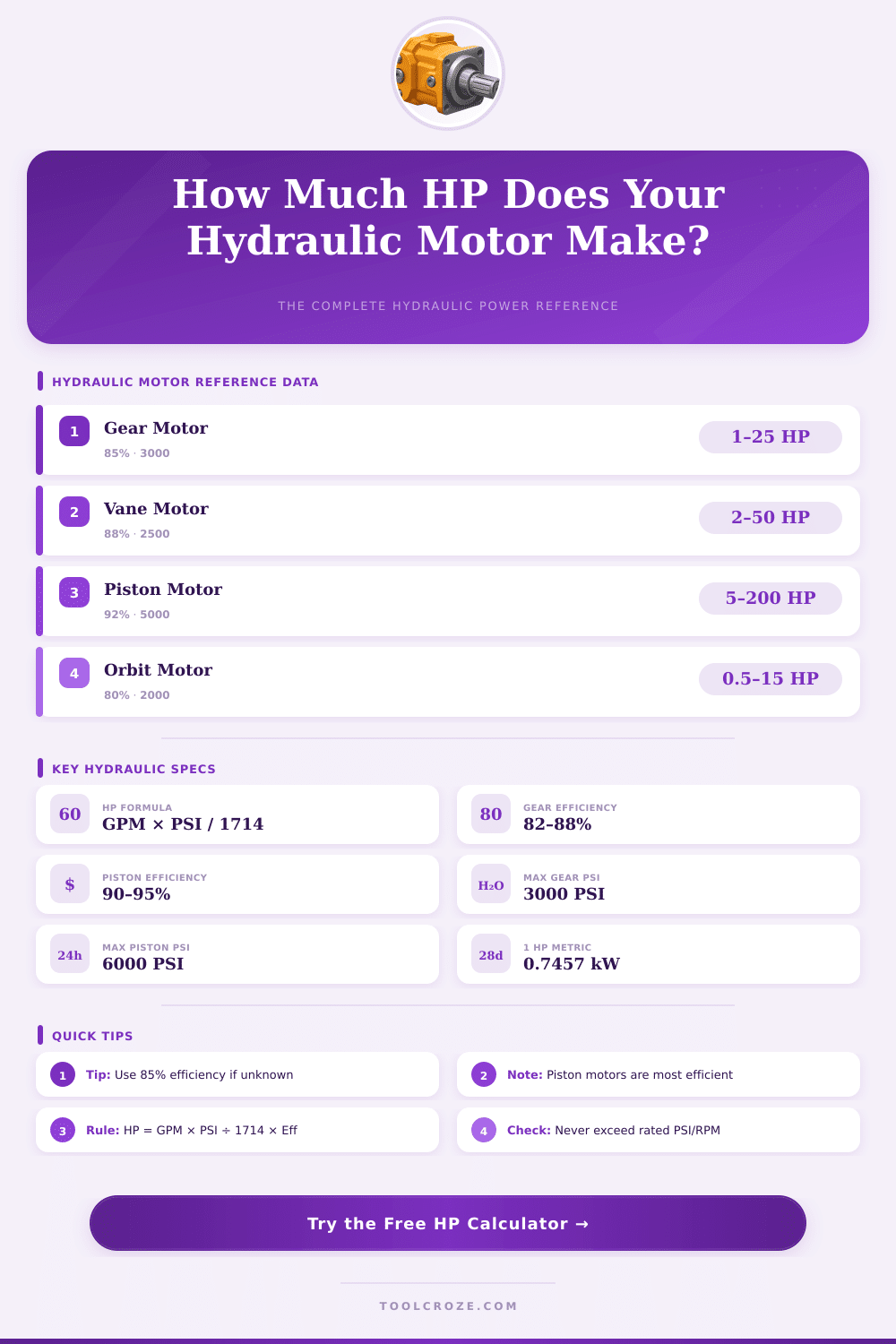
Count the horsepower of a hydraulic motor does not require rocket science, just know the right steps. Here the basic method: take your pressure in pounds per square inch multiply it by the flow in gallons per minute, and then divide the total by 1714. Like this one finds the hydraulic horsepower.
Here the part where things become more tricky. The hydraulic horsepower differs from that of the motor, and mixing them can cause serious troubles during building or repair of a system. Hydraulic horsepower shows what the prime mover, whether electrical motor, gas engine, diesel or other hydraulic (puts into the system).
How to calculate hydraulic horsepower
On the other hand, the motor horsepower shows what truly exits on the other side. The difference appears bigger than one could believe.
At its base, horsepower measures how much work engines can do. Exactly said, it measures the power units an engine creates in a second. One imperial horsepower matches around 745.7 watts, so one can give or take that.
Sizing an electrical motor for a hydraulic pump becomes a bit harder, because efficiency plays a role. The math goes like this: gallons per minute times pressure in pounds per square inch, divided by 1714, then also divided by the efficiency percentage of the pump. For instance, for 25 gallons per minute at 2000 pounds per square inch with 90 percent efficiency, one gets around 32 horsepowers.
Those losses because of efficiency do not stay only theory; they happen actually and add up soon.
Simple math shows that pumping 15 gallons per minute at 2000 pounds per square inch needs around 21 horsepowers. Expand that to 28 gallons per minute at 3000 pounds per square inch with 85 percent efficiency of the system, and quickly you need a motor of almost 55 horsepowers. Those numbers change quite quickly, because it depends on the involved pressure and flow.
In drilling setups dirt-pumps run on engines with limited available energy. The hydraulic horsepower that those pumps deliver at the surface depends on one main factor: surface pressure times the flow rate. Every step in the chain of energy conversion costs a bit of efficiency.
What surprises about hydraulic motors is the amount of energy that they can fit in a small space. Axial piston motors provide high density of power. Orbit motors and radial piston motors add far strong torque density.
Depending on the involved speed, hydraulic systems commonly manage too address more energy than an electrical motor of the same horsepower name.
The high need of horsepower creates the biggest challenge during phases with high pressure. I saw systems where that maximum reaches just 17 horsepowers. It is not possible to escape that limit without changes in pressure, flow or both.
When a pump motor delivers 30 horsepowers but runs at only 90 percent efficiency, you truly take around 33 horsepowers from thesource. Those spots of efficiency weigh more than one would think.