🔧 Thread Pitch Calculator
Calculate pitch, TPI, lead, minor diameter, and tap drill size for metric and imperial threads
| Thread | Coarse Pitch (mm) | Fine Pitch (mm) | Major Dia (mm) | Minor Dia – Coarse | Tap Drill – Coarse |
|---|---|---|---|---|---|
| M2 | 0.40 | 0.25 | 2.0 | 1.509 | 1.6mm |
| M3 | 0.50 | 0.35 | 3.0 | 2.387 | 2.5mm |
| M4 | 0.70 | 0.50 | 4.0 | 3.141 | 3.3mm |
| M5 | 0.80 | 0.50 | 5.0 | 4.019 | 4.2mm |
| M6 | 1.00 | 0.75 | 6.0 | 4.917 | 5.0mm |
| M8 | 1.25 | 1.00 | 8.0 | 6.647 | 6.8mm |
| M10 | 1.50 | 1.00 | 10.0 | 8.376 | 8.5mm |
| M12 | 1.75 | 1.25 | 12.0 | 10.106 | 10.2mm |
| M16 | 2.00 | 1.50 | 16.0 | 13.835 | 14.0mm |
| M20 | 2.50 | 1.50 | 20.0 | 17.294 | 17.5mm |
| M24 | 3.00 | 2.00 | 24.0 | 20.752 | 21.0mm |
| M30 | 3.50 | 2.00 | 30.0 | 26.211 | 26.5mm |
| Size | TPI | Major Dia (in) | Pitch (in) | Minor Dia (in) | Tap Drill |
|---|---|---|---|---|---|
| #4-40 UNC | 40 | 0.1120 | 0.0250 | 0.0813 | #43 (0.089") |
| #6-32 UNC | 32 | 0.1380 | 0.0313 | 0.0997 | #36 (0.1065") |
| #8-32 UNC | 32 | 0.1640 | 0.0313 | 0.1257 | #29 (0.136") |
| #10-24 UNC | 24 | 0.1900 | 0.0417 | 0.1389 | #25 (0.1495") |
| 1/4-20 UNC | 20 | 0.2500 | 0.0500 | 0.1876 | #7 (0.201") |
| 5/16-18 UNC | 18 | 0.3125 | 0.0556 | 0.2403 | F (0.257") |
| 3/8-16 UNC | 16 | 0.3750 | 0.0625 | 0.2938 | 5/16 (0.3125") |
| 1/2-13 UNC | 13 | 0.5000 | 0.0769 | 0.4001 | 27/64 (0.4219") |
| 3/4-10 UNC | 10 | 0.7500 | 0.1000 | 0.6201 | 21/32 (0.6563") |
| 1/4-28 UNF | 28 | 0.2500 | 0.0357 | 0.2062 | #3 (0.213") |
| 3/8-24 UNF | 24 | 0.3750 | 0.0417 | 0.3209 | Q (0.332") |
| 1/2-20 UNF | 20 | 0.5000 | 0.0500 | 0.4459 | 29/64 (0.4531") |
| Material | Rec. Thread Depth % | Tap Drill Offset | Min Engage Length | Tapping Speed (SFM) | Notes |
|---|---|---|---|---|---|
| Mild Steel | 75% | Standard | 1.0x dia | 20–40 SFM | Use cutting fluid |
| Stainless Steel | 65–70% | +0.05mm | 1.0x dia | 10–20 SFM | Low speed, flood coolant |
| Aluminum | 75–85% | Standard | 1.5x dia | 60–100 SFM | WD-40 or kerosene |
| Brass / Bronze | 75% | Standard | 1.0x dia | 40–60 SFM | Dry or light oil |
| Cast Iron | 65% | +0.05mm | 1.0x dia | 20–30 SFM | Dry tapping only |
| Titanium | 60–65% | +0.1mm | 1.5x dia | 5–15 SFM | Requires TiAlN tap |
| Plastic / Nylon | 60–65% | +0.1mm | 2.0x dia | 30–50 SFM | Self-tapping screws OK |
| Copper | 75% | Standard | 1.0x dia | 40–60 SFM | Light oil recommended |
| Standard | Thread Angle | Profile | Crest / Root | Common Use |
|---|---|---|---|---|
| ISO Metric (M) | 60° | Symmetrical V | Flat / Rounded | General fasteners worldwide |
| UNC / UNF (Unified) | 60° | Symmetrical V | Flat / Rounded | US/Canada fasteners |
| BSW (Whitworth) | 55° | Rounded V | Rounded both | Legacy UK / plumbing |
| BSP / BSPP | 55° | Rounded V | Rounded both | Pipe fittings (parallel) |
| NPT (Pipe) | 60° | Tapered V | Flat / Rounded | US pipe fittings (tapered) |
| ACME | 29° | Trapezoidal | Flat both | Lead screws, power transmission |
| Buttress | 7°/45° | Asymmetric | Flat both | High axial load (one direction) |
| Tr (DIN) | 30° | Trapezoidal | Flat both | European lead screws |
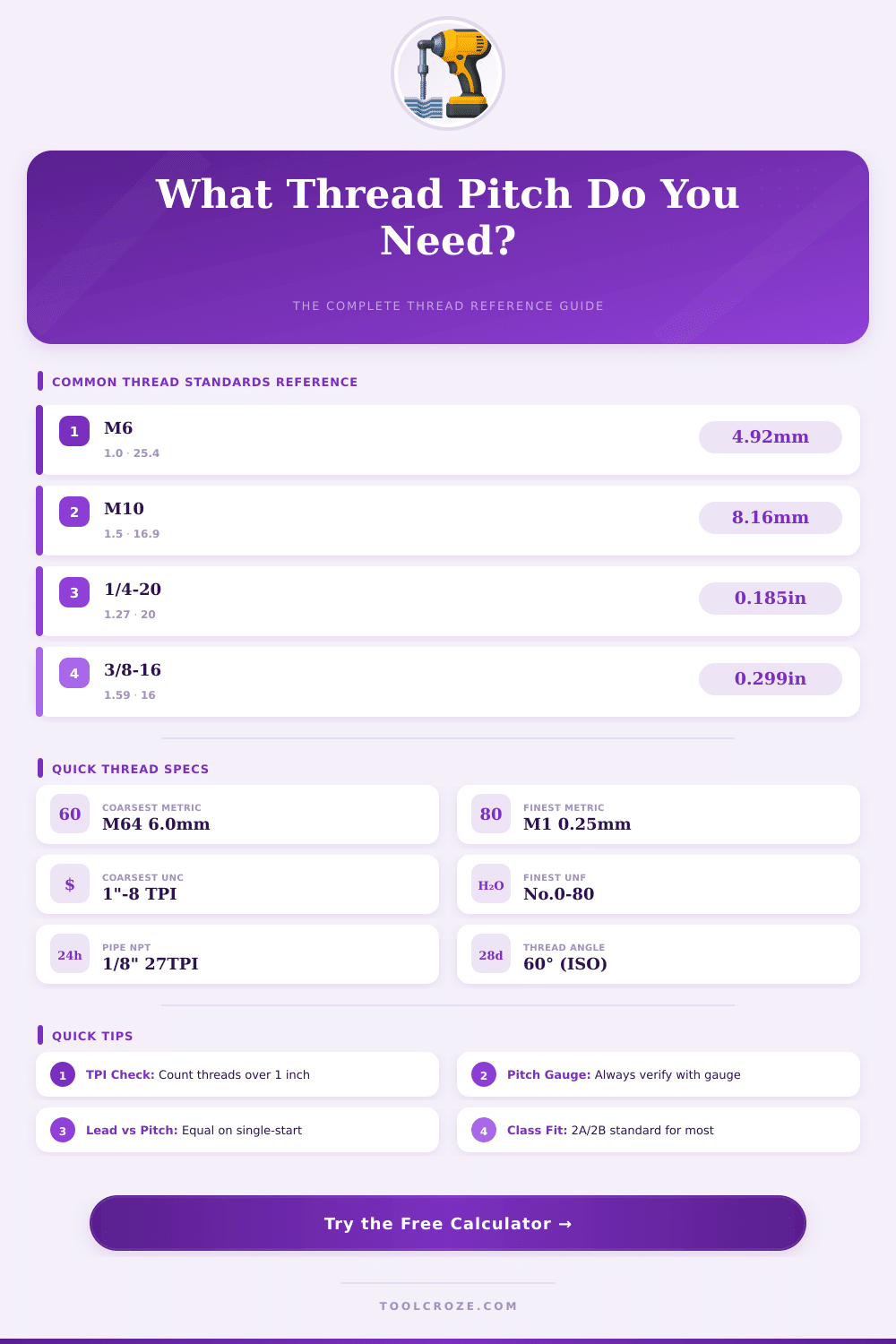
The Thread pitch simply said is the gap between two threads on a screw or bolt. One commonly calls it threads by means of inch, or in short TPI. Both ways to measure it show the same thing only from different viewpoints.
For usual threads the pitch is rated by the number of threads inside one inch. Like this bolt with 20 threads each inch owns TPI of 20. For easy figuring, take a bit of one-inch length on the bolt and count the threads here.
What is Thread Pitch?
Other than that, one can count ten threads, measure the distance from the first to the tenth, and later divide that length by nine to get the pitch.
Metric bolts work otherwise. Instead of counting threads each inch, it is shown by the space between threads, in millimeters. Pitch of 1.5 mm so wants to say 1.5 mm between two consecutive threads.
Like this in metric system small number shows fine Thread, while big number shows corase Thread. Rather in SAE-system, more threads each inch imply fine.
Labels of metric bolts follow a set order. For example M4 x 0.7 x 20: the first part shows the diameter in millimeters. The second points the pitch of Thread.
The third says the length of the bolt. The “M” simply marks that it is metric. Like this M22-bolt has 22 mm diameter, with pitch maybe 1.5 after it.
Almost all metric sizes have usual pitch. M6-bolt usually bears 1 mm pitch, except if specifically pointed. M8-bolt normally has 1.25 mm, what gives around fore threads for every five millimeters of length.
There are also fine and extra fine versions for special uses.
Thread pitch gauges form handy aids to find unknown threads. They do not serve for precise measurement, but well work as references to match Thread profiles. One can buy sets, that include both metric and standard threads.
Some gauges even cover various kinds as Unified, Whitworth or metric. When no measures are available, but a base sample exists, comparison of Thread helps to recognize the type and size fairly easily.
Mixing Thread pitches is a mistake. Wheels with 12×1.25 pitch does not answer for car with 12×1.5. Similarly, NPT pipe threads in 18 TPI do not mix with BSPT-threads in 19 TPI, because they will not close tight, even if they seem tofit.
There is also double pitch Thread, that simply is two-start with two parallel spirals separated at 180 degrees.