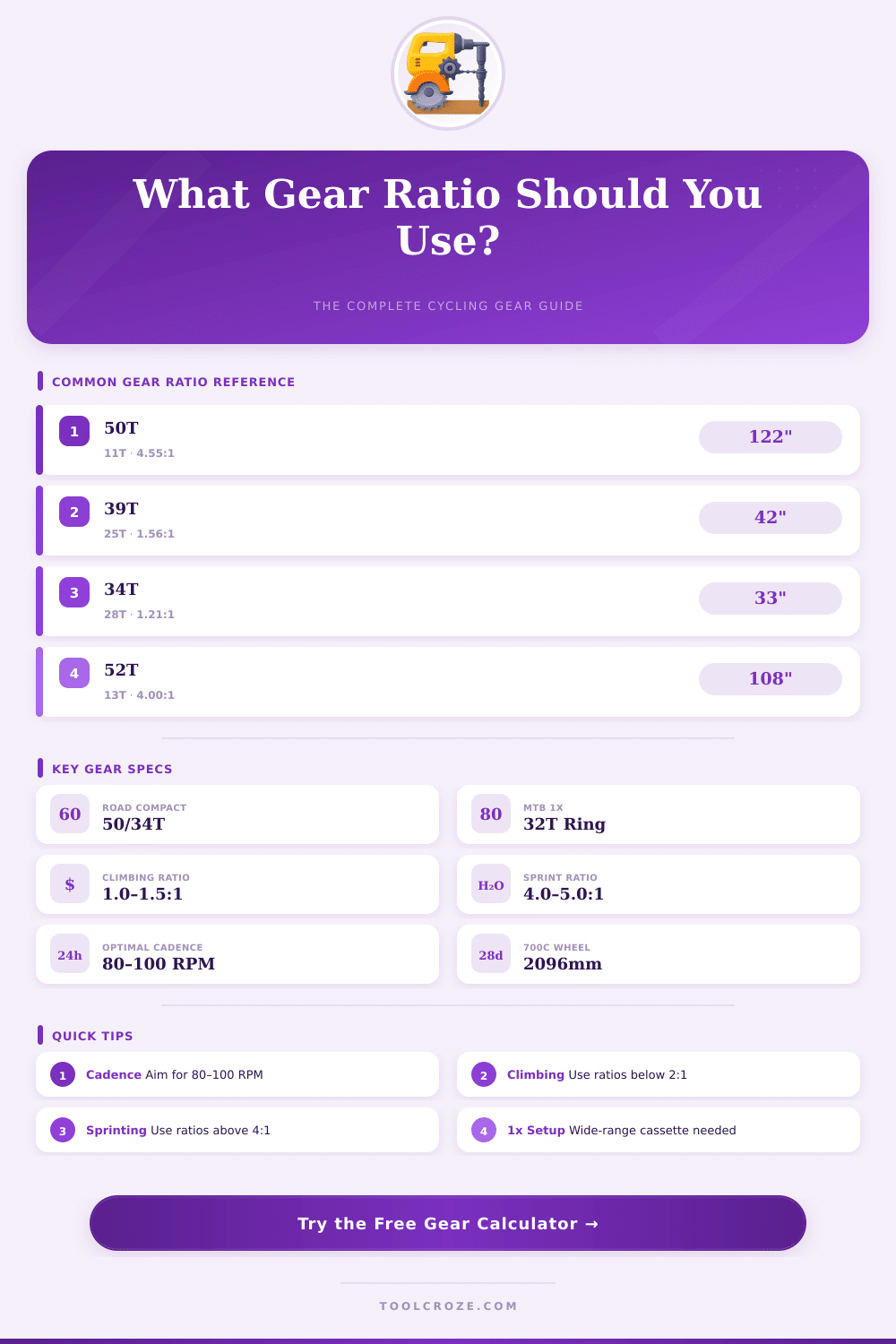
🚴 Cycling Gear Ratio Calculator
Calculate gear ratios, gear inches, meters of development, speed, and optimal cadence for any drivetrain setup
| Chainring (T) | Sprocket (T) | Gear Ratio | Gear Inches | Dev. (m) | Speed @ 90rpm | Use Case |
|---|---|---|---|---|---|---|
| 53 | 11 | 4.82:1 | 129.2" | 10.3m | 55.7 km/h | Road sprint / flat TT |
| 50 | 11 | 4.55:1 | 121.8" | 9.7m | 52.5 km/h | Road racing descent |
| 50 | 17 | 2.94:1 | 78.7" | 6.3m | 34.0 km/h | Road cruising tempo |
| 50 | 25 | 2.00:1 | 53.6" | 4.3m | 23.1 km/h | Road moderate climb |
| 34 | 28 | 1.21:1 | 32.5" | 2.6m | 14.0 km/h | Steep climbing |
| 34 | 32 | 1.06:1 | 28.4" | 2.3m | 12.3 km/h | Alpine / very steep climb |
| 32 | 11 | 2.91:1 | 77.9" | 6.2m | 33.6 km/h | MTB 1x fast trail |
| 32 | 50 | 0.64:1 | 17.2" | 1.4m | 7.4 km/h | MTB 1x steep tech climb |
| 44 | 16 | 2.75:1 | 73.7" | 5.9m | 31.8 km/h | City / single speed |
| 49 | 15 | 3.27:1 | 87.4" | 7.0m | 37.8 km/h | Track / fixie standard |
| Component | Range / Size | Speeds | Best For | Ratio Range |
|---|---|---|---|---|
| Road Cassette 11-25 | 11T–25T | 11-speed | Flat & rolling terrain | 2.0–4.8:1 |
| Road Cassette 11-28 | 11T–28T | 11-speed | Mixed terrain & hills | 1.8–4.8:1 |
| Road Cassette 11-32 | 11T–32T | 11-speed | Climbing & sportive | 1.6–4.8:1 |
| MTB Cassette 11-42 | 11T–42T | 12-speed | MTB all-mountain 1x | 0.76–2.9:1 |
| MTB Cassette 10-52 | 10T–52T | 12-speed | MTB enduro / extreme | 0.62–3.2:1 |
| Gravel Cassette 11-36 | 11T–36T | 11-speed | Gravel & adventure | 1.1–3.6:1 |
| Compact Chainset 50/34 | 50T & 34T | 2x | General road / endurance | 1.0–4.8:1 |
| Standard Chainset 53/39 | 53T & 39T | 2x | Road racing / flat | 1.2–5.1:1 |
| MTB 1x Oval 32T | 32T | 1x | XC / trail MTB | 0.62–2.9:1 |
| Track Chainset 49T | 49T fixed | Fixed | Track / velodrome | 3.0–4.5:1 |
| Wheel / Tire Size | ISO Designation | Circumference | Diameter (approx) | Common Use |
|---|---|---|---|---|
| 700c x 23mm | 23-622 | 1952mm / 76.9" | 668mm / 26.3" | Road racing |
| 700c x 25mm | 25-622 | 1980mm / 78.0" | 672mm / 26.5" | Road endurance |
| 700c x 28mm | 28-622 | 2010mm / 79.1" | 678mm / 26.7" | Road / gravel |
| 700c x 32mm | 32-622 | 2048mm / 80.6" | 686mm / 27.0" | Gravel / touring |
| 700c x 40mm | 40-622 | 2125mm / 83.7" | 702mm / 27.6" | Gravel / cx |
| 29" x 2.2" | 55-622 | 2128mm / 83.8" | 728mm / 28.7" | MTB XC/trail |
| 29" x 2.4" | 60-622 | 2199mm / 86.6" | 740mm / 29.1" | MTB enduro |
| 27.5" x 2.25" | 57-584 | 2134mm / 84.0" | 699mm / 27.5" | MTB trail |
| 26" x 2.0" | 50-559 | 1905mm / 75.0" | 659mm / 26.0" | MTB old school |
| 20" x 1.75" | 44-406 | 1590mm / 62.6" | 514mm / 20.2" | BMX / kids |
| Rider Type | Cadence (RPM) | Gear Inches (flat) | Typical Speed | Gear Ratio Range |
|---|---|---|---|---|
| Recreational / Commuter | 60–75 | 55–75" | 15–22 km/h | 2.0–2.8:1 |
| Endurance Road | 75–90 | 70–95" | 25–35 km/h | 2.6–3.5:1 |
| Road Racing | 90–110 | 80–120" | 35–50 km/h | 3.0–4.5:1 |
| Track Sprint | 110–140 | 85–130" | 50–65 km/h | 3.2–4.9:1 |
| Mountain Climbing | 65–80 | 20–45" | 8–18 km/h | 0.7–1.7:1 |
| MTB Trail | 75–90 | 40–80" | 15–30 km/h | 1.5–3.0:1 |
| Gravel Adventure | 75–95 | 50–90" | 20–35 km/h | 1.9–3.3:1 |
At the base, the reports of Gear simply show the math relation between two Gear. One writes them as relation between input and output so if you see 3:1, that points that the input shaft must twist thrice, so that the output shaft do one rotation. It seems quite simple, even so that tiny tie between Gear causes big impacts in the real world, it allows machines to grow force, vary the speed or even reverse the direction.
Assume that you have two Gear, that sit side by side, and one from them have double width compared to the other. Here what happens: the little Gear requires to twist twice, for stay in same speed with one alone rotation of the big. That results in 2:1 report.
How Gear Ratios Work
Imagine that you roll both wheels over flat surface: the ltitle would do two full turns, for cover the same distance as the big Gear.
Consider other sample. Assume that you have Gear with 100 teeth, that locks against that with 40 teeth. When the 100-tooth Gear truly do one whole turn, it switches 100 teeth through both Gear.
What about the little Gear? Those same 100 teeth force it twist 2.5 times. Because of that, the report is 1:2.5.
Here where it becomes gripping: the reports of Gear affect two things that fight won the other. Speed and torque have mutual relation, increase of one drops the other. Think about Gear like twisting levers.
Vary the report like to alter the length of your lever. Long lever greatly grows the force, while the rotation stay almost unchanged. Short levers twist quickly because of tiny input.
The output torque results from the input torque, multiplied by the Gear report (we leave aside tolls because of friction for now).
In autos, one commonly states the reports as something about one. The first Gear could be around 3.5:1, while the highest could be 0.7:1, here the motor Gear indeed beats the size of the wheel Gear. Between that and the wheels is a differential, that adds its own fixed report, around 3.5:1.
High differential number, like 4.11, help the boost, because it leaves the motor rotation go more quickly, stay in its best power band more long, thus more well turn the wheels.
Engines work well only in a limited set of RPM. Here the role of the transmission, it shifts between various Gear reports, so that the engine stay in that perfect range, while you boost or slow. Some sets of speeds have reports, that is near one to the other, others spread them a lot, or mix both ways.
Nearer reports in low Gear give fast boost, while more spaced in high allow to reach bigger top speeds.
How find Gear report yourself? Simply count the teeth on every Gear. When two Gear involve, they switch torque and share the teeth of one by those of the other, what gives the report.
Alone Gear, that twists on itsown, can not make torque, it always requires a partner for passing the move.