🛞 Tire Size & Gear Ratio Calculator
Calculate gear ratios, speedometer correction, RPM, crawl ratio, and drivetrain performance for any tire size change.
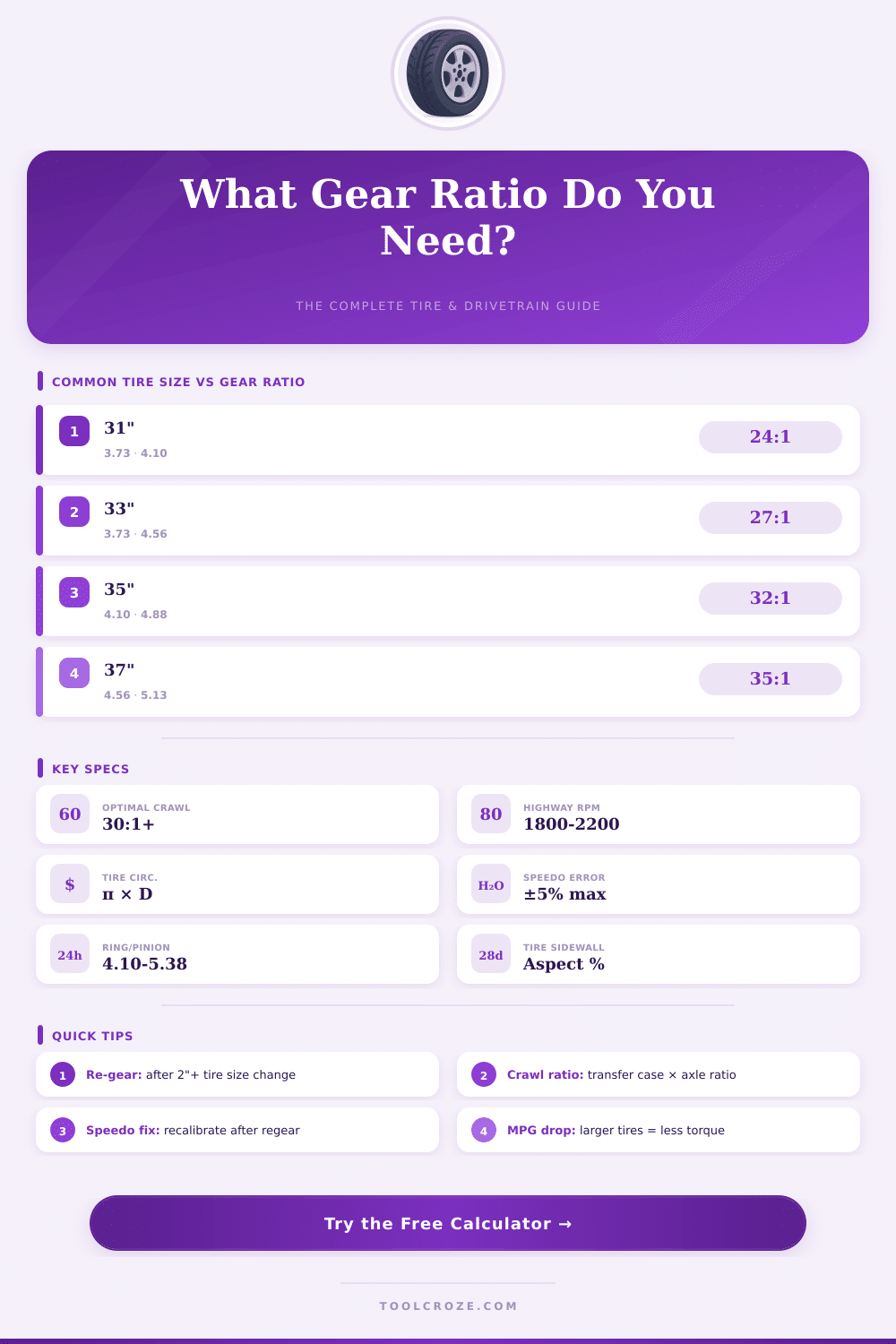
| Tire Diameter | Metric Equiv. | Rec. Gear (Highway) | Rec. Gear (Off-Road) | Rec. Gear (Rock Crawl) | Min. Crawl Ratio |
|---|---|---|---|---|---|
| 30" / P235/75R15 | 762 mm | 3.55 – 3.73 | 3.73 – 4.10 | 4.10 | 20:1 |
| 31" / 265/70R17 | 787 mm | 3.73 | 4.10 | 4.10 – 4.56 | 24:1 |
| 33" / 285/70R17 | 838 mm | 4.10 | 4.10 – 4.56 | 4.56 | 27:1 |
| 35" / 315/70R17 | 889 mm | 4.56 | 4.56 – 4.88 | 4.88 | 30:1 |
| 37" / 315/70R18 | 940 mm | 4.88 – 5.13 | 5.13 | 5.13 – 5.38 | 35:1 |
| 38" | 965 mm | 5.13 | 5.13 – 5.38 | 5.38 | 36:1 |
| 40" | 1016 mm | 5.38+ | 5.38+ | 5.38+ | 40:1 |
| 42" | 1067 mm | 5.38+ | 5.38+ | Custom | 45:1 |
| Transfer Case | Vehicle Fitment | Low Range | 4Lo Range | Crawl Ratio (w/ 4.10) | Notes |
|---|---|---|---|---|---|
| NP231 | Jeep YJ/TJ/XJ | 2.72:1 | Yes | 11.1:1 | Short input shaft |
| NP241 | Jeep TJ/ZJ | 2.72:1 | Yes | 11.1:1 | Common swap unit |
| NP242 | Jeep XJ/ZJ | 2.72:1 | Part-time | 11.1:1 | Full-time capable |
| NVG261 | GM trucks | 2.64:1 | Yes | 10.8:1 | Electronic shift |
| BW1354 | Ford F-150 | 2.48:1 | Yes | 10.2:1 | Electric shift |
| MP3024 | Ford Bronco/Ranger | 3.06:1 | Yes | 12.5:1 | GOAT modes |
| Rubicon T-case | Jeep JK/JL | 4.0:1 | Yes | 16.0:1 | Best stock crawl |
| Atlas (Aftermarket) | Universal | 4.3:1 | Yes | 17.6:1 | Premium upgrade |
| Metric Size | Width (mm) | Aspect | Rim (in) | OD (in) | OD (mm) | Circ. (in) |
|---|---|---|---|---|---|---|
| 205/75R15 | 205 | 75 | 15 | 27.1 | 689 | 85.2 |
| 225/75R16 | 225 | 75 | 16 | 29.3 | 744 | 91.9 |
| 235/75R15 | 235 | 75 | 15 | 28.9 | 733 | 90.6 |
| 245/75R17 | 245 | 75 | 17 | 31.5 | 800 | 98.9 |
| 265/70R17 | 265 | 70 | 17 | 31.6 | 803 | 99.3 |
| 285/70R17 | 285 | 70 | 17 | 32.7 | 831 | 102.7 |
| 305/70R18 | 305 | 70 | 18 | 34.8 | 883 | 109.1 |
| 315/70R17 | 315 | 70 | 17 | 34.4 | 874 | 108.0 |
| 35x12.50R17 | 317 | — | 17 | 35.0 | 889 | 110.0 |
| 37x13.50R17 | 343 | — | 17 | 37.0 | 940 | 116.2 |
When you lay bigger tire on car, that alters the gear reports on way. The report of the gear points how many times the shaft must twist so that the tire do one complete rotation. For instance, report of 3.73 wants to say that the shaft turns 3.73 times for every single rotation of the tire.
That affects the real power, the use of fuel, the revolutions of the engine and even the reading of the speedometer.
How Bigger Tires Change Gear Ratios
Big tire look great and help more well in open terrain, but they steal force. Tire with big diameter work like low back gear report. That results in less torque in low speed and lower revolutions of the engine for any given pace.
The engine ultimately struggles to reach higher speed. Moreover, broader tire strengthens the rolling drag, what hurts both the work and the fuel efficiency.
To make up the toll of power because of bigger tire, one can alter the gear in the differential. A simple formula helps to count the wanted new gear report. You take the new size of the tire, share it by the prior size, and later multiply by the current report.
For sample, if one passes from 31-inch tire to 35-inch with report of 3.42, one receives around 3.86. Because that precise report does not exist, the nearest option like 3.73 would work well.
Other sample applies the same idea, but vice versa. If one has gear of 4.10 and alter from 33-inch tire down to 28-inch, the calculation is 4.10 multiplied by 33 and divided by 28, what gives 4.83. So more little tire do that the gear act much more aggressively.
Charts of gear reports show, wear the size of tire runs along one axis and the reports along the second. Important cause for control is, does the pointed tire size is the real measured or only the listed of the maker. Tire marked as 37 inches can in truth rise only 35 inches.
For travel on highway and good fuel economy, stay around 2600 RPM works well. Everyday motion in city should be near 2800 RPM. For better dragging force or skill in low speeds, reports beside 3100 RPM work most.
The size of tire certainly does not leave the equation, although they are not gear. The report between the pinion and the ring gear stays same, whatever happens with the tire. But the real driving report, that truly matters for the feeling of the car, changes with the diameter of the tire.
If one swaps original 28-inch tire for 35-inch, that causes about 24.5 percent toll, because each inch differs about 3.5 percent. With original gear report of 4.9, new gear around 6.125 would be needed to make up. Having different sizes oftire can also stress the differentials, so everything must stay equal.