🪣 Log Splitter Tonnage Calculator
Calculate the exact splitting force needed for any wood species, log diameter, and moisture condition
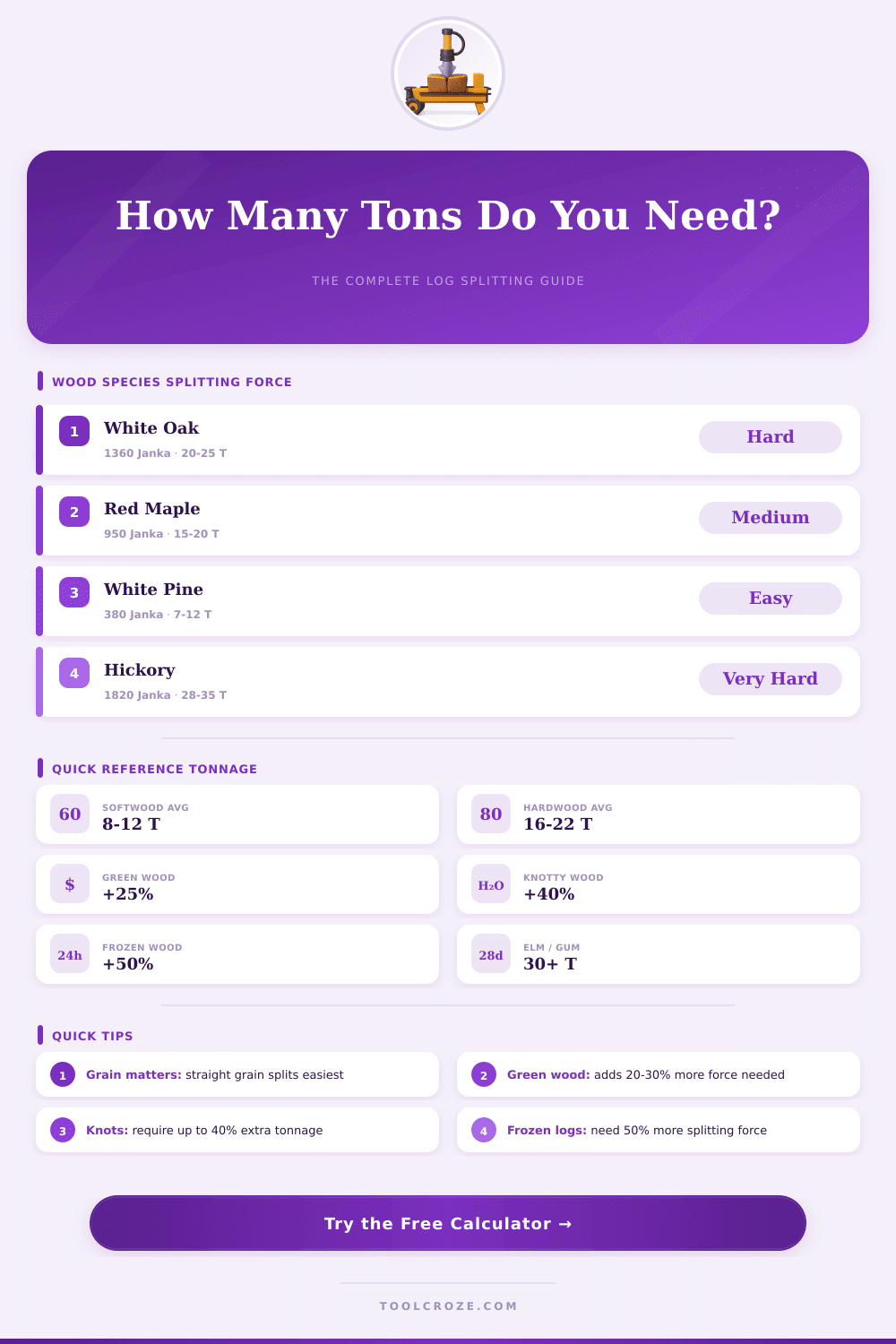
| Wood Species | Janka (lbf) | Base Tons (12" dia) | Base Tons (18" dia) | Green Wood Multiplier | Difficulty |
|---|---|---|---|---|---|
| Pine / Cedar / Spruce | 380–500 | 6–8 T | 10–14 T | 1.20x | Easy |
| Douglas Fir / Larch | 620–830 | 8–11 T | 13–18 T | 1.22x | Easy–Med |
| Ash | 830–1320 | 11–14 T | 17–22 T | 1.18x | Medium |
| Cherry | 950 | 12–15 T | 18–23 T | 1.20x | Medium |
| Birch | 1260 | 13–16 T | 19–24 T | 1.25x | Medium |
| Soft Maple | 700 | 10–13 T | 15–20 T | 1.20x | Medium |
| Red Oak | 1290 | 14–18 T | 20–26 T | 1.25x | Med–Hard |
| White Oak | 1360 | 15–20 T | 22–28 T | 1.28x | Hard |
| Hard Maple | 1450 | 16–21 T | 23–30 T | 1.28x | Hard |
| Black Walnut | 1010 | 13–16 T | 19–25 T | 1.22x | Medium |
| Black Locust | 1700 | 18–24 T | 25–33 T | 1.30x | Very Hard |
| Hickory / Pecan | 1820 | 20–26 T | 28–36 T | 1.30x | Very Hard |
| Elm (Interlocked) | 830 | 16–22 T | 24–32 T | 1.35x | Very Hard |
| Splitter Tonnage | Max Log Dia. | Best For | Engine / Motor | Cycle Time | Type |
|---|---|---|---|---|---|
| 4–6 Ton | 6–8" | Kindling, small softwood | Electric 1.5–2 HP | 10–14 sec | Electric |
| 7–10 Ton | 10–12" | Softwood, light hardwood | Electric 2–3 HP | 12–18 sec | Electric |
| 12–15 Ton | 14–16" | Hardwood, medium diameter | Gas 5–6.5 HP | 10–14 sec | Gas / Electric |
| 20–22 Ton | 18–20" | Most hardwoods | Gas 6.5–9 HP | 10–12 sec | Gas |
| 25–27 Ton | 22–24" | Large hardwood, oak, maple | Gas 9–12 HP | 9–11 sec | Gas |
| 30–35 Ton | 26–30" | Hickory, elm, large oak | Gas 12–18 HP | 8–10 sec | Gas / Hydraulic |
| 40+ Ton | 30"+ | Commercial, large burls | PTO / 18+ HP | 6–9 sec | PTO / Commercial |
| Condition | Multiplier | Typical MC% | Effect on Splitting | Notes |
|---|---|---|---|---|
| Seasoned / Dry | 1.00x | <20% | Baseline | Optimal splitting condition |
| Partially Dry | 1.15x | 20–25% | +15% force | Split soon or var dry further |
| Green / Fresh | 1.25x | 25–50% | +25% force | Fibers still bonded with moisture |
| Frozen | 1.50x | Any | +50% force | Ice bonds fibers — use caution |
| Straight Grain | 1.00x | — | Baseline | Splits cleanly along grain |
| Knotty | 1.35x | — | +35% force | Knots redirect grain unpredictably |
| Interlocked Grain | 1.60x | — | +60% force | Elm, sycamore notorious for this |
| Very Knotty / Burl | 1.80x | — | +80% force | May need chainsaw pre-cut |
| Project / Scenario | Log Size | Species | Recommended Tonnage | Logs/Hour Est. |
|---|---|---|---|---|
| Campfire Wood | 8–10" dia, 16" L | Pine / Fir | 7–10 T | 60–80 |
| Fireplace Hardwood | 12–16" dia, 18" L | Oak / Maple | 18–22 T | 35–50 |
| Wood Stove Splits | 10–14" dia, 16" L | Ash / Birch | 14–18 T | 40–60 |
| Large Cord Production | 16–24" dia, 16–20" L | Hickory / Oak | 25–35 T | 20–35 |
| Kindling & Starter | 4–6" dia, 12" L | Any softwood | 4–6 T | 80–120 |
| Elm / Interlocked | 14–18" dia, 18" L | Elm / Sycamore | 28–35 T | 15–25 |
The tonnage shows the force that the log splitter applies to the wood. The bigger it is, the stronger the push of the rams and the more well it will split big logs. Big hydraulic log splitters commonly have 20 to 30 tons, while little models stay between 4 and 6 tons.
The needed tonnage depends on the size, species and state of the wood that one splits. For logs with big diameter you need higher force. Logs of middle size, around 8 to 12 inches, require tonnage in the middle range.
How Much Tonnage Do You Need for a Log Splitter
For logs more than 12 inches you need heavy log splitters. For instance, a 28-ton model well works for heavy work, while a 22-ton version is enough for home needs.
The species of wood plays a big role also. Soft wood like pine or larch requires only little force. Ash and sweet chestnut split quite simply.
On the other hand, hard wood commonly requires more power. For instance, beech wood is widely very tough, especially if it is dry and requires at least 7 tons. Knotty bits from hard wood can need a 15-ton log splitter without big troubles.
Fresh wood, that recently was cut or not well dry, requires more force for splitting. Tonnage between 12 and 20 tons works for the most many cases. Too high rating of the tonnage can cause unnecessary costs, while too low rating slows the work.
There are guides about tonnage, that help to choose the right log splitter according to species and diameter of the wood. For ash, the hardness falls between 901 and 1500 pounds. When the biggest piece of ash has around 14 inches, you need a log splitter with at least 26 tons.
Big rounds from red oak, of 28 to 32 inches in diameter, can be handled by a 27-ton vertical log splitter.
Other times higher tonnage brings longer cycle however. A kinetic log splitter can cycle in around 3 seconds for straight-grain soft wood. Even a top hydraulic log splitter above 30 tons requires around 6 seconds for one cycle.
Between a 20-ton and 27-ton model the main difference is only a bigger hydraulic cylinder, while the rest stays the same.
A 4-inch cylinder usually gives 16 to 22 tons and works well for home use. A 4.5- or 5-inch cylinder more fits for work in the forest. At 3600 psi, a 4.5-inch cylinder reaches around 27 tons of force.
The frame of the log splitter must be quite strong to handle high tonnage. Heavy log splitters with 80 to 90 tons use two big I-beams stacked together too resist the pressure.
Most producers like to brag about there patterns on tonnage and cycle time. Nobody actually checks thoseratings genuinely. A 25-ton log splitter works ideally for a one- or two-person team and can handle difficult knotty bits from acacia without problems.