⚙️ V-Belt Pulley Size Calculator
Calculate driven pulley RPM, belt length, speed ratio, center distance & more for any V-belt drive system
| Section | Top Width | Depth | Angle | Min Pulley Dia | Max Speed (ft/min) | Typical HP Range |
|---|---|---|---|---|---|---|
| A | 0.50 in (13 mm) | 0.31 in (8 mm) | 40° | 3.0 in | 4,000 | Up to 10 HP |
| B | 0.66 in (17 mm) | 0.41 in (10 mm) | 40° | 5.0 in | 4,500 | Up to 25 HP |
| C | 0.88 in (22 mm) | 0.53 in (13 mm) | 40° | 7.0 in | 4,500 | Up to 75 HP |
| D | 1.25 in (32 mm) | 0.75 in (19 mm) | 40° | 12.0 in | 3,800 | Up to 150 HP |
| E | 1.50 in (38 mm) | 0.91 in (23 mm) | 40° | 16.0 in | 3,000 | Up to 250 HP |
| 3V | 0.38 in (10 mm) | 0.31 in (8 mm) | 40° | 2.65 in | 5,000 | Up to 15 HP |
| 5V | 0.63 in (16 mm) | 0.53 in (13 mm) | 40° | 4.4 in | 5,000 | Up to 75 HP |
| 8V | 1.00 in (25 mm) | 0.88 in (22 mm) | 40° | 8.0 in | 4,500 | Up to 600 HP |
| Application | Motor RPM | Output RPM | Ratio | Driver Dia (in) | Driven Dia (in) | Belt Section |
|---|---|---|---|---|---|---|
| Bench Lathe | 1725 | 600–1200 | 1.4:1–2.9:1 | 3–4 | 6–10 | A or B |
| Drill Press | 1725 | 250–3000 | 0.6:1–7:1 | 2–6 | 2–14 | A |
| Band Saw | 1725 | 800–1200 | 1.5:1–2.2:1 | 4–6 | 8–12 | A or B |
| Air Compressor | 1725 | 500–900 | 1.9:1–3.5:1 | 4–6 | 10–18 | B or C |
| HVAC Fan | 1725 | 700–1200 | 1.4:1–2.5:1 | 4–6 | 8–14 | A or B |
| Conveyor | 1725 | 50–400 | 4:1–35:1 | 3–6 | 12–24 | B or C |
| Centrifugal Pump | 1725 | 1000–1800 | 1:1–1.7:1 | 4–8 | 6–12 | B |
| Wood Planer | 3450 | 3000–4000 | 0.9:1–1.1:1 | 6–8 | 6–9 | B or C |
| Belt Number | Section | Outside Length (in) | Pitch Length (in) | Typical Application |
|---|---|---|---|---|
| A34 | A | 36 | 35.3 | Small lathes, drill presses |
| A42 | A | 44 | 43.3 | Bench grinders, small fans |
| A48 | A | 50 | 49.3 | Drill presses, small compressors |
| A60 | A | 62 | 61.3 | Medium lathes, band saws |
| B35 | B | 38 | 36.8 | Medium duty fans |
| B46 | B | 49 | 47.8 | Lathes, pumps |
| B68 | B | 71 | 69.8 | Air compressors, conveyors |
| B90 | B | 93 | 91.8 | Large compressors, heavy fans |
| C51 | C | 55 | 53.9 | Industrial pumps, compressors |
| C75 | C | 79 | 77.9 | Large industrial drives |
Choosing the right size of v belt pulley is very important during the setup of any system with belt drives. One of the main things to consider is the profile of the belt. It relates to the shape and the size of the belt that one uses together with the pulley.
Pulleys for V-belts, that one also calls sheaves, work with belts in various setups to send power. They come in several kinds, for instance tight idlers and pulleys for variable speed. The angles and sizes of the grooves in the sheaves, together with the gaps of the faces for multi-belt drives all need precise limits, that one must follow.
How to Measure and Choose a V Belt Pulley
During the measurement of a v belt pulley, the main things to check are the diameter, the groove and the pitch. Both the outer diameter of the pulley and the gap of the outer groove matter a lot. Also the size of the central hole for the shaft plays a role.
Like this one can describe a pulley as something around 6 inches in diameter, with a certain gap of the groove and a set size for the shaft holder. One measures the pitch diameter from the center of the belt on one side, through the center of the pulley, to the other side of the belt. For belts that rest on the bottom of the groove, that matches to the root diameter plus the thikness of the belt.
One must also take the whole gap of the pulley as a measure. In most cases it shows what type or series of belts you use. Accuracy helps if one keeps the tools straight to the surface during the measurement.
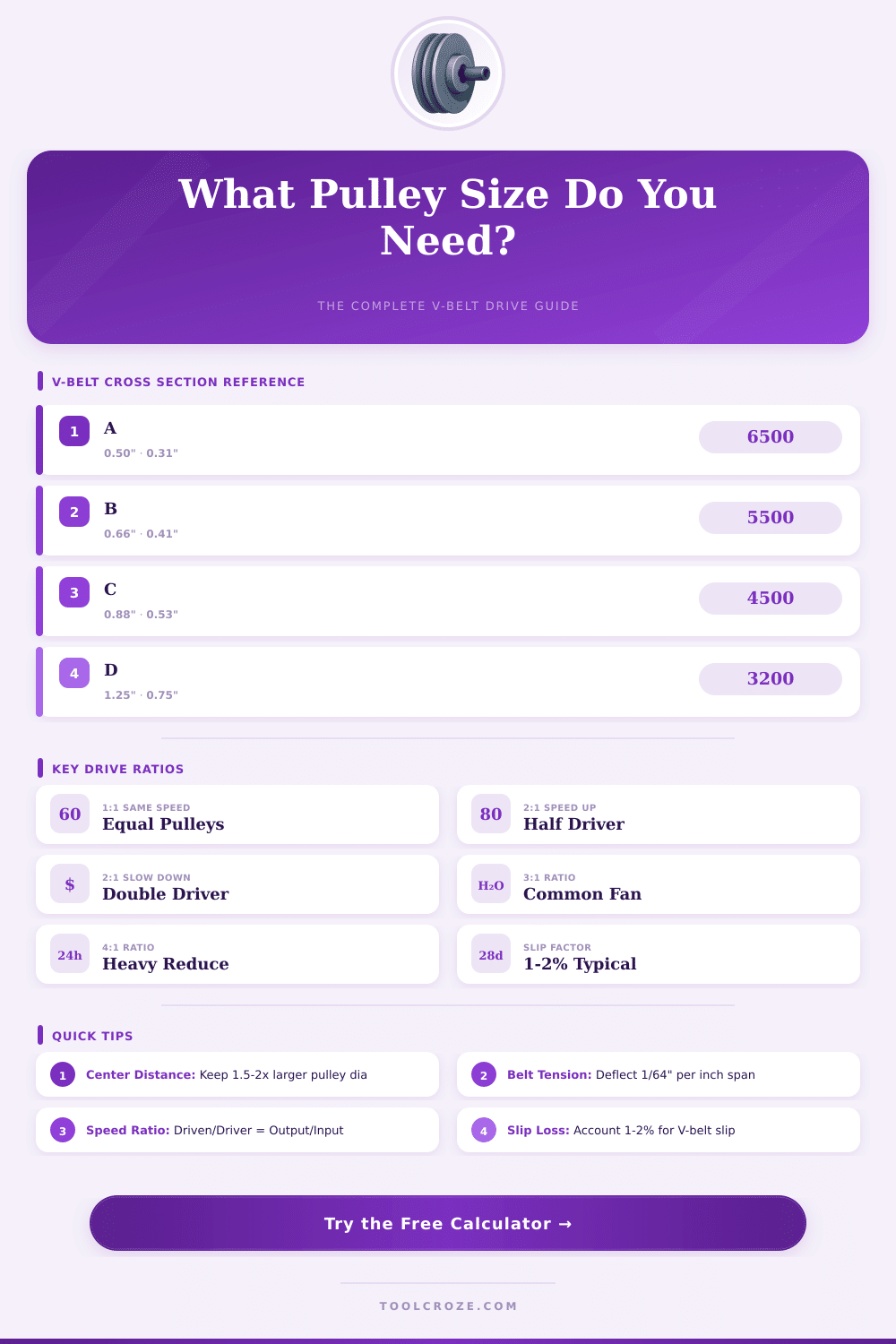
The standard sizes for V-belts are A, B, C, D and E. A-belt has a width of half inch and depth of 5/16 inches. B-belt measures 21/32 inches in width and 13/32 in depth. C-belts are 7/8 inches wide.
Classic V-belts for smaller horsepower machines, like those in woodworking, usually come in sizes 3L and 4L. The 3L measures 3/8 inches wide and is not very commonly used. The 4L is the most common of them.
A simple way to find the diameter of a pulley is to wrap string flat around the flat part, wear the belt sits. Mark the spot where it crosses, measure the length and divide it by 3.14. Like this one finds the diameter.
The angle of the groove in a pulley ranges between 34 and 38 degrees, depending on the pitch diameter, and this angle stays the same no matter the size of the belt used.
Also the length of the belt matters. There is a formula that counts the difference between the diameters of the pulleys and the distance between them. It works especially well when one pulley is much bigger than the other.
Also, good to know that the real length of a belt can differ from the listed size. For instance, an A-35 belt is really 33 inches. Smaller diameters of pulleys can be rough and harder for the system, sobigger pulleys commonly send power more effectively.