⚡ AC Motor HP Calculator
Calculate horsepower, kilowatts, and full-load current for single-phase and three-phase AC motors
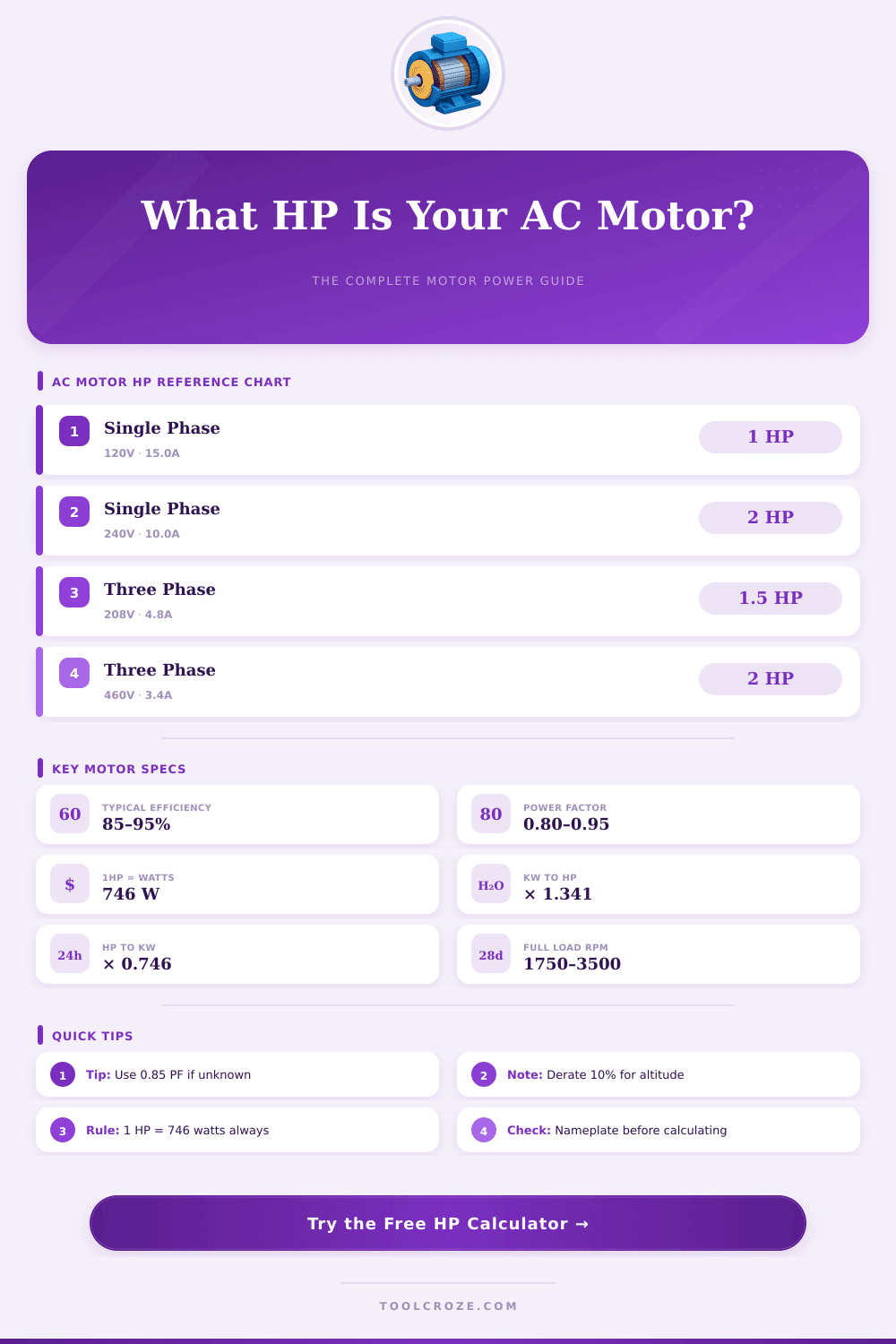
| HP Rating | 1-Ph 120V (A) | 1-Ph 240V (A) | 3-Ph 208V (A) | 3-Ph 460V (A) | 3-Ph 480V (A) |
|---|---|---|---|---|---|
| 1/4 HP | 5.8 | 2.9 | 1.1 | 0.5 | 0.5 |
| 1/3 HP | 7.2 | 3.6 | 1.4 | 0.6 | 0.6 |
| 1/2 HP | 9.8 | 4.9 | 2.2 | 1.0 | 1.0 |
| 3/4 HP | 13.8 | 6.9 | 3.2 | 1.5 | 1.5 |
| 1 HP | 16.0 | 8.0 | 4.6 | 2.1 | 2.0 |
| 1.5 HP | 20.0 | 10.0 | 6.6 | 3.0 | 2.9 |
| 2 HP | 24.0 | 12.0 | 7.5 | 3.4 | 3.3 |
| 3 HP | 34.0 | 17.0 | 10.6 | 4.8 | 4.7 |
| 5 HP | 56.0 | 28.0 | 16.7 | 7.6 | 7.4 |
| 7.5 HP | 80.0 | 40.0 | 24.2 | 11.0 | 10.7 |
| 10 HP | 100.0 | 50.0 | 30.8 | 14.0 | 13.5 |
| 15 HP | — | — | 46.2 | 21.0 | 20.3 |
| 20 HP | — | — | 59.4 | 27.0 | 26.3 |
| 25 HP | — | — | 74.8 | 34.0 | 33.1 |
| 30 HP | — | — | 88.0 | 40.0 | 38.9 |
| Motor Type / Application | Typical Eff. % | Typical PF | Voltage Range | HP Range |
|---|---|---|---|---|
| Standard Induction (NEMA B) | 85 – 91 | 0.82 – 0.88 | 115–460V | 0.25 – 500 |
| Premium Efficiency (IE3) | 91 – 96 | 0.86 – 0.92 | 208–480V | 1 – 500 |
| Inverter Duty (VFD) | 90 – 95 | 0.85 – 0.95 | 208–480V | 0.5 – 250 |
| Capacitor Start (CSR) | 72 – 85 | 0.75 – 0.85 | 115–230V | 0.125 – 10 |
| PSC (HVAC Blower) | 55 – 70 | 0.70 – 0.80 | 115–230V | 0.1 – 2 |
| Servo / Brushless DC | 90 – 97 | 0.90 – 0.99 | 48–480V | 0.1 – 100 |
| Explosion-Proof Motor | 84 – 93 | 0.82 – 0.90 | 230–460V | 0.5 – 75 |
| Single-Phase Split-Phase | 60 – 75 | 0.70 – 0.80 | 115V | 0.05 – 0.5 |
| HP | kW (Output) | Watts | kVA (0.85 PF) | Typical Application |
|---|---|---|---|---|
| 1/8 HP | 0.093 | 93 | 0.110 | Small fans, pumps |
| 1/4 HP | 0.186 | 186 | 0.219 | Sump pumps, small tools |
| 1/2 HP | 0.373 | 373 | 0.439 | Drill press, band saw |
| 3/4 HP | 0.559 | 559 | 0.658 | Lathe, bench grinder |
| 1 HP | 0.746 | 746 | 0.878 | Table saw, air compressor |
| 1.5 HP | 1.119 | 1119 | 1.317 | Router, shop vac |
| 2 HP | 1.492 | 1492 | 1.755 | Pool pump, jointer |
| 3 HP | 2.238 | 2238 | 2.633 | Air compressor, planer |
| 5 HP | 3.730 | 3730 | 4.388 | Industrial lathe, mill |
| 7.5 HP | 5.595 | 5595 | 6.582 | CNC router, hydraulic pump |
| 10 HP | 7.460 | 7460 | 8.776 | Large compressor, conveyor |
| 15 HP | 11.190 | 11190 | 13.165 | Industrial equipment |
| 20 HP | 14.920 | 14920 | 17.553 | Large pump, blower |
AC Motor receive his power in horsepower or HP, what is simply rating of the work, that the AC Motor can produce. Here the main point: that horsepower adjusts at the same time with the revolutions in minute of the AC Motor. At higher pace it delivers more power.
Understand the tie between HP and RPM is key when one chooses the right AC Motor for any task, that one plans.
AC Motor Power and Speed
1 HP for AC Motor match around 750 watts. They come in two types: single-phase and three-phase. Single-phase AC Motor of 1 HP spin at 1500 RPM or 3000 RPM, depending on the model and the voltage, that usually falls between 110V, 220V, 230V and 240V, with frequency of 50 or 60 Hz.
Interesting fact is, that some of those single-phase induction AC Motor use two capacitors… One for starting and another for running, to ensure, that they start and run without problems.
For three-phase AC Motor the calculation of power works like this: voltage multiplied by amps, multiplied by power factor, and then multiplied by 1.732. That formula one can reverse to find the amps, if one already knows the other values. When the voltage drops, the AC Motor must take more current to mantain the same power, that makes sense when one thinks about it.
From here the ratings of HP only grow. And 2 HP and 2.5 HP AC Motor follow the same line between power and pace. AC Motor of 2 HP, that runs at 115V or 230V, can handle heavy tasks and install without knead of a professional.
Later comes the 3 HP single-phase AC Motor (some jobs need it), for instance running a rebuilt pump; but really, finding a good single-phase at that size is not always simple.
Half horsepower AC Motor, so we talk about around 374 watts, work more well in small sizes. If the line frequency is 50 Hz and the AC Motor has four poles, it reaches top power at around 1440 RPM. The smallest AC Motor, half HP and below, depend on only one capacitor, that helps both starting and running.
Here something, what commonly confuses folks: technically 746 watts match 1 HP, but that counts only for a perfect AC Motor at absolute maximum output. In real life AC Motor never reach that, so they use more energy than the math points. Also, multiplying amps by voltage does not give watts for AC devices like AC Motor, the power factor adds error in that equation.
Many folks confuse HP with torque, but here everything gets interesting. Most loads depend on torque, not on whole horsepower. HP is only short way for a certain torque rotation at a certain pace.
Lowering the frequency of an AC Motor slows it, and the HP adjusts together with it by definition. AC Motor of 1 HP can produce big torque, if it spins slowly. Standard AC Motor under 3 HP arealmost always better than custom, because they come in standard sizes and replacements are easy to find.