⚙️ V-Belt Length Calculator
Calculate exact v-belt pitch length, speed ratio, wrap angle, and belt section recommendation for any two-pulley drive system.
| Section | Top Width (in) | Depth (in) | Angle (°) | Min. Pulley Dia. (in) | Max HP Rating | Typical Use |
|---|---|---|---|---|---|---|
| 3L | 0.375 | 0.250 | 40 | 2.0 | 1.0 | Small appliances, light tools |
| 4L | 0.500 | 0.313 | 40 | 2.5 | 2.5 | Lawn mowers, small fans |
| 5L | 0.625 | 0.406 | 40 | 3.0 | 5.0 | Washing machines, drills |
| A (4L) | 0.500 | 0.313 | 40 | 3.0 | 2.0 | Bench grinders, light drives |
| B (5L) | 0.656 | 0.406 | 40 | 5.0 | 5.0 | Table saws, drill presses |
| C | 0.875 | 0.531 | 40 | 7.0 | 15.0 | Industrial fans, pumps |
| D | 1.250 | 0.750 | 40 | 12.0 | 40.0 | Heavy conveyors, large pumps |
| E | 1.500 | 0.906 | 40 | 16.0 | 75.0 | Very heavy industrial drives |
| Belt Section | Optimal Belt Speed (FPM) | Max Belt Speed (FPM) | Typical HP Range | Recommended SFM Range |
|---|---|---|---|---|
| 3L / 4L | 2500–3500 | 4500 | 0.5 – 2.5 | 2000–4000 |
| 5L / A | 3000–4000 | 5000 | 1 – 5 | 2500–4500 |
| B | 3500–4500 | 5500 | 2 – 10 | 3000–5000 |
| C | 3500–4500 | 5500 | 5 – 25 | 3000–5000 |
| D | 3000–4000 | 4500 | 15 – 60 | 2500–4500 |
| E | 2500–3500 | 4000 | 40 – 100+ | 2000–4000 |
| Section | Belt Number | Outside Length (in) | Pitch Length (in) | Common Application |
|---|---|---|---|---|
| A | A26 | 28 | 27.3 | Small bench tools |
| A | A34 | 36 | 35.3 | Bench grinders |
| A | A42 | 44 | 43.3 | Drill presses |
| B | B40 | 43 | 41.8 | Table saws |
| B | B52 | 55 | 53.8 | Bandsaws, jointers |
| B | B68 | 71 | 69.8 | Lathes, larger drives |
| C | C60 | 63 | 61.9 | Industrial pumps |
| C | C80 | 83 | 81.9 | Large fans, blowers |
| D | D90 | 93 | 91.9 | Heavy conveyors |
| Machine | Belt Section | Typical Driver Dia. (in) | Typical Driven Dia. (in) | Speed Ratio | Approx. Center (in) |
|---|---|---|---|---|---|
| Bench Grinder | A | 3.0 | 3.0 | 1:1 | 10–14 |
| Table Saw | B | 4.0 | 8.0 | 2:1 | 14–20 |
| Bandsaw | B | 4.0 | 10.0 | 2.5:1 | 16–22 |
| Drill Press | A | 2.0–5.0 | 2.0–5.0 | Variable | 9–13 |
| Lathe | B | 5.0 | 12.0 | 2.4:1 | 18–24 |
| Air Compressor | A/B | 2.0 | 8.0 | 4:1 | 10–16 |
| Centrifugal Pump | C | 8.0 | 12.0 | 1.5:1 | 22–30 |
| Industrial Fan | C/D | 10.0 | 16.0 | 1.6:1 | 24–36 |
Get the right length of v-belt is really important. When the v-belt is too short or too long then everything simply will not work well. There are several ways to measure the right length, and that helps to explain what hides behind the numbers on the v-belt.
The most exact method for measuring v-belt is to use a special tool for v-belt measures or a flexible tape. A steel tape measure or simple line does not give good results, because they do not bend around the v-belt. Also, one can wrap a small string around the v-belt and later measure it.
How to Measure the Right V-Belt Length
A cloth tape measure works well, because it can curve to follow the shape of the v-belt and give a more exact value, even down to fractions.
The length of a v-belt can get different names. It can be outer length, working length or pitch length. The outer length measures around the outside of the v-belt without any tension, but it only gives a rough guess and does not really help for choosing the right v-belt.
To reach the data length, one takes away a certan value from the outer length. For instance, if the outer length is 1518 mm, one takes away 18 to get a data length of 1500, which gives the part number SPA 1500.
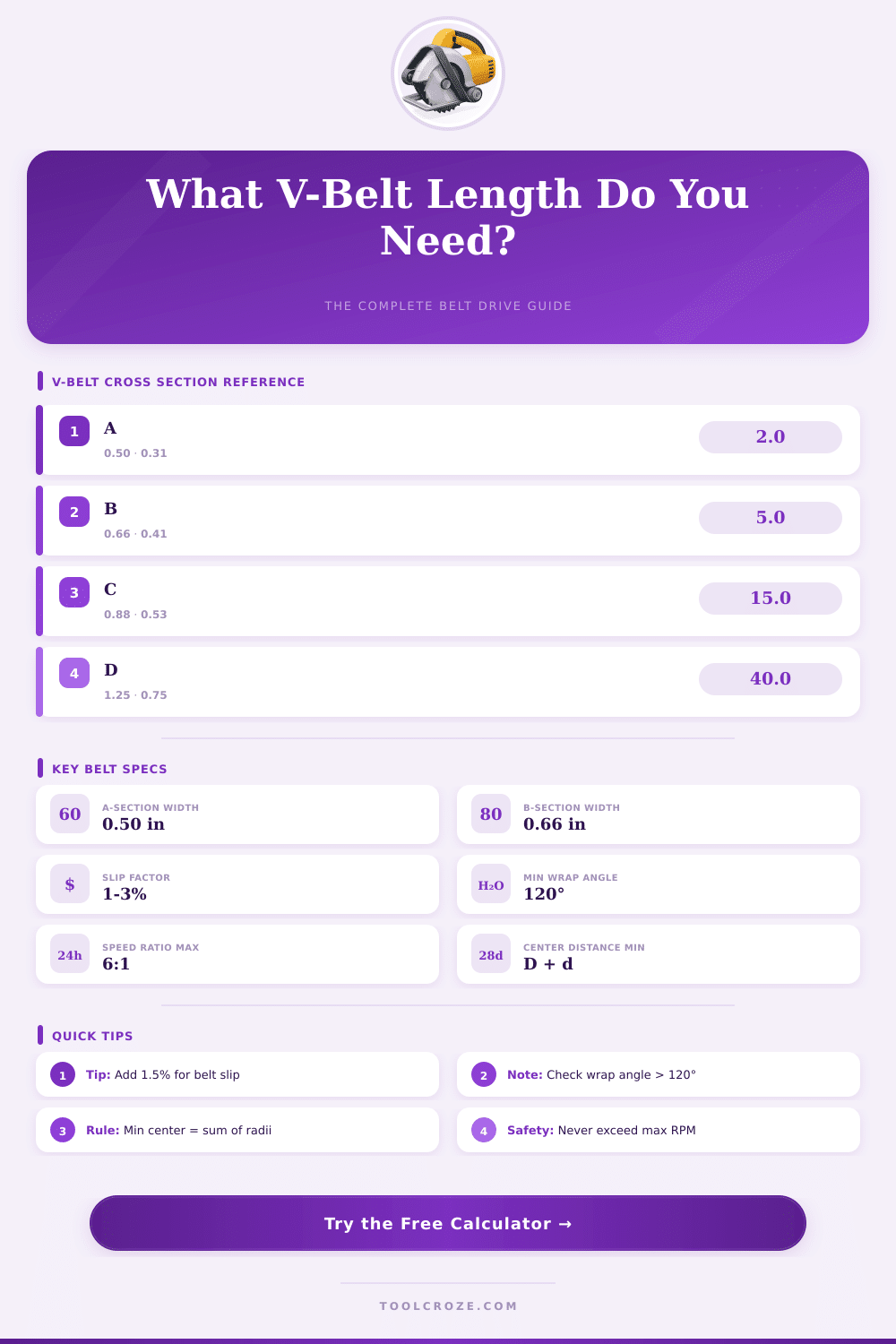
When one measures a v-belt along the outside with a tape measure, count some general rules. For A-belt, take away 2. For B-belt, take away 3.
For C-belt, take away 4. That fix helps, because the real working length differs from the outer measure.
There are charts for sizes of v-belts, that show the top width, the height and how to find the part number. One finds hear sizes for A, B, 3VX and 5VX v-belts, together with working lengths for many types of v-belts. For instance, the part number 5V500 shows a top width of 5/8 inches with outer length of 50.0 inches.
The classic A v-belt has a half-inch width and is the most used kind here.
One can also see a v-belt marked with AX. The X shows that it has a toothed design with cuts in the shape of teeth. This toothed shape helps to send more energy and is used more often in factory machines, because it costs more.
Online tools can be useful too. One enters the center distance between pulleys, the width of the big pulley and that of the other pulley, and the tool finds the length of the v-belt. Using a tool like the Browning Belt Rule is the simplest way to find the length of the v-belt.
It is also important to first find the cross section type and if the v-belt is spiral or toothed, before finding the length. When all threedetails are right, the new v-belt will certainly work well.