🔥 Nichrome Wire Gauge Calculator
Calculate resistance, current, wattage & wire length for nichrome heating elements
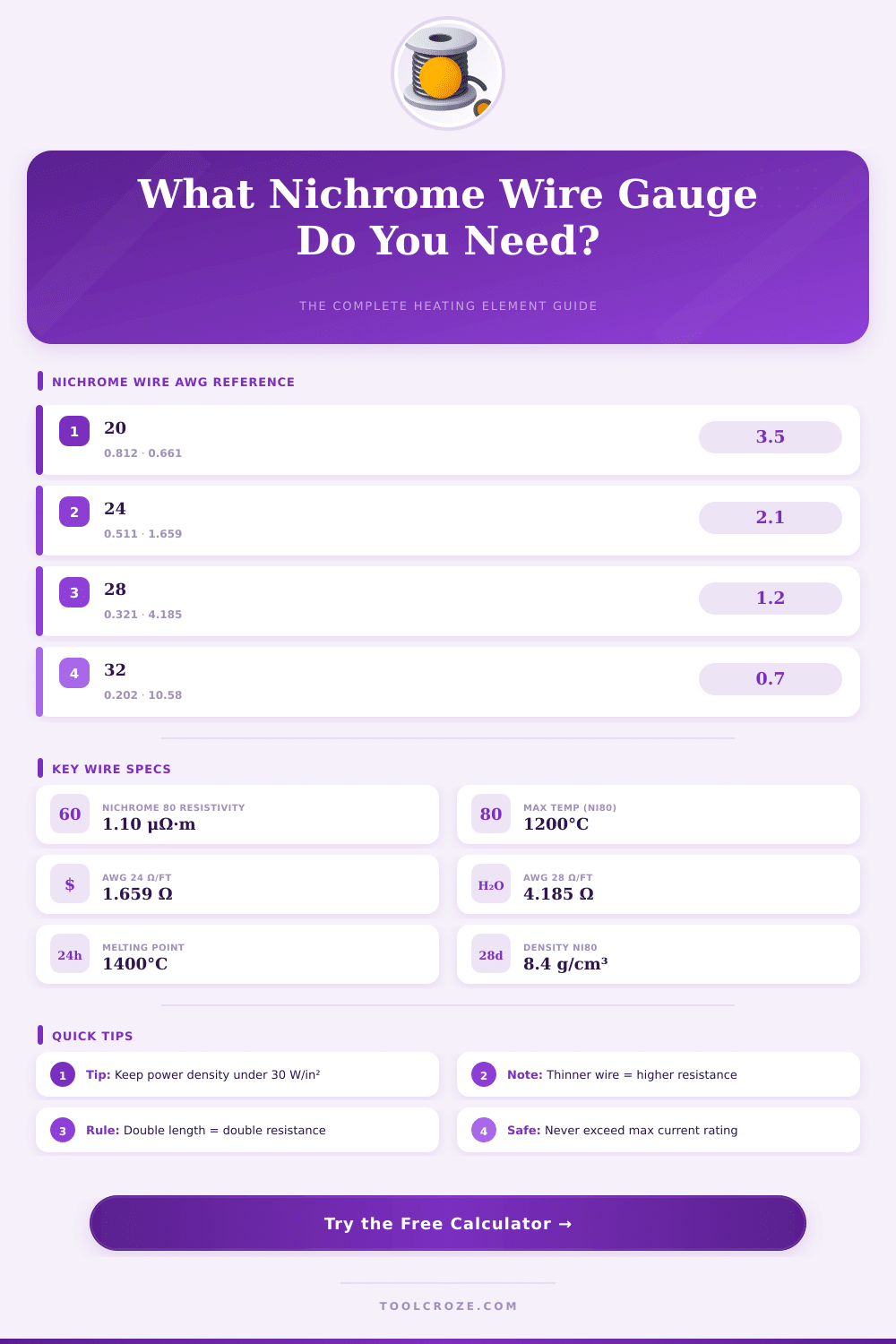
| AWG | Dia (mm) | Dia (in) | Ω/ft (Ni80) | Ω/m (Ni80) | Max Current (A) | Cross Section (mm²) |
|---|---|---|---|---|---|---|
| 18 | 1.024 | 0.0403 | 0.413 | 1.355 | 5.5 | 0.823 |
| 20 | 0.812 | 0.0320 | 0.661 | 2.169 | 3.5 | 0.518 |
| 22 | 0.644 | 0.0253 | 1.051 | 3.448 | 2.5 | 0.326 |
| 24 | 0.511 | 0.0201 | 1.659 | 5.443 | 2.1 | 0.205 |
| 26 | 0.405 | 0.0159 | 2.654 | 8.707 | 1.5 | 0.129 |
| 28 | 0.321 | 0.0126 | 4.185 | 13.73 | 1.2 | 0.0810 |
| 30 | 0.255 | 0.0100 | 6.651 | 21.82 | 0.86 | 0.0510 |
| 32 | 0.202 | 0.0080 | 10.58 | 34.72 | 0.53 | 0.0320 |
| 36 | 0.127 | 0.0050 | 26.80 | 87.93 | 0.28 | 0.0127 |
| Alloy | Resistivity (μΩ·m) | Max Temp (℃) | Density (g/cm³) | TCR (ppm/℃) | Melting Pt (℃) |
|---|---|---|---|---|---|
| Nichrome 80 (Ni80Cr20) | 1.10 | 1200 | 8.40 | 110 | 1400 |
| Nichrome 60 (Ni60Cr16) | 1.18 | 1000 | 8.25 | 150 | 1350 |
| Nichrome 90 (Ni90Cr10) | 1.00 | 1000 | 8.72 | 200 | 1420 |
| Kanthal A1 (FeCrAl) | 1.39 | 1400 | 7.10 | 50 | 1500 |
| Kanthal D (FeCrAl) | 1.35 | 1300 | 7.10 | 50 | 1500 |
| Stainless 316L | 0.75 | 750 | 8.00 | 1060 | 1375 |
| Titanium Grade 1 | 0.56 | 600 | 4.51 | 3800 | 1668 |
| Application | Typical Voltage | Typical Wattage | Recommended AWG | Alloy |
|---|---|---|---|---|
| Foam Cutter (DIY) | 9–12V DC | 5–20W | 24–28 AWG | Ni80 |
| Vape/E-Cig Coil | 3–4.2V | 20–80W | 24–32 AWG | Ni80, Kanthal A1 |
| Toaster Element | 120/240V AC | 600–1200W | 20–24 AWG | Ni80 |
| Heat Gun Element | 120/240V AC | 1000–2000W | 18–22 AWG | Ni80 |
| 3D Printer Bed | 12/24V DC | 60–200W | 20–24 AWG | Kanthal A1 |
| Lab/Hobby Kiln | 120/240V AC | 500–3000W | 18–22 AWG | Kanthal A1 |
| Soldering Iron Tip | 12–24V DC | 30–65W | 22–26 AWG | Ni80 |
| Water Heater Immersion | 120/240V AC | 1000–4500W | 18–20 AWG | Ni60 |
Nichrome wire comes in many kinds of thicknesses, and choosing the right one depends much on the use, for what it will serve. The rating points to the diameter but matter to know, that Standard Wire Gauge and American Wire Rating are two separate systems. They do not match hence always check, that one you mean to mention.
Nichrome wire is available in 40 to 14 ratings. Spools offer various lengths, for instance 10 feet, 30 feet, 100 feet, 250 feet, or even quarter-pound or one-pound rolls. Some stores deliver same day or the next day, what helps for urgent jobs.
How to Choose the Right Nichrome Wire
One usual type, Nichrome 80 resistance wire, is availabel in 36 rating on 250-foot roll. Extra option is 14 AWG Nichrome 80 wire in 100-foot length with diameter of 0.0641 inches.
For cutting tables with warm wire for foam, 28 rating nichrome wire is commonly used. The Proxxon foam knife indeed includes 32 rating wire, but changing to 28 rating extends the life while accuracy stays. Nichrome wire works for foam cutting, because it makes heat by means of electrical resistance.
Some users test different thicknesses and currents using an old computer power supply too strip, what best cuts the foam.
Slim ratings like 34 or 36 heat up soon with little energy. A heavy bit of such thin wire can reach enough heat from a simple 9-volt battery. On the other hand, 14 rating wire is more thick and has low resistance, around 0.2 ohms for a short bit, what makes it good for warm elements, that need firmness.
Nichrome 80 keeps its form well and stays solid even after many uses. For warm coils, one usually suggests ratings between 18 and 22. 20 AWG Nichrome 80 wire shows resistance of 0.635 ohms each foot. Longer bits of heavy ratings like 27 or 28 lower the surface heat and help to protect insulation against damage over time.
An online calculator makes this easier. Simply enter the length and thickness of the wire between 10 and 40 ratings, and the program figures out resistance, energy, electricity and voltage. Choose the right rating in the end is all about matching the resistance to the power source and the distance, that it will cover.
Nichrome wire is wrapped in coils to reach wanted resistance, while electricity passes through it to make heat. Type A and Type C are common kinds of nichrome coils, and the material has high meltingpoint together with good resistance against rust.