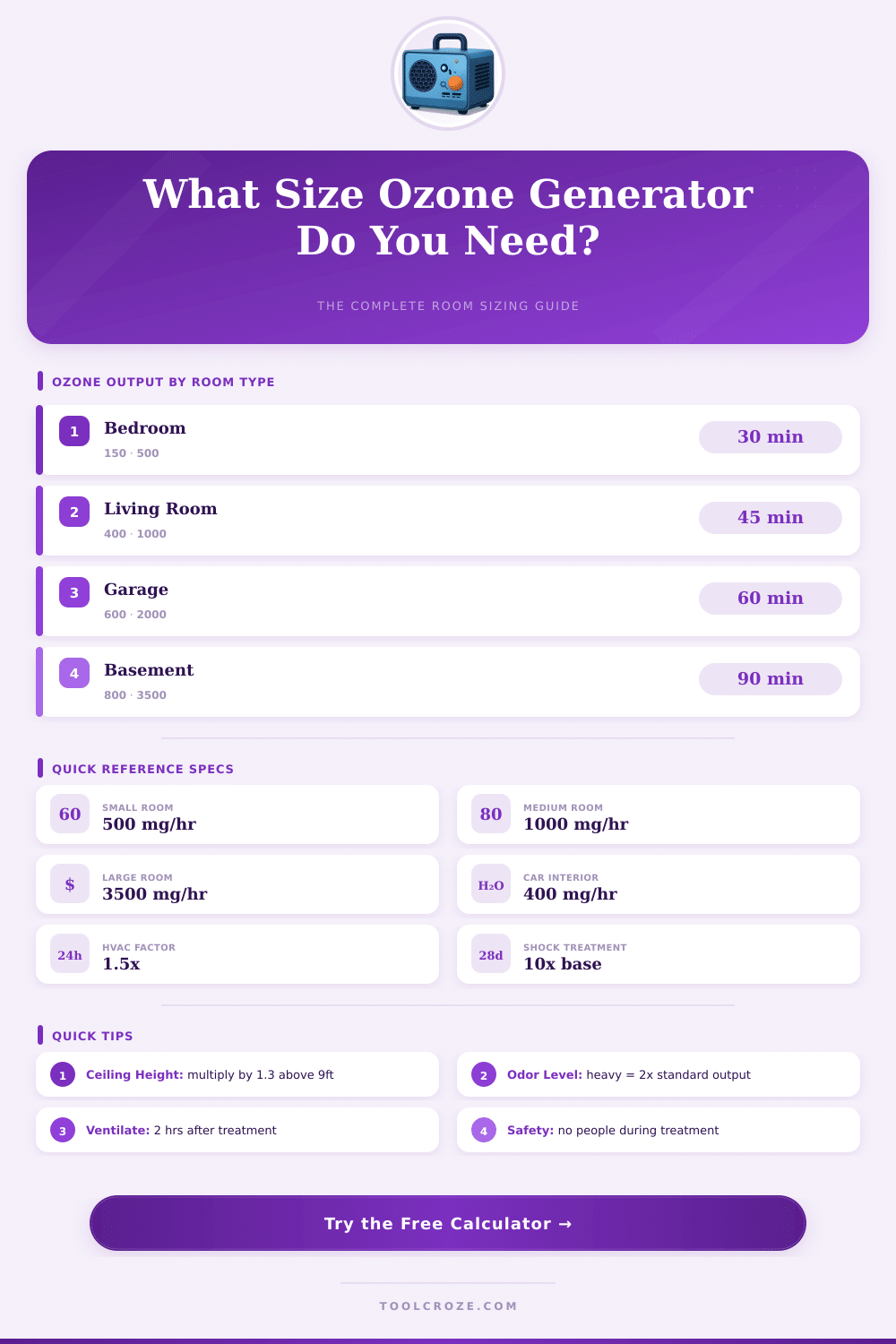
🌬️ Ozone Generator Size Calculator
Find the correct ozone output (mg/hr) for any room, vehicle, or application based on volume, odor level, and treatment type.
| Room Type | Sq Ft (approx) | Volume (ft³) | Light Odor (mg/hr) | Moderate Odor (mg/hr) | Heavy Odor (mg/hr) |
|---|---|---|---|---|---|
| Bathroom | 50 | 400 | 200 | 400 | 1,000 |
| Small Bedroom | 120 | 960 | 400 | 1,000 | 2,500 |
| Master Bedroom | 200 | 1,600 | 600 | 1,500 | 4,000 |
| Living Room | 350 | 2,800 | 1,000 | 2,500 | 7,000 |
| Open Plan Living | 600 | 4,800 | 1,500 | 4,000 | 10,000 |
| Garage (1-car) | 250 | 2,500 | 800 | 2,000 | 5,000 |
| Garage (2-car) | 500 | 5,000 | 1,500 | 3,500 | 9,000 |
| Basement | 800 | 6,400 | 2,000 | 5,000 | 12,000 |
| Car Interior | 30 | 120 | 200 | 400 | 1,000 |
| Restaurant Kitchen | 400 | 3,200 | 1,000 | 3,000 | 8,000 |
| Hotel Room | 300 | 2,400 | 800 | 2,000 | 5,000 |
| Office Space | 500 | 4,000 | 1,200 | 3,000 | 7,000 |
| Generator Class | Output (mg/hr) | Max Room Size (ft³) | Typical Use | Treatment Duration | Notes |
|---|---|---|---|---|---|
| Portable Mini | 200–500 | 500 | Car, bathroom, closet | 15–30 min | Low power draw |
| Residential Small | 500–1,000 | 1,200 | Bedroom, small rooms | 30–60 min | Common household |
| Residential Medium | 1,000–3,500 | 4,000 | Living room, apartment | 45–90 min | Good for mold |
| Residential Large | 3,500–7,000 | 8,000 | Full home, basement | 60–120 min | Shock treatment capable |
| Commercial Small | 7,000–15,000 | 18,000 | Office, restaurant | 60–180 min | Industrial quality |
| Commercial Large | 15,000–40,000 | 50,000 | Warehouse, large facility | 120–360 min | Pro remediation |
| HVAC Inline | 100–500 | N/A | Continuous duct treatment | Continuous | Sized per CFM |
| Odor / Contamination | Factor (x base) | mg/hr per ft³ | Examples | Min. Time |
|---|---|---|---|---|
| Light Maintenance | 0.5x | 0.4–0.6 | Mild mustiness, stale air | 20–30 min |
| Moderate Odor | 1.0x | 0.8–1.2 | Pet, food, light smoke | 45–60 min |
| Heavy Odor | 2.5x | 2.0–3.5 | Strong smoke, mold, fire | 60–120 min |
| Shock Treatment | 5–10x | 5.0–10.0 | Fire/flood remediation | 120–360 min |
| Vehicle Interior | 0.8x | 0.8–2.0 | Smoke, pet, food spill | 30–90 min |
| Fully Carpeted Room | 1.4x | 1.2–2.0 | Carpet absorbs ozone faster | 60–90 min |
| Crawlspace / Attic | 1.5x | 1.5–3.0 | Mold, rodent odor | 60–120 min |
| HVAC Continuous | 0.05x | 0.03–0.08 | Inline duct purification | Continuous |
Standard formulas assume 8 ft ceilings. For every additional foot of ceiling height above 8 ft, multiply your calculated mg/hr by 1.12. Vaulted ceilings (12+ ft) can require 50–60% more ozone output than a flat-ceiling room of the same floor area.
Ozone is consumed by organic materials — carpets, upholstery, drapery, and wood all absorb O3 faster than bare walls. A fully furnished room typically requires 30–50% more output than an empty room of the same volume. Always add a contents buffer when sizing your generator.
| Scenario | Room / Volume | Odor Level | Recommended (mg/hr) | Treatment Time | Ventilation After |
|---|---|---|---|---|---|
| Car smoke removal | 120 ft³ | Heavy | 400–600 | 60 min | 2 hrs |
| Bedroom musty smell | 960 ft³ | Moderate | 1,000 | 60 min | 2 hrs |
| Pet odor — living room | 2,800 ft³ | Moderate | 2,500 | 90 min | 2–3 hrs |
| Mold remediation — basement | 6,400 ft³ | Heavy | 12,000–15,000 | 120 min | 4 hrs |
| Fire restoration — house | 15,000 ft³ | Shock | 30,000+ | 240 min | 8 hrs |
| Hotel room turnover | 2,400 ft³ | Moderate | 2,000 | 30 min | 1.5 hrs |
| Restaurant after-hours | 3,200 ft³ | Heavy | 5,000 | 90 min | 3 hrs |
| Storage unit mold | 2,000 ft³ | Heavy | 4,000 | 90 min | 3 hrs |
Election of apt ozone generator is not easy task, and probably that depends on that, that different makers use various units. Some talk about parts per million, others mention grams per hour, or even percentages and grams per cubic metre. If there existed a universal standard for estimating the product, comparing uses and counting what one truly requires would become much more simple, no more guesswork.
What truly matters is the size of the space that you address. Choosing a generator according to the surface of your room will ensure that enough ozone moves in the air. The ideal seems to be about 10 000 mg of ozone per hour for every 100 square metres.
How to Choose the Right Ozone Generator
A machine with more power will end the task more quickly in the same space than one with less force.
Various models answer for different cases. There is one that produces under 10 000 mg per hour, good for shock treatment in spaces less than 1 000 square feet, although the ozone reach goes up to around 3 000 square feet. Another, stronger, puts out around 15 000 mg per hour and covers shock up to 1 500 sqaure feet, with reach up to about 4 500 square feet.
Both have the same physical size, 15 by 5 by 5 inches (and weigh around 11 pounds).
Here is something odd about the function of those devices: they do not create ozone from nothing in poor air. They actually convert oxygen into ozone. The problem is that after conversion of all surrounding air the production drops.
You could end up with a dense cloud of ozone right beside the machine, while the distant corner of the room stays with a lot of unaffected oxygen floating. Moving the ozone generator to a central position, maybe three or four feet high, helps spread it equally and ensures good air flow.
Ozone does not stay forever, and that is actually a good thing. Its half life is usually under 30 minutes, because of changes in temperature, dust particles and other elements in the air. It does its role, then breaks down into normal oxygen.
Hence shorter sessions work better then long marathons. Too much ozone flooding the space can cause harm, you will end with a smell worse than before. Sessions of 10 to 20 minutes, according to size of the room, most commonly succeed, then leave time to pass before new treatment.
Calculations for water treatment become more complex. One must consider quality of the water, the need of ozone according to tested sample, flow rates, internal pressure and total volume, if one recycles. Assume you have 50 cubic metres of pool and want to reach 0,07 ppm of ozone focus in cold water…
You need to dissolve about 3,5 grams of ozone. Actual conditions still make everything harder. At 25 degrees Celsius, ozone in water stays only around 15 minutes before breaking down.
Industrial generators work in an entirely other world. Factories for water cleaning use them to sterilize and destroy germs. Steps in gas creation, targets of the plan, budget limits and total square area all affect the choice of unit.
Voltage on industrial models ranges from 5 kV to 100 kV, with bigger plates drawing more electricity. For removing smells andodors, only shock treatment in empty spaces gets endorsement.