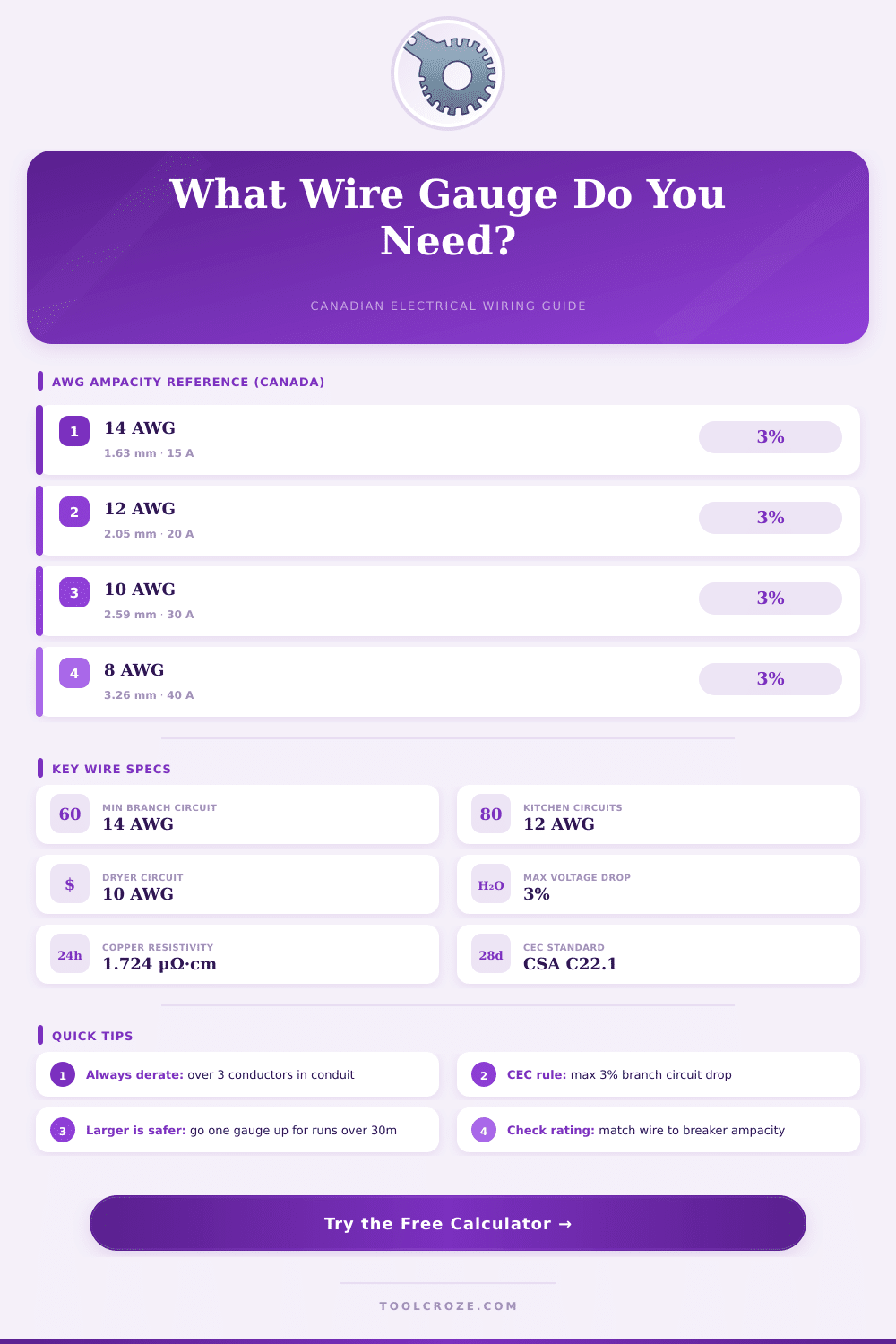
⚡ Wire Gauge Calculator Canada
AWG & metric sizing, ampacity, voltage drop & conduit fill — CEC compliant
| AWG / kcmil | Diam. (mm) | Area (mm²) | Resist. (Ω/km) | Ampacity 90°C (A) | Ampacity 75°C (A) | Metric Equiv. |
|---|---|---|---|---|---|---|
| 14 AWG | 1.63 | 2.08 | 8.286 | 20 | 15 | 2.5 mm² |
| 12 AWG | 2.05 | 3.31 | 5.209 | 25 | 20 | 4 mm² |
| 10 AWG | 2.59 | 5.26 | 3.277 | 40 | 30 | 6 mm² |
| 8 AWG | 3.26 | 8.37 | 2.061 | 55 | 40 | 10 mm² |
| 6 AWG | 4.11 | 13.30 | 1.296 | 75 | 55 | 16 mm² |
| 4 AWG | 5.19 | 21.15 | 0.815 | 95 | 70 | 25 mm² |
| 3 AWG | 5.83 | 26.67 | 0.646 | 110 | 85 | 35 mm² |
| 2 AWG | 6.54 | 33.62 | 0.513 | 130 | 95 | 35 mm² |
| 1 AWG | 7.35 | 42.41 | 0.407 | 150 | 110 | 50 mm² |
| 1/0 AWG | 8.25 | 53.49 | 0.322 | 170 | 125 | 50 mm² |
| 2/0 AWG | 9.27 | 67.43 | 0.256 | 195 | 145 | 70 mm² |
| 3/0 AWG | 10.40 | 85.01 | 0.203 | 225 | 165 | 95 mm² |
| 4/0 AWG | 11.68 | 107.2 | 0.161 | 260 | 195 | 120 mm² |
| 250 kcmil | 12.70 | 126.7 | 0.136 | 290 | 215 | 150 mm² |
| 350 kcmil | 15.01 | 177.4 | 0.097 | 350 | 260 | 185 mm² |
| AWG / kcmil | Diam. (mm) | Area (mm²) | Resist. (Ω/km) | Ampacity 90°C (A) | Ampacity 75°C (A) | Typical Use |
|---|---|---|---|---|---|---|
| 12 AWG | 2.05 | 3.31 | 8.564 | 15 | 15 | Lighting (not recommended) |
| 10 AWG | 2.59 | 5.26 | 5.384 | 25 | 20 | Small appliances |
| 8 AWG | 3.26 | 8.37 | 3.387 | 30 | 25 | Dryer, water heater |
| 6 AWG | 4.11 | 13.30 | 2.129 | 40 | 30 | Range, large appliance |
| 4 AWG | 5.19 | 21.15 | 1.339 | 55 | 40 | Sub-panel feed |
| 2 AWG | 6.54 | 33.62 | 0.842 | 75 | 55 | 100A service entrance |
| 1/0 AWG | 8.25 | 53.49 | 0.529 | 100 | 75 | 100–125A service |
| 2/0 AWG | 9.27 | 67.43 | 0.420 | 115 | 90 | 125A service |
| 3/0 AWG | 10.40 | 85.01 | 0.333 | 135 | 100 | 150A service |
| 4/0 AWG | 11.68 | 107.2 | 0.264 | 155 | 120 | 200A service (main) |
| 350 kcmil | 15.01 | 177.4 | 0.159 | 210 | 155 | 200A+ service |
| AWG | 15A / 50ft | 15A / 100ft | 20A / 50ft | 20A / 100ft | 30A / 50ft | 30A / 100ft |
|---|---|---|---|---|---|---|
| 14 AWG | 1.86% | 3.72% | 2.48% | 4.96% | — | — |
| 12 AWG | 1.17% | 2.34% | 1.56% | 3.13% | 2.34% | 4.69% |
| 10 AWG | 0.74% | 1.48% | 0.98% | 1.97% | 1.47% | 2.95% |
| 8 AWG | 0.46% | 0.93% | 0.62% | 1.24% | 0.93% | 1.86% |
| 6 AWG | 0.29% | 0.59% | 0.39% | 0.78% | 0.59% | 1.17% |
| 4 AWG | 0.18% | 0.37% | 0.24% | 0.49% | 0.37% | 0.74% |
| Application | Breaker | Min Cu Wire | Min Al Wire | Voltage | CEC Rule |
|---|---|---|---|---|---|
| Lighting / outlets | 15A | 14 AWG | Not rec. | 120V | 14-010 |
| Kitchen small appliance | 20A | 12 AWG | Not rec. | 120V | 26-712 |
| Bathroom GFCI | 20A | 12 AWG | Not rec. | 120V | 26-714 |
| Washer | 20A | 12 AWG | Not rec. | 120V | 26-720 |
| Electric dryer | 30A | 10 AWG | 8 AWG | 240V | 26-744 |
| Electric range | 40A | 8 AWG | 6 AWG | 240V | 26-744 |
| EV charger (L2) | 40–50A | 8–6 AWG | 6–4 AWG | 240V | 86-306 |
| Central A/C | 30–60A | 10–6 AWG | 8–4 AWG | 240V | 28-106 |
| Hot water heater | 30A | 10 AWG | 8 AWG | 240V | 26-746 |
| 100A sub-panel | 100A | 3 AWG Cu | 1/0 AWG | 240V | 14-012 |
| 200A service | 200A | 3/0 AWG Cu | 4/0 AWG | 240V | 6-200 |
| Conduit Size | Area (in²) | 40% Fill (in²) | Max 14 AWG | Max 12 AWG | Max 10 AWG | Max 8 AWG |
|---|---|---|---|---|---|---|
| 1/2 in EMT | 0.304 | 0.122 | 9 | 7 | 5 | 2 |
| 3/4 in EMT | 0.533 | 0.213 | 16 | 12 | 8 | 4 |
| 1 in EMT | 0.864 | 0.346 | 26 | 20 | 13 | 7 |
| 1-1/4 in EMT | 1.496 | 0.598 | 45 | 34 | 23 | 12 |
| 1-1/2 in EMT | 2.036 | 0.814 | 61 | 46 | 31 | 16 |
| 2 in EMT | 3.356 | 1.342 | 100 | 76 | 51 | 27 |
The rating of wires is a basic measuring method that informs you about the thickness of wire. You seriously need to understand the rating of wire uses, because it shows how much current wire can handle without overheating. There is not only one way to measure the thickness of wire; one uses the AWG system in North America the more ancient SWG (British standard) and the metric way to measure the cross-section area in square millimeters.
In United States the AWG system, or American wire Rating, is the usual standard for finding wire size. It comes from 1857 and was created to set up a uniform system about the diameter of round, solid wires from non-iron, well conducting materials. The official details appear in the ASTM standard B 258.
What Wire Ratings Mean
In North America people depend much on AWG for electrical wire and calbe production.
Here is where things become unlikely. In the AWG system a lower rating number points to actually thicker wire, not vice versa. A higher number shows that the wire becomes thinner.
Like this 12-rated wire is actually thicker than 18-rated. With higher numbers the diameter shrinks. That happens because the system is based on a logarithmic scale, so the sizes decline gradually instead of in equal steps.
The reason that this system works like this comes directly from the way that one makes wires. One draws a metal rod through a plate for drawing and while it exits the other side, it becomes a bit narrower then before. Here is a short description of cold pushing in practice.
The rating of wires has real presence when one works with electrical wiring. Choosing too thin a wire can cause overheating or even trigger fire. Vice versa, thick wire costs more each meter and adds weight.
A 10-rated wire weighs about 31 pounds for 1000 feet, while 12-rated comes in around 20 pounds for same length. One must also consider voltage drop. For 12-rated wire at around 40 feet the drop is maybe 0.2 volts.
If one uses thin wire, the situation gets bad quickly, 14-rated drops to around 0.3 volts, 16-rated to 0.5 and 20-rated gives roughly 1.2 volt drop.
To measure wire one does not need fancy tools. There are physical gauges, round or oval metal plates with notches on the edge, that match with various wire sizes. Each notch has a number and one simply lays the wire in the right space.
Calipers work just as well, if one wants to measure the diameter directly.
wire insulating covers are stamped with letter codes, that show important details like the type of material, the rating and the voltage limit. The National Electrical Code uses this letter coding, so anyone can quickly figure out the skill of wire. THHN, XHHW and THW are common kinds.
For usual home circuits 12-ratedwire works well until one deals with heavy devices.