⚡ 24V Wire Gauge Calculator
Find the correct AWG wire size for your 24V system — enter load current, wire run length, and acceptable voltage drop
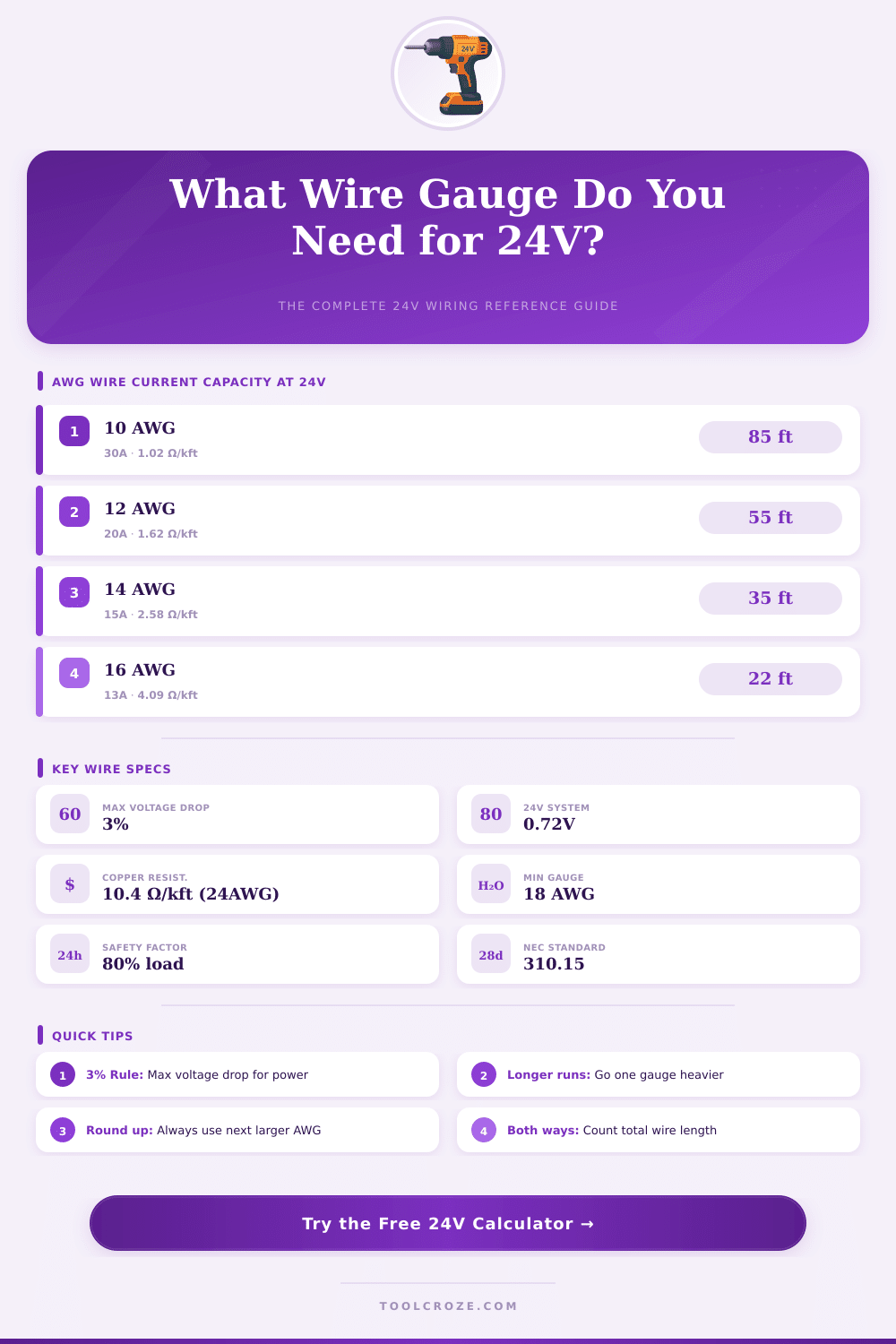
| AWG | Area (kcmil) | Diameter (in) | Resistance (Ω/1000ft) | Max Amps (Open Air) | Max Amps (Conduit) | Max 24V Run @ 3% / 10A (ft) |
|---|---|---|---|---|---|---|
| 6 AWG | 26.24 | 0.162" | 0.395 | 75A | 55A | 222 ft |
| 8 AWG | 16.51 | 0.128" | 0.628 | 50A | 40A | 140 ft |
| 10 AWG | 10.38 | 0.102" | 1.02 | 30A | 25A | 86 ft |
| 12 AWG | 6.53 | 0.081" | 1.62 | 20A | 20A | 54 ft |
| 14 AWG | 4.11 | 0.064" | 2.58 | 15A | 15A | 34 ft |
| 16 AWG | 2.58 | 0.051" | 4.09 | 13A | 13A | 21 ft |
| 18 AWG | 1.62 | 0.040" | 6.51 | 10A | 7A | 13 ft |
| 20 AWG | 1.02 | 0.032" | 10.15 | 7.5A | 5A | 8.5 ft |
| 22 AWG | 0.642 | 0.025" | 16.14 | 3A | 3A | 5.4 ft |
| 24 AWG | 0.404 | 0.020" | 25.67 | 2A | 2A | 3.4 ft |
| Application | Typical Load (A) | Typical Run (ft) | Recommended AWG | Min AWG (NEC) | Max Voltage Drop |
|---|---|---|---|---|---|
| Solar Panel (small) | 5–10A | 10–30 ft | 12–10 AWG | 14 AWG | 3% |
| Solar Panel (large) | 15–30A | 30–80 ft | 8–6 AWG | 10 AWG | 3% |
| LED Strip Lighting | 1–5A | 5–25 ft | 18–16 AWG | 18 AWG | 3–5% |
| CCTV / Security Cam | 0.5–2A | 50–300 ft | 20–16 AWG | 22 AWG | 5% |
| Motor / Actuator | 10–25A | 5–20 ft | 12–10 AWG | 14 AWG | 3% |
| RV / Marine Loads | 20–40A | 10–30 ft | 10–6 AWG | 10 AWG | 3% |
| Irrigation Valves | 1–5A | 50–200 ft | 18–14 AWG | 18 AWG | 5–10% |
| UPS / Battery Link | 10–20A | 3–15 ft | 12–10 AWG | 12 AWG | 2–3% |
| 24V Heater | 20–30A | 5–20 ft | 10–8 AWG | 10 AWG | 3% |
| Telecom / Control | 0.5–3A | 50–500 ft | 22–18 AWG | 24 AWG | 5–10% |
| Size (mm²) | Nearest AWG | Resistance (Ω/km) | Max Amps (Open) | Max Amps (Conduit) | Typical 24V Use |
|---|---|---|---|---|---|
| 0.5 mm² | ~20 AWG | 36.0 | 3A | 2.5A | Control signal wiring |
| 0.75 mm² | ~18 AWG | 24.5 | 6A | 4A | LED, sensors |
| 1.0 mm² | ~17 AWG | 18.1 | 10A | 7A | Small loads, lighting |
| 1.5 mm² | ~15 AWG | 12.1 | 13A | 10A | LED panels, cameras |
| 2.5 mm² | ~13 AWG | 7.41 | 18A | 13A | Motors, short runs |
| 4.0 mm² | ~11 AWG | 4.61 | 25A | 18A | Solar, medium motors |
| 6.0 mm² | ~10 AWG | 3.08 | 32A | 23A | Solar PV, RV |
| 10.0 mm² | ~8 AWG | 1.83 | 44A | 32A | High-current, forklift |
| 16.0 mm² | ~6 AWG | 1.15 | 58A | 41A | Chargers, heavy loads |
| Ambient Temp | 60°C Wire | 75°C Wire | 90°C Wire | Action Required |
|---|---|---|---|---|
| Up to 30°C (86°F) | 1.00 | 1.00 | 1.00 | No derating needed |
| 31–35°C (87–95°F) | 0.91 | 0.94 | 0.96 | Minor derating |
| 36–40°C (96–104°F) | 0.82 | 0.88 | 0.91 | Derate or upsize |
| 41–45°C (105–113°F) | 0.71 | 0.82 | 0.87 | Upsize 1 gauge |
| 46–50°C (114–122°F) | 0.58 | 0.75 | 0.82 | Upsize 1–2 gauges |
| 51–60°C (123–140°F) | 0.33 | 0.58 | 0.71 | Upsize 2 gauges |
Choosing the right wire for 24V setups is not a task that one can simply ignore. If you choose too small a size, you risk loss of voltage, overheating or even more serious problems. The good part?
Small tools for counting wire size in 24V help do that very easily. They will lead you to the right AWG, cross area and diameter, that works for any building that you plan.
How to Choose the Right Wire for 24V Systems
Charts for wire size that cover 12V, 24V and 48V circuit systems really save time during design of renewable energy setups. Here is what really matters: at higher voltage you can use a bit thinner cables. A 24V system needs less thick wire than 12V for same power.
Consider 720 W use (at 24V it needs only 30 amps), but at 12V sharply 60 amps flow. That makes a big difference in the needed cables.
For small 24V uses the choice of thickness is much more flexible. Home 24V circuits, like doorbells or thermostats, usually work with 18 AWG and that ends the matter. A control system for sprinklers with around 200 mA?
Again, 18 AWG wroks well and it is found everywhere. In low flows for 24V setups even 22 AWG alarm cable one uses without any problems.
LED strips show up often in 24V setups. The inner thickness of such LED tapes is already quite a lot small, and the glow drops clearly after around 20 feet, so jumpers are useful here. While joining LED connections and other low voltages in circuit work, 18 or 20 AWG works perfectly.
On the other hand, 20 amps in 24V match only 480 watts, much less then 20 amps in a typical 120V AC home net.
Big loads need naturally thicker cables, without doubt. A 3 kW system in 24V? It pulls 125 amps, and 2 AWG battery cable handles that easily.
Total controls often combine with 6 AWG battery cable. Putting values in a free wire calculator, 24V, 40 feet whole way, 50 amps, 3% voltage drop, gives 4 AWG as ideal. Same from the control to batteries and to inverter; 4 AWG stays faithful in every step.
Trolling motors form their own group. 8 AWG hookup works for a 24V 70-pound motor, but for an 80-pound model one must switch to 6 AWG. Small models under 3 amps with maybe 9 feet of way?
Here charts point to 16 or 18 AWG. One key spot to recall: 24 AWG wire limits to around 577 mA, regardless of the voltage, because it is simply tooslim for more. Always match the cable to the real flow that your system needs.