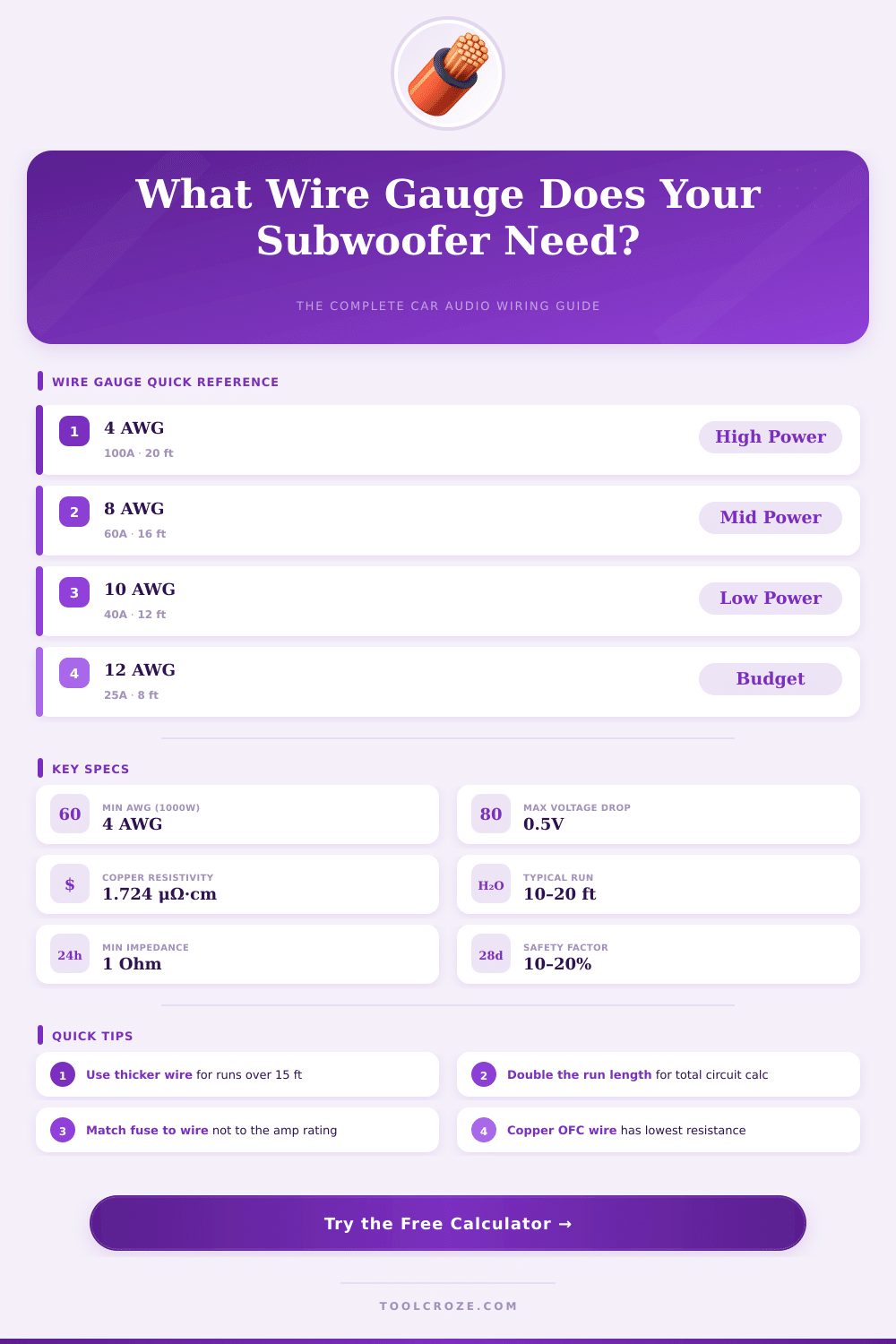
🔊 Subwoofer Wire Gauge Calculator
Find the correct AWG wire size for your subwoofer install — enter power, impedance & run length
| AWG | Diameter (mm) | Resistance (μΩ/ft OFC) | Max Amps (Car) | Max Amps (Home) | Typical Use |
|---|---|---|---|---|---|
| 0 AWG (1/0) | 8.25 | 97 | 200+ | 150 | Alternator, Big 3 |
| 2 AWG | 6.54 | 156 | 150 | 95 | High power amps >1500W |
| 4 AWG | 5.19 | 249 | 100 | 70 | Amps 800–1500W |
| 6 AWG | 4.11 | 395 | 75 | 55 | Amps 400–800W |
| 8 AWG | 3.26 | 628 | 50 | 40 | Amps 200–400W |
| 10 AWG | 2.59 | 999 | 30 | 30 | Amps 100–200W |
| 12 AWG | 2.05 | 1588 | 20 | 20 | Low power <100W |
| 14 AWG | 1.63 | 2525 | 15 | 15 | Speaker wire short runs |
| RMS Power (W) | Current Draw (A) | Recommended AWG | Fuse Rating | Ground Wire |
|---|---|---|---|---|
| 100W | ~8.3A | 12 AWG | 15A | 12 AWG |
| 250W | ~20.8A | 10 AWG | 25A | 10 AWG |
| 500W | ~41.7A | 8 AWG | 50A | 8 AWG |
| 800W | ~66.7A | 4 AWG | 80A | 4 AWG |
| 1000W | ~83.3A | 4 AWG | 100A | 4 AWG |
| 1500W | ~125A | 2 AWG | 150A | 2 AWG |
| 2000W | ~166.7A | 1/0 AWG | 200A | 1/0 AWG |
| 3000W | ~250A | 2x 1/0 AWG | 2x 150A | 2x 1/0 AWG |
| Install Type | Typical Power | Impedance | Wire Run | Min AWG | Est. Current |
|---|---|---|---|---|---|
| Budget Sedan | 200W | 4Ω | 12 ft | 10 AWG | ~17A |
| Mid SUV | 500W | 2Ω | 15 ft | 8 AWG | ~42A |
| Truck / Long Run | 800W | 4Ω | 25 ft | 4 AWG | ~67A |
| High Power Car | 1500W | 1Ω | 18 ft | 2 AWG | ~125A |
| SPL Competition | 3000W | 1Ω | 10 ft | 2x 1/0 AWG | ~250A |
| Home Theater | 300W | 8Ω | 20 ft | 12 AWG | ~2.5A |
The wire gauge for subwoofer matters more than many people think. The American standard for wire gauge, or AWG, simply shows how one measures the thickness of wire. Here the part that surprises: lower wire gauge number indeed points to thicker wire.
That thickness really helps, because it lowers the resistance, letting the current flow freely without obstacles. Think of that like water in tubes, broad tubes allow the water to flow without blocks, while less broad ones create jams.
Which Wire Gauge Is Best for Your Subwoofer
For most subwoofer setups wire gauge 12 hits the ideal level. Even so, if you enter the area of high power… Talking about more than 1,000 watts RMS, best use wire gauge 10 or even 8.
An amplifier of 3,000 watts that moves heavy speakers? It clearly requires AWG 10. The range extends quite a lot, from 24 for the most lightweight finish (something fine for many basic audios) to 12 for the stronger systems.
Here the key spot: bigger power forces more current through the wire, so you need thicker wire gauge to handle that burden. Take a ceiling-installed subwoofer at home, depending on the amplifier that it powers, you will choose between 12 and 10. For general wiring of subwoofer setups staying between 12 and 16 wire gauge keeps you in a relibale zone.
The distance from the amplifier to the subwoofer changes everything also. If the cable length is under 25 feet, 16 wire gauge commonly gives good result with little loss of signal. For even shorter runs, for instance 6 to 8 feet?
(16 wire gauge is only extra expense). Use the right wire gauge, and your subwoofer will work best, without hurting the sound experience.
Here what surprises: thicker wire has no disadvantages except cost for your pocket. Going from 14 to 12 wire gauge on a setup adds only some dollars. It is worth it.
The result that I found too work are that 16 wire gauge does the task, 14 improves everything clearly, and 12 is the best choice. Flat wire in one cover, usually white or black. Is another good option, if you connect several subwoofer units.
The copper itself plays a role. Copper without oxygen, commonly marked OFC, beats copper covered with aluminium always. Combine good leads with firm connections, soldered, clamped or banana plugs.
And you will lower the contact resistance well.
Some users choose full 8 wire gauge for everything about subwoofer setups, simply to be safe. Others wonder whether 4 wire gauge for a 150 RMS subwoofer is too much, when 8 is suggested. It will not hurt anything, but it will not unlock secret power.
The wire gauge should match your whole current draw, the ohm load and the cablelength, not the speaker power itself.