⚙️ Generator Exhaust Pipe Size Calculator
Calculate the correct exhaust pipe diameter, velocity, and back pressure for any generator installation
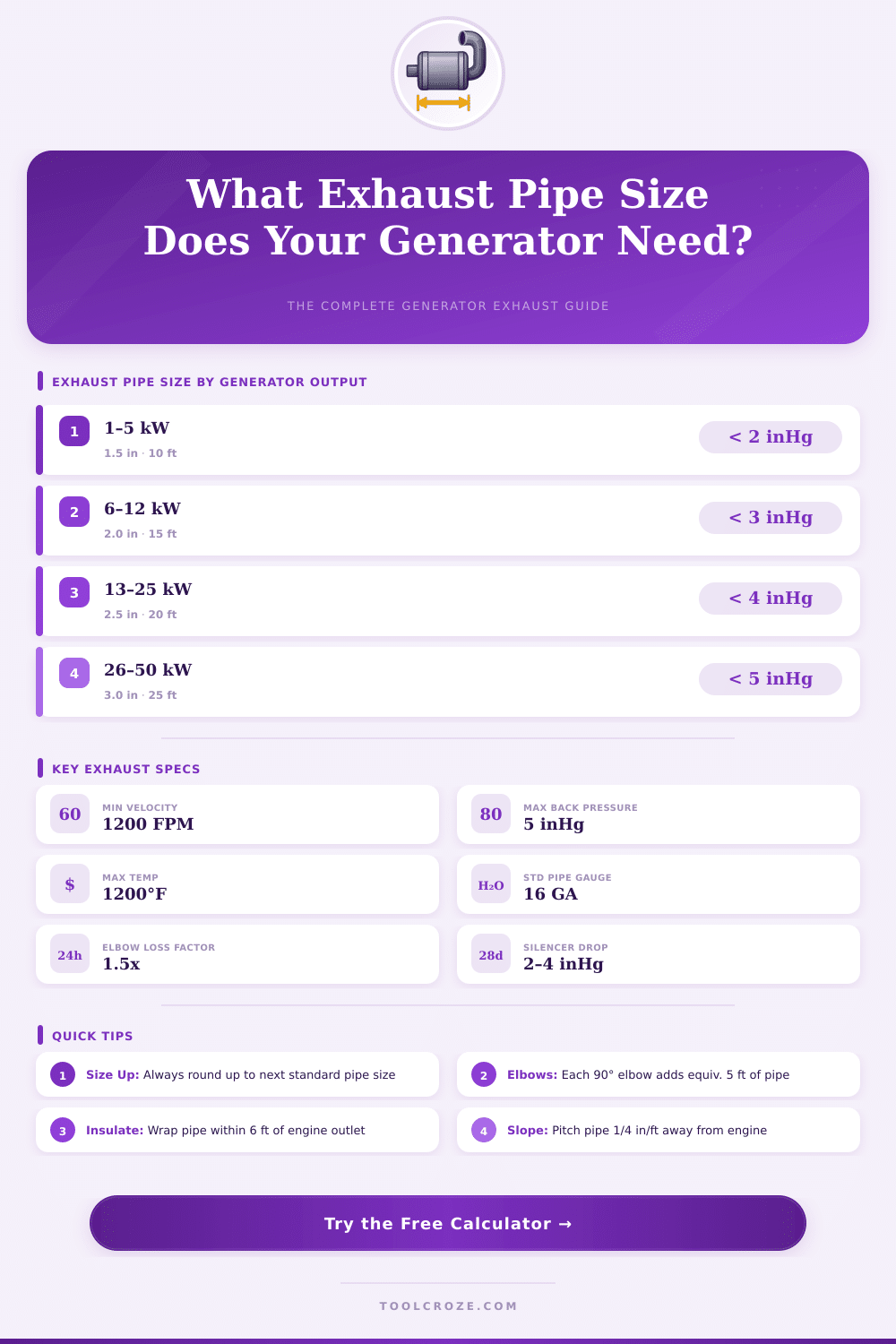
| Generator Output | Min Pipe ID (in) | Min Pipe ID (mm) | Max Run Length | Max Back Pressure | Recommended Pipe |
|---|---|---|---|---|---|
| 1 – 3 kW | 1.25 in | 32 mm | 8 ft (2.4 m) | 2 inHg | 1.5 in Sch 40 |
| 3 – 6 kW | 1.5 in | 38 mm | 12 ft (3.7 m) | 2.5 inHg | 2 in Sch 40 |
| 6 – 10 kW | 2.0 in | 51 mm | 15 ft (4.6 m) | 3 inHg | 2.5 in Sch 40 |
| 10 – 15 kW | 2.5 in | 64 mm | 20 ft (6.1 m) | 3.5 inHg | 3 in Sch 40 |
| 15 – 25 kW | 3.0 in | 76 mm | 25 ft (7.6 m) | 4 inHg | 3.5 in Sch 40 |
| 25 – 40 kW | 3.5 in | 89 mm | 30 ft (9.1 m) | 4.5 inHg | 4 in Sch 40 |
| 40 – 60 kW | 4.0 in | 102 mm | 35 ft (10.7 m) | 5 inHg | 5 in Sch 40 |
| 60 – 100 kW | 5.0 in | 127 mm | 40 ft (12.2 m) | 5 inHg | 6 in Sch 40 |
| Fuel Type | Exhaust Temp (°F) | Exhaust Temp (°C) | Exhaust Gas Factor | Typical BSFC | Notes |
|---|---|---|---|---|---|
| Gasoline | 900 – 1,400°F | 480 – 760°C | 1.00 | 0.50 lb/hp·hr | Highest temp range |
| Diesel | 700 – 1,100°F | 370 – 595°C | 0.90 | 0.40 lb/hp·hr | Lower temp, more volume |
| Natural Gas | 800 – 1,200°F | 425 – 650°C | 1.10 | 0.55 lb/hp·hr | More exhaust volume |
| Propane (LPG) | 850 – 1,250°F | 455 – 675°C | 1.05 | 0.52 lb/hp·hr | Similar to natural gas |
| Dual Fuel | 800 – 1,300°F | 425 – 705°C | 1.03 | 0.51 lb/hp·hr | Use gas factor for sizing |
| Pipe Material | Max Temp (°F) | Wall Thickness | Friction Factor | Corrosion Resist. | Best Use |
|---|---|---|---|---|---|
| Mild Steel Sch 40 | 800°F | Standard | 0.046 | Moderate | General standby |
| Stainless Steel 304 | 1,500°F | Thin wall OK | 0.040 | Excellent | High-temp / marine |
| Aluminized Steel | 1,000°F | Standard | 0.045 | Good | Residential standby |
| Cast Iron | 1,200°F | Thick wall | 0.048 | Good (dry) | Heavy industrial |
| Flexible Stainless | 1,200°F | Corrugated | 0.065 | Excellent | Vibration isolation |
| Fitting Type | 2 in Pipe (ft) | 3 in Pipe (ft) | 4 in Pipe (ft) | Pressure Loss Factor |
|---|---|---|---|---|
| 90° Standard Elbow | 5.0 ft | 7.5 ft | 10.0 ft | 1.50 |
| 90° Long Radius Elbow | 3.5 ft | 5.0 ft | 7.0 ft | 1.30 |
| 45° Elbow | 2.5 ft | 3.5 ft | 5.0 ft | 1.20 |
| Tee (flow-through) | 1.5 ft | 2.0 ft | 3.0 ft | 1.10 |
| Residential Silencer | 6.0 ft | 9.0 ft | 12.0 ft | 2.50 |
| Critical Silencer | 3.0 ft | 4.5 ft | 6.0 ft | 1.80 |
| Rain Cap / Outlet Hood | 2.0 ft | 3.0 ft | 4.0 ft | 1.20 |
Do not simply guess about the right size of the Exhaust Pipe for a Generator. If the pipe is too small, the back pressure starts to build in the whole system. That forces the engine to work much harder than needed consuming more fuel and laying too much burden on the internal parts, that wear out more quickly.
So choosing the sizes really is worth the effort.
Choose the Right Exhaust Pipe Size for Your Generator
Smaller portable Generators usually have quite simple Exhaust Pipes. For instance, the Honda EU2200i uses a setup with 1.25-inch diameter. When you add an extension to such a model, flexible car Exhaust Pipe of the same size ensures good flow and stops potential problems.
One also finds special exhaust extensions, designed right for this, usually around 25 inches long with 1.25-inch outer diameter.
Different Generators require different sizes, because it depends on their build. For some models a black gas pipe with 1.5-inch inner diameter works as the main exhaust. There are also options like double-wall stainless steel chimney.
On Onan Generators folks successfully used 1.5-inch outer diameter of electrical conduit stuck in flexible tube from car stores. I saw 1.25-inch matching conduit, that wroked well on Onan setups.
Sometimes choosing a bit bigger tube really solves the issue. Expanding the diameter helps to reduce restrictions and back pressure in the system. For wall setups, 3-inch or 4-inch double-wall Exhaust Pipes from water heaters work fine.
On really big industrial Generators you must consider even bigger. 10-inch or 12-inch round flue pipes become the usual standard.
A half-inch tube simply does not work for Generator exhaust. You need something much more wide. A 2-inch tube could seem too much for small Generators, yes, but if the maker says 2-inch diameter, follow that without pause.
Long Exhaust Pipes really give some solid benefits. The longer length cools the smoke more, helps quiet noise and pushes it away from your air vents. Six feet of length gets those benefits without taking too much space.
Even a ten-foot setup can serve as a good muffler on its own, and adding a cap on top stops reign from getting in.
During setup of the Exhaust Pipe system, connect the Generator exhaust port to a flexible stainless steel hose more than 24 inches long. That bit absorbs heat expansion, motions and vibrations from the machine. All those Generators shake a lot and can break rigid pipe links or damage welds over time.
Set bolts also can fail. Vibration is the main enemy here, and ignoring it risks you with cracks from stress.
The makers of Generators should be part of the talk about sizes. This matters especially with diesel turbo engines, that need very low back pressure after the top and muffler. Local building codes and environmental laws also will matter, as you plan the exhaust.
Horsepower based calculators for exhaust exist online, thatshow pipe sizes in millimeters and inches.