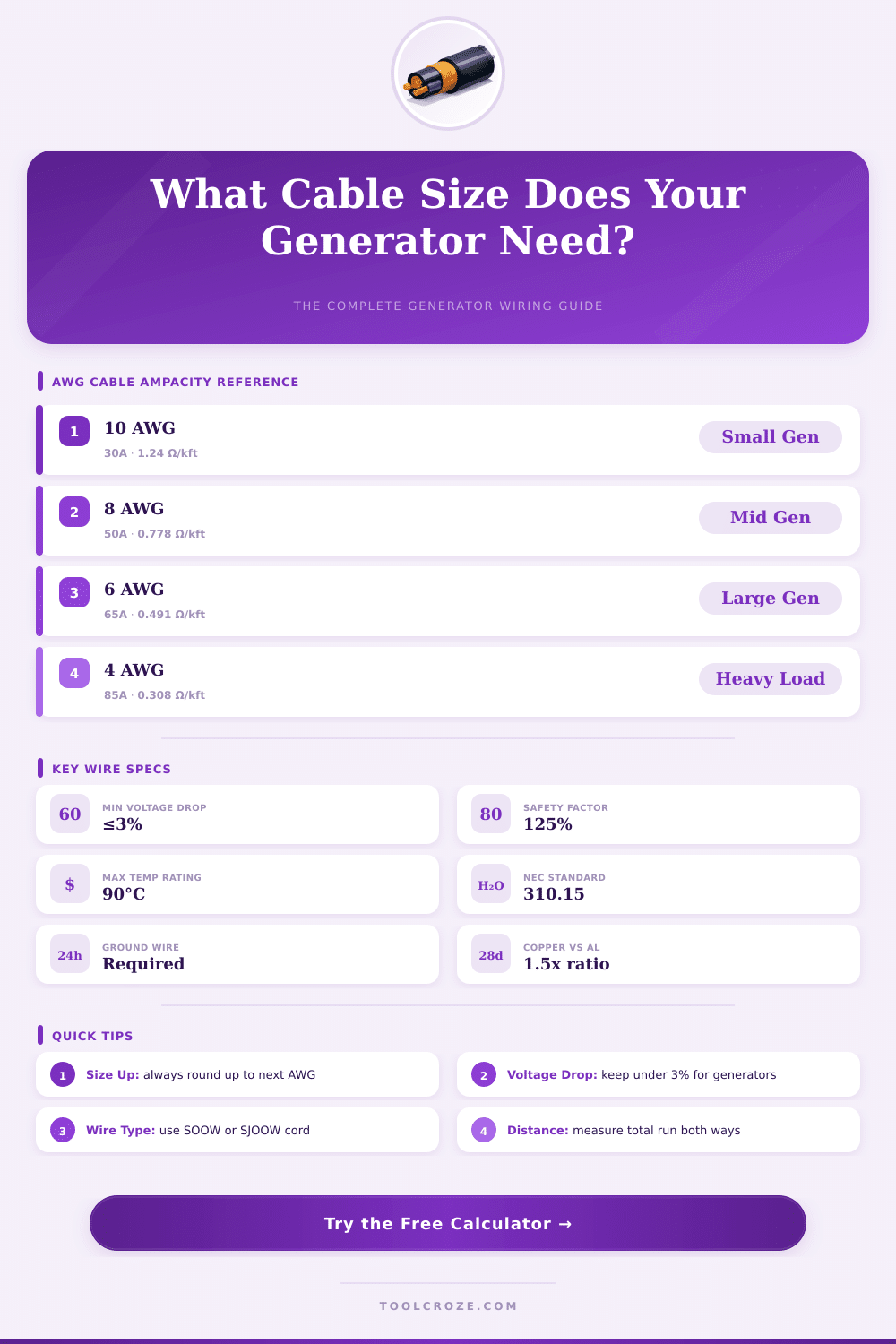
⚡ Generator Cable Size Calculator
Find the correct wire gauge (AWG) for your generator based on load, distance & voltage
| AWG | mm² (approx) | Max Amps (60°C) | Max Amps (75°C) | Max Amps (90°C) | Resistance (Ω/1000ft) | Typical Use |
|---|---|---|---|---|---|---|
| 14 AWG | 2.08 | 15A | 20A | 25A | 3.07 | Light circuits |
| 12 AWG | 3.31 | 20A | 25A | 30A | 1.93 | 15A outlets |
| 10 AWG | 5.26 | 30A | 35A | 40A | 1.24 | Small generators |
| 8 AWG | 8.37 | 40A | 50A | 55A | 0.778 | Mid generators |
| 6 AWG | 13.3 | 55A | 65A | 75A | 0.491 | Large generators |
| 4 AWG | 21.1 | 70A | 85A | 95A | 0.308 | Heavy loads |
| 3 AWG | 26.7 | 85A | 100A | 110A | 0.245 | Sub-panels |
| 2 AWG | 33.6 | 95A | 115A | 130A | 0.194 | Main service |
| 1 AWG | 42.4 | 110A | 130A | 150A | 0.154 | Large service |
| 1/0 AWG | 53.5 | 125A | 150A | 170A | 0.122 | Industrial |
| 2/0 AWG | 67.4 | 145A | 175A | 195A | 0.0967 | Industrial |
| 3/0 AWG | 85.0 | 165A | 200A | 225A | 0.0766 | Large industrial |
| 4/0 AWG | 107 | 195A | 230A | 260A | 0.0608 | Heavy industrial |
| Generator Size | Rated Amps | Min AWG (NEC) | Recommended AWG | Extension Cord Size | Notes |
|---|---|---|---|---|---|
| 1000–2000W | 8–17A | 14 AWG | 12 AWG | 12 AWG | Standard household |
| 2000–3500W | 17–30A | 12 AWG | 10 AWG | 10 AWG | Size up for long runs |
| 3500–5000W | 30–42A | 10 AWG | 8 AWG | 8 AWG | Include 125% NEC factor |
| 5000–7500W | 42–63A | 8 AWG | 6 AWG | 6 AWG | Hardwired preferred |
| 7500–10000W | 63–84A | 6 AWG | 4 AWG | N/A hardwire | Transfer switch required |
| 10000–15000W | 84–125A | 4 AWG | 2 AWG | N/A hardwire | Licensed electrician |
| 15000–20000W | 125–167A | 2 AWG | 1/0 AWG | N/A hardwire | Licensed electrician |
| Cable Type | Max Temp | Voltage Rating | Wet/Dry | Best Use |
|---|---|---|---|---|
| THWN-2 | 90°C | 600V | Both | Conduit wiring |
| SOOW | 60°C | 300V | Both | Portable generator cords |
| SJOOW | 60°C | 300V | Both | Light portable use |
| USE-2 | 90°C | 600V | Both | Underground / direct burial |
| XHHW-2 | 90°C | 600V | Both | High temperature, conduit |
| SER | 75°C | 600V | Dry | Service entrance |
| SEU | 75°C | 600V | Dry | Service entrance, above ground |
| Scenario | Power | Distance | Voltage | Recommended AWG | V-Drop @ Full Load |
|---|---|---|---|---|---|
| Emergency Home Backup | 5000W | 75ft | 240V | 6 AWG Cu | ~2.4% |
| RV / Campsite | 3000W | 50ft | 120V | 10 AWG Cu | ~2.9% |
| Construction Site | 7500W | 100ft | 240V | 4 AWG Cu | ~2.8% |
| Standby Whole Home | 12000W | 50ft | 240V | 2 AWG Cu | ~1.6% |
| Portable Small Gen | 2000W | 25ft | 120V | 12 AWG Cu | ~1.8% |
| Industrial 3-Phase | 15000W | 100ft | 480V | 6 AWG Cu | ~1.2% |
Election of the right size for the cable of the generator is really important. If you use wrong cable, it can cause failure or even dangerous cases. Moreover, that can damage the generator itself and the connected devices when the drop of voltage becomes too big.
So it really matters to choose it correctly from the first time.
Pick the Right Wire Size for Your Generator
Check the nameplate of the generator as good starting point. This label points the voltages of the system in volts and the power of the generator in watts. From that, it is possible to figure out the amps.
When you know the number of amps multiply it by 1.25 to follow the rule of 80% according to NEC. Like this you receive the needed size for the wire, that ensures safe mode. Later, asking a wire expert will help to specify the right cable size.
For the most common home uses, sizes of wires between 14 AGW and 6 AGW is usual. Even so, the exact size depends on factors like voltage, electricity and especially the length, that the cable must cover. Knowing the current force and the distance allow to estimate teh right wire size.
Length really affects a lot. Cable of 10 AGW typical L14-30 works well until around 65 feet. So, if the way passes 50 feet and reaches 125, better choose 8 AGW.
For 30-amp setup with 75-foot cable, 10 AGW actually is too little at that distance. It only lasts until 25 amps, before the fuse bursts. Rather, 8 AGW wire is necessary.
Longer cable from 14 AGW will heat more quickly, so always pick shorter lengths with smaller wires.
For 50-amp systems, 6 AGW is the usual choice. But if the run passes 100 feet, it requires 4 AGW copper. With aluminium, go to 3 AGW.
One calculation using a tool four wire size showed, that 6 AGW copper works for single phase way, 60-foot in pipe at 240V and 50 amps with under 3% voltage drop.
If the voltage of the generator is 120/240V, probably the cable is 10/4. Doubling the length of the cable requires to grow the size or keep the drop of voltage under load. So, 8 AGW or 6 AGW.
For 24 kW generator, that commonly means 100-amp service. The base is size 1 aluminium, before considering the drop of voltage. Stay under 3% drop allows around 180 feet withthis setup.
Some folks prefer to use bigger wire size, even if the current need does not require it. Choosing 8 AGW or 6 AGW leaves space for a stronger generator later. It is always smart to match the cable size to the strongest output of the generator.