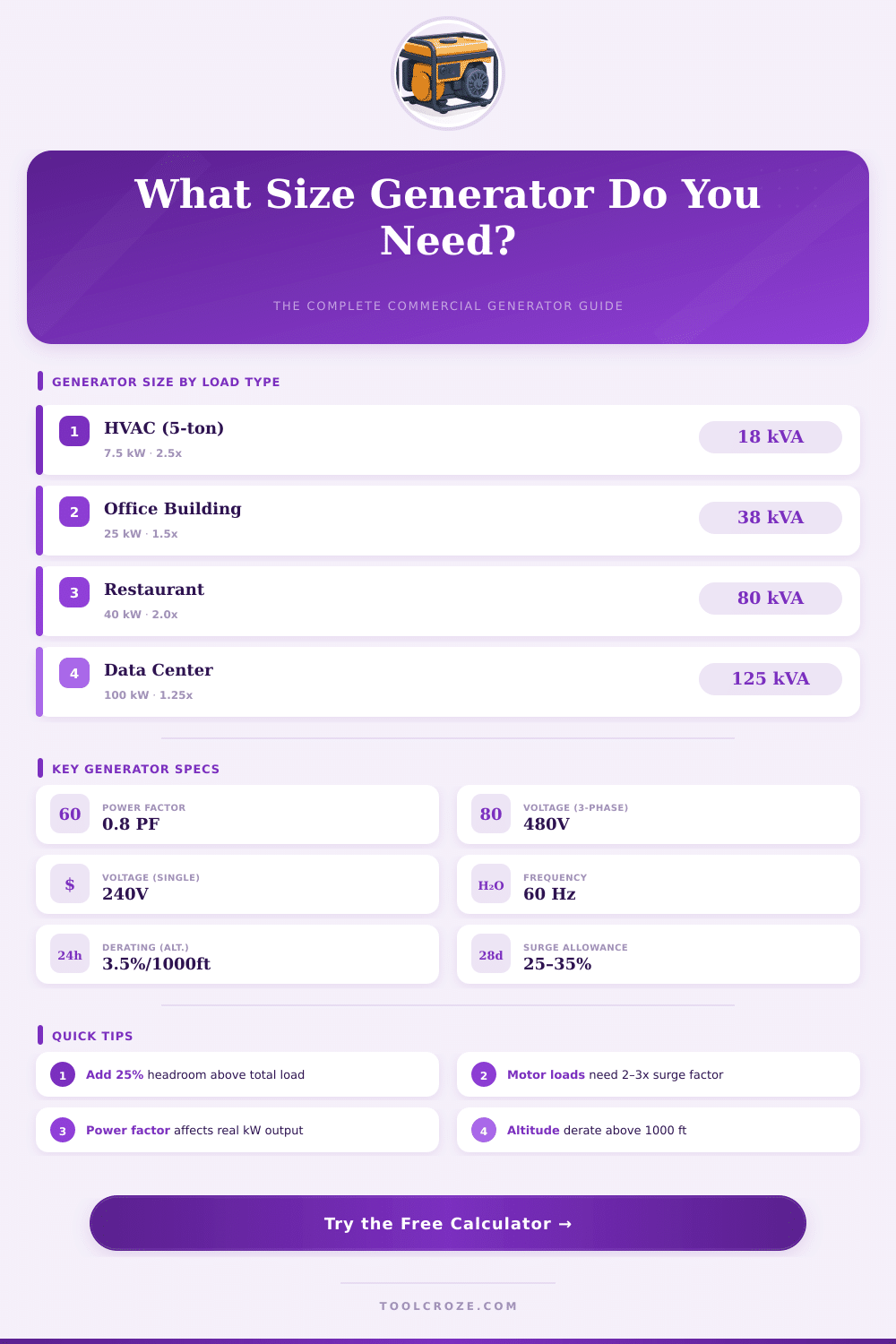
⚡ Commercial Generator Size Calculator
Calculate the exact generator kW/kVA rating needed for your commercial or industrial application
| Building Type | Lighting (W/sqft) | HVAC (tons/1000sqft) | Total Load Density (kW/1000sqft) | Typical Generator Range |
|---|---|---|---|---|
| Small Office (under 5,000 sqft) | 1.5 – 2.0 | 0.8 – 1.2 | 8 – 12 kW | 15 – 25 kW |
| Large Office Building | 2.0 – 2.5 | 1.0 – 1.5 | 12 – 18 kW | 50 – 200 kW |
| Restaurant / Food Service | 2.5 – 3.5 | 1.5 – 2.0 | 30 – 50 kW | 60 – 150 kW |
| Retail Store | 3.0 – 5.0 | 1.0 – 1.5 | 15 – 25 kW | 30 – 100 kW |
| Warehouse / Light Industrial | 0.5 – 1.0 | 0.3 – 0.8 | 5 – 15 kW | 20 – 150 kW |
| Manufacturing Plant | 1.5 – 2.0 | 0.5 – 1.0 | 20 – 60 kW | 100 – 2000 kW |
| Medical Clinic / Hospital | 2.5 – 3.5 | 1.5 – 2.5 | 20 – 35 kW | 100 – 500 kW |
| Data Center / Server Room | 1.0 – 1.5 | 2.0 – 4.0 | 50 – 200 kW | 200 – 2000 kW |
| Hotel / Hospitality | 2.0 – 3.0 | 1.2 – 1.8 | 15 – 25 kW | 75 – 500 kW |
| School / Education | 1.5 – 2.5 | 0.8 – 1.2 | 10 – 18 kW | 30 – 150 kW |
| Generator Size (kW) | kVA (at 0.8 PF) | Typical Application | Fuel Consumption (gal/hr at full load) | Approximate Weight (lbs) |
|---|---|---|---|---|
| 15 kW | 18.75 kVA | Small office, retail kiosk | 1.4 – 1.8 | 800 – 1,200 |
| 20 kW | 25 kVA | Small restaurant, small office | 1.8 – 2.2 | 1,000 – 1,500 |
| 30 kW | 37.5 kVA | Medium office, retail store | 2.5 – 3.2 | 1,400 – 2,000 |
| 45 kW | 56.25 kVA | Restaurant, clinic | 3.5 – 4.5 | 2,000 – 2,800 |
| 60 kW | 75 kVA | Medium office building | 5.0 – 6.0 | 2,500 – 3,500 |
| 80 kW | 100 kVA | Large restaurant, small hotel | 6.5 – 7.5 | 3,000 – 4,000 |
| 100 kW | 125 kVA | Small school, hotel, medical | 8.0 – 9.5 | 3,500 – 5,000 |
| 125 kW | 156.25 kVA | Hospital wing, large hotel | 10 – 11.5 | 4,500 – 6,000 |
| 150 kW | 187.5 kVA | Large clinic, warehouses | 12 – 14 | 5,000 – 7,000 |
| 200 kW | 250 kVA | Large school, data center | 15 – 17 | 6,500 – 9,000 |
| 300 kW | 375 kVA | Hospital, large manufacturing | 22 – 25 | 9,000 – 12,000 |
| 500 kW | 625 kVA | Large data center, factory | 35 – 40 | 14,000 – 20,000 |
| 750 kW | 937.5 kVA | Industrial complex, campus | 52 – 58 | 20,000 – 28,000 |
| 1000 kW (1 MW) | 1250 kVA | Large hospital, campus, utility | 68 – 75 | 28,000 – 38,000 |
| Motor Type | HP Range | Starting Surge (x Running) | Starting Method | Generator Sizing Multiplier |
|---|---|---|---|---|
| Single Phase Motor | 0.25 – 5 hp | 5 – 7x | Capacitor start | 3.0x rated kW |
| 3-Phase Squirrel Cage | 5 – 50 hp | 6 – 8x | Across-the-line | 2.5x rated kW |
| 3-Phase with Soft Starter | 10 – 200 hp | 2 – 3x | Electronic soft start | 1.5x rated kW |
| 3-Phase with VFD | 1 – 500 hp | 1 – 1.5x | Variable Freq. Drive | 1.25x rated kW |
| HVAC Compressor | 5 – 100 ton | 4 – 6x | PSC / capacitor | 2.0x rated kW |
| Pump (centrifugal) | 1 – 100 hp | 3 – 5x | Across-the-line | 2.0x rated kW |
| Air Compressor | 5 – 50 hp | 5 – 7x | Unloaded start | 2.5x rated kW |
| Elevator Motor | 15 – 60 hp | 4 – 5x | Star-delta | 2.0x rated kW |
Choosing the right size for a commercial generator is really important. If one buys it wrong, that can create serious troubles. When the generator is too small, it will not be enough to give the needed energy, so that everything works during a power outage.
No single size works for everything when dealing with standby power, so every business must figure out its own needs.
How to Choose the Right Generator Size for Your Business
One commonly uses the method of square feet to figure out the right size. For typical businesses like grocery stores, restaurants and stores of everyday products, the rule is 50 kilowatts for 10 watts per square foot. For other commercial buildings, it comes to 50 kilowatts for 5 watts per square foot.
Like this, for a building of 10,000 square feet, one needs a generator with around 100,000 watts, or 100 kW. Even so, this is a simple rule of thumb that does not consider particular electrical loads.
Another way is to convert amps into kilowatts and later combine all kW to find the whole needed energy output. That helps too ensure, that the generator is able to serve all involved gear and machines. When one does the calculations, one adds 25 percent for reserve load and extra capacity, and then adjusts the size of the generator according to that number.
Generally, a generator should deliver at least 25 percent more kilowatts than the service or gear must consume.
Online calculators for the size of commercial generators can simplify this task. They need information about square feet and electrical loads. It is good to use several calculators, to check the accuracy of the results.
Most importantly even so, turn to an expert to figure out the right energy needs. Commercial generators, that feed buildings, are not endless energy sources, and one should not size them the same as the planned load withoutthat extra reserve.
Cost is another spot that one must consider. The fuel efficiency, the noise level and the class of emissions can all affect the price. Generators that are more fuel efficient, more silent and with lower emissions, usually cost more.
A generator of Tier 4 Final will cost much more than a model of Tier 2 or Tier 3. The size of industrial diesel generators changes a lot according to the particular usage and energy demands.
Both options of diesel and natural gas are available in a broad range of prices. Some specialist services mix typical review of current energy systems with advanced testing and simulation to find the best capacity. They take into account the type of fuel, the size, the power, the current setup and the access before giving solid advice.
Choosing the right size for a generator is key so that operations go smoothly.