⚡ Generator Size Calculator UK
Calculate the exact kVA generator you need for home, construction site, or events — with UK 230V / 50Hz standards
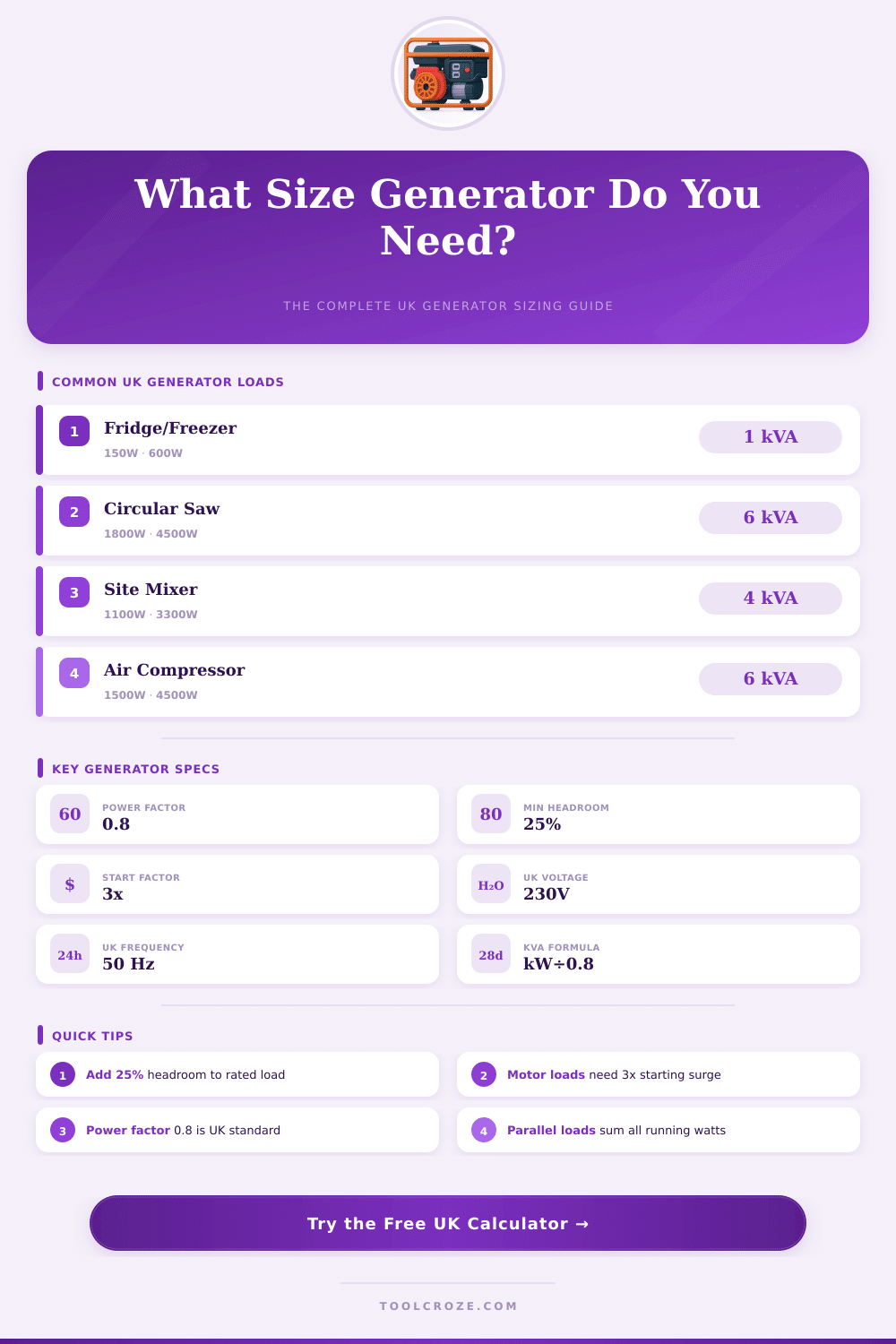
| Appliance | Running Watts | Starting Watts | Start Multiplier | Typical Use |
|---|---|---|---|---|
| Fridge / Freezer | 100–200 W | 400–800 W | 3x–4x | Residential |
| Washing Machine | 500–2000 W | 1000–2500 W | 2x–3x | Residential |
| Electric Kettle | 2000–3000 W | 2000–3000 W | 1x (resistive) | Residential |
| Microwave | 800–1500 W | 800–1500 W | 1x (resistive) | Residential |
| Central Heating Pump | 60–150 W | 200–450 W | 3x | Residential |
| Circular Saw (185mm) | 1400–1800 W | 3500–5400 W | 3x | Construction |
| 110V Site Drill | 600–900 W | 1800–2700 W | 3x | Construction |
| Air Compressor (11L) | 1100–1500 W | 3300–4500 W | 3x | Workshop |
| Angle Grinder (115mm) | 700–900 W | 700–900 W | 1x–1.5x | Construction |
| Concrete Mixer (140L) | 750–1100 W | 2250–3300 W | 3x | Construction |
| LED Lighting (per fitting) | 10–25 W | 10–25 W | 1x | All |
| Desktop PC + Monitor | 200–500 W | 200–500 W | 1x | Office |
| PA System (1kW RMS) | 500–1000 W | 500–1500 W | 1x–1.5x | Events |
| Catering Hob (4-ring) | 5000–8000 W | 5000–8000 W | 1x (resistive) | Catering |
| Water Pump (domestic) | 500–900 W | 1500–2700 W | 3x | All |
| Generator Size | Running kW | Typical Use | UK Price Range | Fuel Type |
|---|---|---|---|---|
| 1 kVA | 0.8 kW | Small power tools, lighting | £200–£400 | Petrol |
| 2 kVA | 1.6 kW | Camping, caravan, small site | £300–£600 | Petrol/Inverter |
| 3.5 kVA | 2.8 kW | Home backup, small site tools | £400–£800 | Petrol |
| 5 kVA | 4.0 kW | Small construction, home essentials | £600–£1,200 | Petrol/Diesel |
| 7.5 kVA | 6.0 kW | Large site, small event | £900–£1,800 | Diesel |
| 10 kVA | 8.0 kW | Full home backup, medium events | £1,200–£3,000 | Diesel |
| 15 kVA | 12.0 kW | Large construction, medium events | £2,000–£5,000 | Diesel |
| 20 kVA | 16.0 kW | Large events, industrial site | £3,500–£8,000 | Diesel |
| 50 kVA | 40.0 kW | Large industrial, major events | £8,000–£20,000 | Diesel |
| 100 kVA | 80.0 kW | Standby power, large facilities | £15,000+ | Diesel/Gas |
| Motor / Load Type | Start Multiplier | Start Duration | Example Loads |
|---|---|---|---|
| Resistive (no motor) | 1.0x | Instant | Kettle, heater, incandescent lights |
| Small Universal Motor | 1.5x | 0.1–0.5 sec | Drill, jigsaw, vacuum |
| Induction Motor (single phase) | 3x | 0.5–2 sec | Fridge, pump, compressor, mixer |
| Capacitor Start Motor | 3x–4x | 0.5–3 sec | Air compressor, table saw |
| 3-Phase Induction Motor | 5x–7x | 1–5 sec | Industrial machines, large pumps |
| Soft Start / VFD | 1.1x–1.5x | Ramp up | Modern industrial, HVAC |
Election of the right size for generator can seem hard, but everything depends on the power that you truly need. Small generators with different watts fit to run some devices, while standby type for whole home backs the whole house. Seriously estimate your real needs before buying one.
Many folks wrongly consider only the total amount of watts. One could believe that a 5300-watt generator is enough for your home, but reality works otherwise. Consider which devices you switch on at the same time, not the daily total use.
How to Choose the Right Generator Size
When all power is used in one single hour you need much more big power. Even so, if the usage spreads equally through 20 hours, a bit more small model is enough.
To find the right size, gather the watts of every device that you want to use together. That much results the needed skill of the generator. A 22 kW model is correctly right.
With 100-amp service and desire to run everything normally, around 22 kW answers. On the other hand, if you match the generator with 200-amp main breaker, that would need 48 kW, which is too a lot and costs a lot.
In simpler setups, a 2200-watt generator maybe barely reaches the basic needs, while a 3000-watt version handles the load without problems. The prices between them are not very different. Two small refrigerators need around 1500 to 2500 watts to run.
For two big modern refrigerators you need at least 2000 to 3500 watts, and one suggests 3500.
A 7500-watt generator well served in a four-story house with seven bedrooms, wear heated by oil and cook by gas. Even so at that size the carrying ability is low, because many weigh more than 200 pounds. Thanks to those extra watts you can power a whole build site with lamps, heaters and several machines working together.
In tools, 1.5 to 2 kVA should widely be enough for most tools on their own. A 2200-watt reverse generator answers well for building, but not for compressor and saw at the same time. Always mind the limits of the generator and avoid running several heavy devices together.
When matters low noise, loud single-phase generators cost less. Inverters with closed frames are quiet, although more expensive. Middle size of closed-frame inverter can almost power whole house.
One method is to size the generator like this, that it works at 30 to 50 percent of load constantly. Moreover, the generator must provide 240 volts, otherwise it only covershalfway the breaker box.
Pumps for wells deserve attention also. A 2 HP pump uses around 1500 watts during running, but a 3 HP pump needs 5000 watts with start loads that go past around 10 000 watts. A water tank for reserve could be cheaper than buying a big generator for that need.