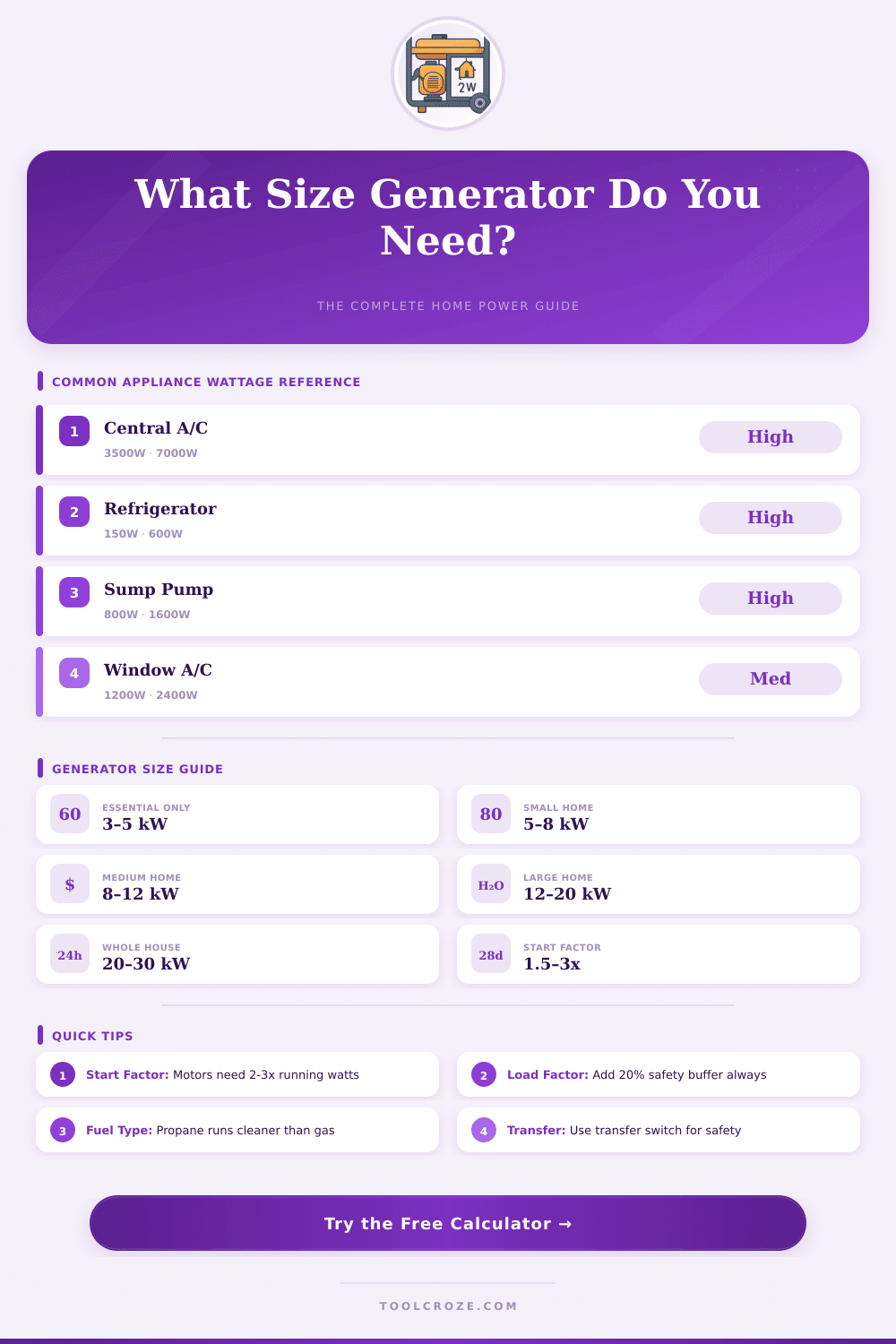
⚡ House Generator Size Calculator
Enter your home's appliances to calculate the exact generator wattage you need
| Appliance | Running Watts | Starting Watts | Start Factor | Priority |
|---|---|---|---|---|
| Central A/C (3 ton) | 3,500 W | 7,000 W | 2.0x | High |
| Central A/C (5 ton) | 5,500 W | 11,000 W | 2.0x | High |
| Window A/C (10,000 BTU) | 1,200 W | 2,400 W | 2.0x | Medium |
| Refrigerator | 150 W | 600 W | 4.0x | High |
| Chest Freezer | 100 W | 400 W | 4.0x | High |
| Electric Water Heater | 4,000 W | 4,000 W | 1.0x | Low |
| Electric Furnace | 10,000 W | 10,000 W | 1.0x | High |
| Gas Furnace (fan only) | 800 W | 1,600 W | 2.0x | High |
| Sump Pump (1/3 HP) | 800 W | 1,600 W | 2.0x | High |
| Well Pump (1 HP) | 1,000 W | 3,000 W | 3.0x | High |
| Well Pump (1/2 HP) | 500 W | 1,500 W | 3.0x | High |
| Washer (Standard) | 1,200 W | 2,400 W | 2.0x | Low |
| Clothes Dryer (Electric) | 5,400 W | 5,400 W | 1.0x | Low |
| Microwave | 1,000 W | 1,000 W | 1.0x | Medium |
| Electric Range (1 burner) | 1,250 W | 1,250 W | 1.0x | Medium |
| Dishwasher | 1,200 W | 1,200 W | 1.0x | Low |
| Lights (per 100W equiv.) | 10 W | 10 W | 1.0x | High |
| TV / Entertainment | 200 W | 200 W | 1.0x | Medium |
| Computer / Router | 150 W | 150 W | 1.0x | High |
| CPAP Machine | 100 W | 100 W | 1.0x | Critical |
| Oxygen Concentrator | 300 W | 300 W | 1.0x | Critical |
| Garage Door Opener | 350 W | 700 W | 2.0x | Low |
| Table Saw (10 in, 1.5 HP) | 1,800 W | 5,400 W | 3.0x | Low |
| Air Compressor (1 HP) | 1,000 W | 3,000 W | 3.0x | Low |
| Electric Vehicle Charger (L2) | 7,200 W | 7,200 W | 1.0x | Low |
| Generator Type | Typical Size Range | Fuel | Runtime (full tank) | Best For |
|---|---|---|---|---|
| Portable Inverter | 1–4 kW | Gasoline | 4–8 hrs | Camping, essentials |
| Portable Conventional | 3–12 kW | Gasoline | 8–12 hrs | Short outages |
| Dual-Fuel Portable | 4–12 kW | Gas/Propane | 8–16 hrs | Flexibility |
| Standby (Air-Cooled) | 7–20 kW | NG/Propane | Unlimited* | Whole house auto |
| Standby (Liquid-Cooled) | 20–150 kW | NG/Propane | Unlimited* | Large homes, commercial |
| Diesel Portable | 5–25 kW | Diesel | 12–24 hrs | Construction, long outages |
| Generator Size | Running Watts | Amps @ 120V | Amps @ 240V | Typical Use |
|---|---|---|---|---|
| 3,500 W | 3,500 W | 29 A | 14.6 A | Essentials + small A/C |
| 5,000 W | 5,000 W | 41.7 A | 20.8 A | Small home backup |
| 7,500 W | 7,500 W | 62.5 A | 31.3 A | Medium home backup |
| 10,000 W | 10,000 W | 83.3 A | 41.7 A | Large home essentials |
| 12,000 W | 12,000 W | 100 A | 50 A | Whole house (avg) |
| 20,000 W | 20,000 W | 166.7 A | 83.3 A | Large whole house |
Choosing the right size for a generator can seem hard because it mainly depends on how much power you truly need. Generators have various levels of watts. Small models can back some devices, while a big generator fits a whole house.
What size you choose relates to your own case.
How to Choose the Right Size Generator
A common error is to consider only the total amount of watts. When you simply add everything together, maybe you believe that a 5300-watt generator is enough for your home. But that method commonly leads to a too big purchase.
Rather think about the devices that you plan to use at the same time. It does not help to look at your daily energy use to estimate the needed size. What matters is how quickly you consume that energy.
If you spend your daily amount in one single hour, then you need a truly powerful machine. But if you spread it evenly over twenty hours, even a much smaller generator will work gerat.
Adding the running watts of the devices that you want to run together, you find the real needed size. A generator of 22 kW is quite strong. For a house under 2100 square feet, 22 kW maybe is a bit much.
One person in a 2200-square-foot house with gas devices found that a 9500-watt running generator was enough four ninety percent of the needed devices.
A generator of 7500 watts works well for a four-story house with five bedrooms that has gas heating and a gas kitchen. But when everything is on electric, the need jumps a lot. More than the house size, what matters is which devices you want to back.
Air conditioning always makes the strongest starting load. Adding a low start device for your AC can lower that big spike.
To run two small fridges, a generator of 1500 to 2500 watts works. Two big modern fridges need at least 2000 to 3500 watts, where 3500 watts is the more safe option. At minimum, 2200 watts maybe barely works for light uses, while a 3000-watt model handles everything more easily.
The price gap between those two options is not big.
At the level of 7500 watts, being portable gets harder. Many weigh more than 200 pounds. But those extra watts let you power a whole place with lamps, heaters and several devices at the same time.
If noise bothers you, consider closed-case inverter generators. When price matters, cheaper basic models work, but they are more noisy. A good habit is to size the generator so that it runs at around thirty to fifty percent of load in daily use.
When you use any generator, always mind its limits andescape running several heavy tools together.