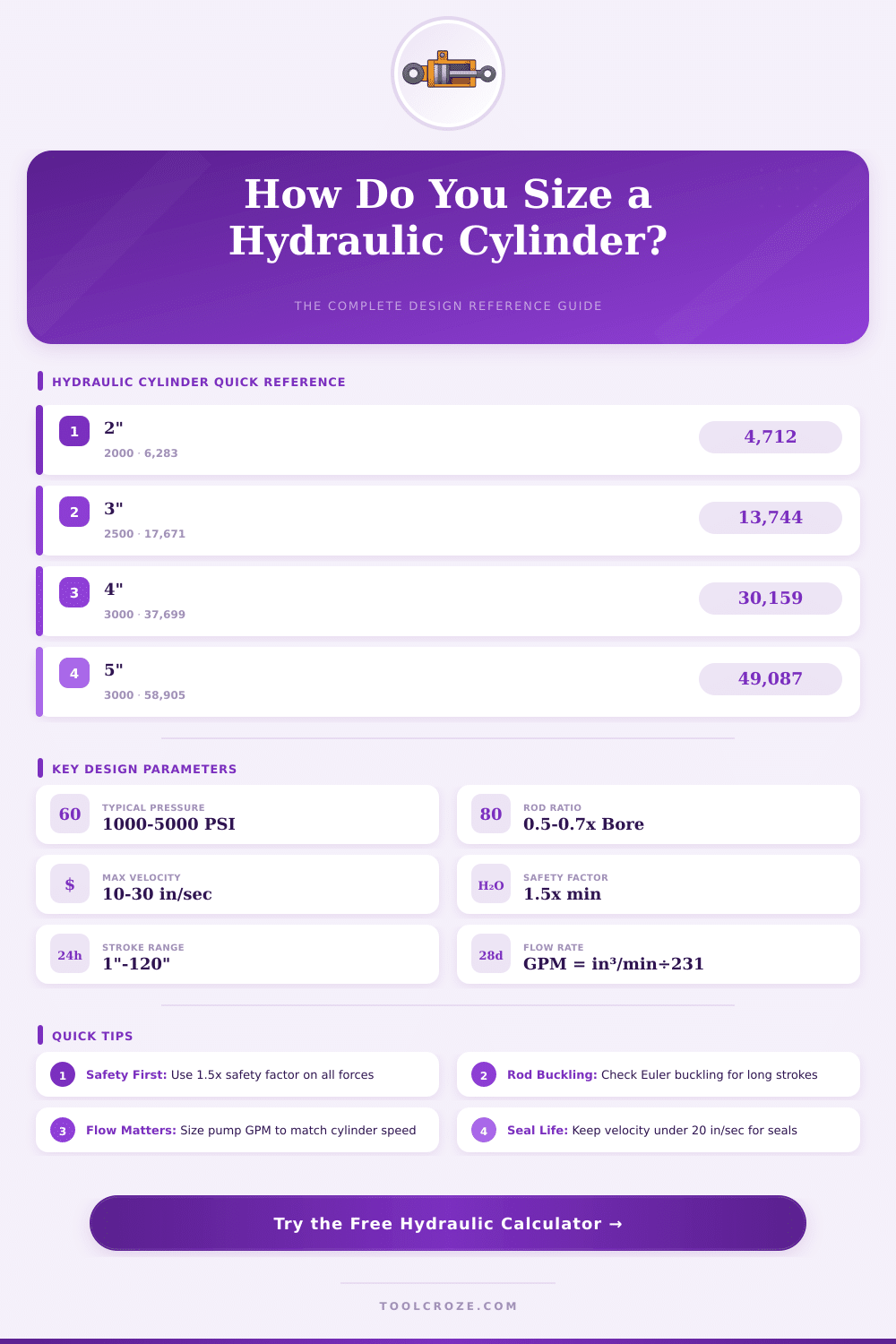
⚙️ Hydraulic Cylinder Design Calculator
Calculate bore size, rod diameter, force output, flow rate & stroke velocity for any hydraulic cylinder application
| Bore (in) | Common Rod (in) | Push Area (in²) | Pull Area (in²) | Max Pressure (PSI) | Typical Application |
|---|---|---|---|---|---|
| 1.5 | 0.75 | 1.77 | 1.33 | 3000 | Small clamp, valve actuator |
| 2.0 | 1.25 | 3.14 | 2.16 | 3000 | Light press, gate valve |
| 2.5 | 1.50 | 4.91 | 3.14 | 3000 | Agricultural lift arms |
| 3.0 | 1.75 | 7.07 | 4.68 | 3000 | Log splitter, plow |
| 3.5 | 2.00 | 9.62 | 6.49 | 2500 | Dump trailer hoist |
| 4.0 | 2.50 | 12.57 | 7.66 | 3000 | Excavator, backhoe |
| 5.0 | 3.00 | 19.63 | 12.57 | 3000 | Press brake, forklift |
| 6.0 | 3.50 | 28.27 | 18.64 | 2500 | Heavy machinery lift |
| 8.0 | 4.50 | 50.27 | 34.36 | 2000 | Large press, dock leveler |
| 10.0 | 6.00 | 78.54 | 50.27 | 2000 | Industrial press, crane |
| Bore (in) | Velocity (in/sec) | Extend Flow (GPM) | Retract Flow (GPM) | Cycle Time 12in (sec) | Typical Pump Size |
|---|---|---|---|---|---|
| 2.0 | 6 | 2.45 | 1.69 | 2.0 | 5 GPM |
| 3.0 | 6 | 5.50 | 3.64 | 2.0 | 8 GPM |
| 4.0 | 6 | 9.78 | 5.96 | 2.0 | 12 GPM |
| 4.0 | 10 | 16.29 | 9.93 | 1.2 | 18 GPM |
| 5.0 | 8 | 20.44 | 13.09 | 1.5 | 22 GPM |
| 6.0 | 6 | 21.98 | 14.49 | 2.0 | 25 GPM |
| 8.0 | 4 | 26.17 | 17.89 | 3.0 | 30 GPM |
| 10.0 | 3 | 30.68 | 19.64 | 4.0 | 35 GPM |
| Application Type | Typical Pressure (PSI) | Metric (bar) | Duty Cycle | Recommended Safety Factor |
|---|---|---|---|---|
| Agricultural / Farm | 1500–2500 | 103–172 | Intermittent | 1.5x |
| Construction / Mobile | 2500–4000 | 172–276 | Continuous | 2.0x |
| Log Splitter / DIY | 2000–3000 | 138–207 | Intermittent | 1.5x |
| Industrial Press | 3000–5000 | 207–345 | Continuous | 2.0x |
| Overhead Lifting | 1500–3000 | 103–207 | Intermittent | 2.5x |
| Injection Molding | 1500–2500 | 103–172 | Continuous | 1.5x |
| Marine / Offshore | 3000–5000 | 207–345 | Continuous | 2.5x |
| Automotive Lifts | 1000–2000 | 69–138 | Intermittent | 2.0x |
| Rod Dia (in) | Stroke 12in | Stroke 24in | Stroke 36in | Stroke 48in | End Condition |
|---|---|---|---|---|---|
| 1.0 | 9,869 lbf | 2,467 lbf | 1,097 lbf | 617 lbf | Pin-Pin (K=1) |
| 1.5 | 33,290 lbf | 8,323 lbf | 3,699 lbf | 2,081 lbf | Pin-Pin (K=1) |
| 2.0 | 78,957 lbf | 19,739 lbf | 8,773 lbf | 4,935 lbf | Pin-Pin (K=1) |
| 2.5 | 154,604 lbf | 38,651 lbf | 17,178 lbf | 9,663 lbf | Pin-Pin (K=1) |
| 3.0 | 266,802 lbf | 66,700 lbf | 29,645 lbf | 16,675 lbf | Pin-Pin (K=1) |
| 3.5 | 422,160 lbf | 105,540 lbf | 46,907 lbf | 26,385 lbf | Pin-Pin (K=1) |
Liquid pressure adjusts mechanical move inside a hydraulic cylinder, here happens the main miracle. Those machines allow motion forward and backwards when one ties energy from liquid, and there exist a lot of types according to what one wants to reach. If one chooses no fit type, it can reduce your speed and safety, so it matters to choose it well.
In building, two main kinds rule the industrial world: hydraulic cylinder with tied rod and designs with welded body. Beyond that base, there are options like telescoping, piston, differential and staged, that offer more flexibility. Also exist single against double sided actions, and for special uses one finds double rods, rectangular and tandem types.
Types of Hydraulic Cylinders and How to Choose the Right One
Every type gives his own benefits chiefly according to the needs of the task.
To choose the fit design, start by careful review of the use needs. One must guess the needed force, the length of the move (stroke distance), the pressure, that must work well, and how it will mount. Mounting types, flange, clevis, trunnion, each with his own downsides.
The best mount method depends truly on your real case.
Here enters the physics: the force is made, when pressure pushes against the surface of the plunger. The relation is simple, force matches pressure multiplied by area. For hydraulic cylinder with moving rod, one takes the hydraulic pressure and multiplies it by the rod surface.
Those hydraulic cylinder types have added benefit (they remove the need of extra valve), what gives longer life for the seal and simpler whole builds. Beyond force, there exist calculations for output speed, flow amount, oil speed and hydraulic port size.
One finds hydraulic cylinder types done in almost every possible size and pressure. They are used everywhere, in building machines, farm tools, factory presses, ships. Right choice of diameter, hydraulic cylinder type and internal parts truly alter the speed and safety of the hole system.
Their flexibility allows a designer to use them in totally different settings.
The secret of current hydraulic cylinder types are, that they are quite complex, full of bits in various forms and materials. Choosing one must be balanced, because change of one part always touches the others. One must think of two sides in the design: the mechanical part, that cares about force, pressure handling, resistance against wear and work rate, together with the whole hydraulic system design.
Stresses like circular and radial need control, to ensure, that the hydraulic cylinder does not fail under theinvolved pressure.
Most hydraulic cylinder types are based on standard parts, chrome rods, honed tubes, usual mount spots. Custom orders allow to adapt the right length, port and rod width for best mode. Weight commonly is a problem in classic models, so engineers offer new materials and plastic mixes to ease them.
Cushion systems matter, when one works with high speeds. Right space between plunger and tube stops scratching, and guide rings ensure, that everything stays well lined up.