⚙️ Hydraulic Cylinder Wall Thickness Calculator
Calculate safe wall thickness using Lamé & Barlow formulas — supports imperial & metric, 8 materials, safety factors
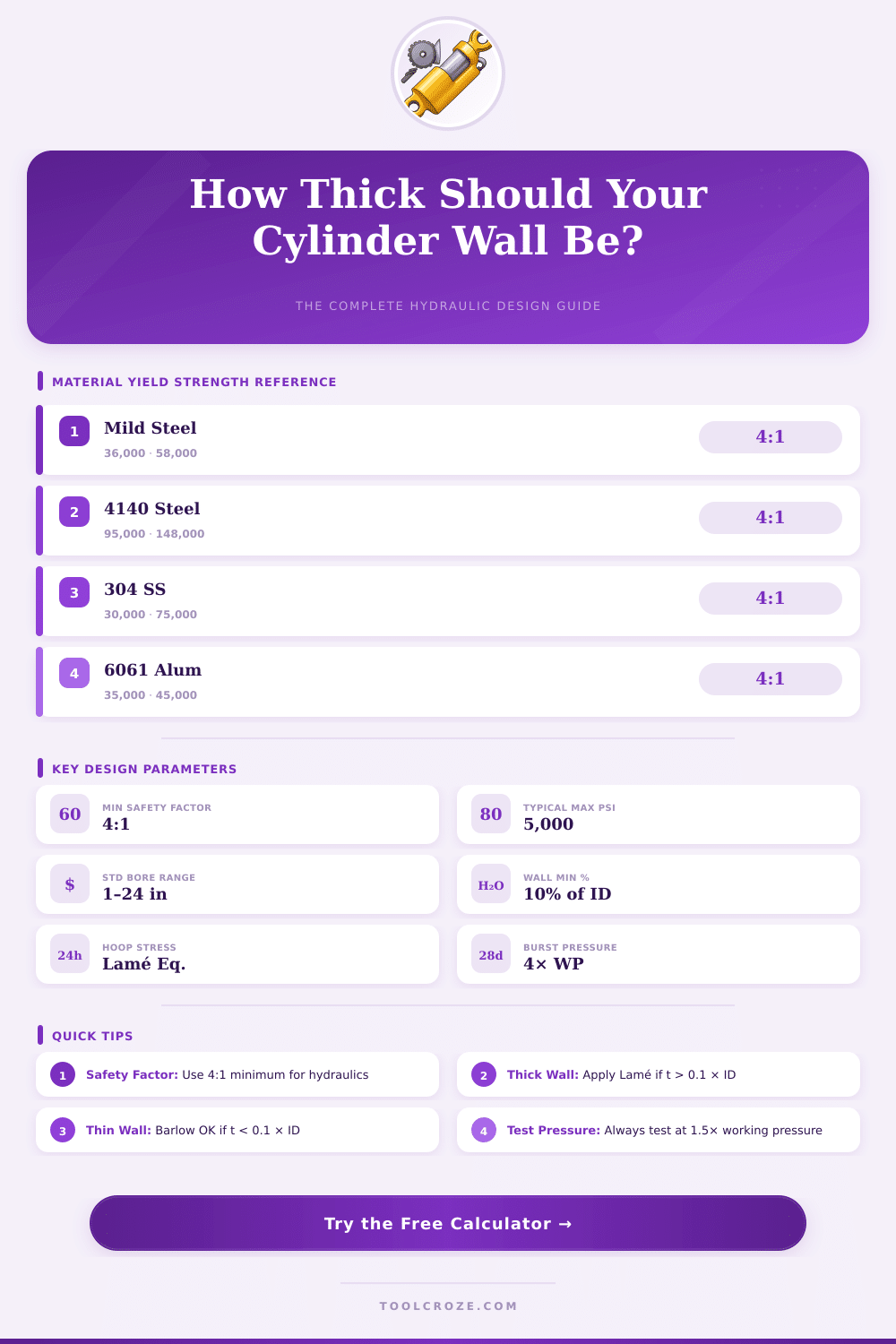
| Material | Yield Strength (psi) | Tensile Strength (psi) | Yield (MPa) | Density (lb/in³) | Max Temp (°F) | Corr. Resistance |
|---|---|---|---|---|---|---|
| Mild Steel A36 / 1020 | 36,000 | 58,000 | 248 | 0.284 | 700 | Low |
| 4140 Alloy Steel (HT) | 95,000 | 148,000 | 655 | 0.283 | 800 | Low |
| DOM 1026 Steel | 70,000 | 80,000 | 483 | 0.284 | 700 | Low |
| 304 Stainless Steel | 30,000 | 75,000 | 207 | 0.290 | 1500 | High |
| 316 Stainless Steel | 28,000 | 70,000 | 193 | 0.290 | 1650 | Very High |
| 6061-T6 Aluminum | 35,000 | 45,000 | 241 | 0.098 | 300 | Good |
| 7075-T6 Aluminum | 73,000 | 83,000 | 503 | 0.102 | 250 | Medium |
| Naval Brass C46400 | 25,000 | 55,000 | 172 | 0.304 | 400 | Excellent |
| Bore Diameter | 1,500 psi | 2,000 psi | 3,000 psi | 5,000 psi | Min. Wall (in) | OD at 3000 psi |
|---|---|---|---|---|---|---|
| 1.5" (38mm) | 0.063" | 0.083" | 0.125" | 0.208" | 0.063" | 1.75" |
| 2.0" (51mm) | 0.083" | 0.111" | 0.167" | 0.278" | 0.083" | 2.33" |
| 2.5" (64mm) | 0.104" | 0.139" | 0.208" | 0.347" | 0.104" | 2.92" |
| 3.0" (76mm) | 0.125" | 0.167" | 0.250" | 0.417" | 0.125" | 3.50" |
| 4.0" (102mm) | 0.167" | 0.222" | 0.333" | 0.556" | 0.167" | 4.67" |
| 6.0" (152mm) | 0.250" | 0.333" | 0.500" | 0.833" | 0.250" | 7.00" |
| 8.0" (203mm) | 0.333" | 0.444" | 0.667" | 1.111" | 0.333" | 9.33" |
| Bore (in) | Wall Thickness (in) | OD (in) | Max WP (psi) SF 4:1 | Weight (lb/ft) | Typical Application |
|---|---|---|---|---|---|
| 1.50 | 0.188 | 1.875 | 3,733 | 2.5 | Light duty cylinders |
| 2.00 | 0.188 | 2.375 | 2,800 | 3.4 | Small log splitters |
| 2.50 | 0.250 | 3.000 | 2,800 | 5.5 | Mid-range hydraulics |
| 3.00 | 0.250 | 3.500 | 2,333 | 6.7 | Construction equipment |
| 3.50 | 0.313 | 4.125 | 2,500 | 9.3 | Dump trailers |
| 4.00 | 0.375 | 4.750 | 2,625 | 12.8 | Excavator arms |
| 5.00 | 0.375 | 5.750 | 2,100 | 16.1 | Large press cylinders |
| 6.00 | 0.500 | 7.000 | 2,333 | 26.5 | Industrial presses |
| Formula | Equation | When to Use | Key Variables |
|---|---|---|---|
| Lamé (Thick Wall) | t = (ID/2) × (√((σy/SF + P) / (σy/SF – P)) – 1) | t > 0.1 × ID; high pressure | P, ID, σy, SF |
| Barlow's (Thin Wall) | t = (P × ID × SF) / (2 × σy × E) | t < 0.1 × ID; low pressure | P, ID, σy, E (joint eff.) |
| ASME VIII Div.1 | t = (P × R) / (S × E – 0.6 × P) + CA | Code vessels, pressure vessels | P, R, S, E, CA |
| Burst Pressure | P_burst = (2 × σt × t) / OD | Verify safety margin | σt (tensile), t, OD |
| Hoop Stress | σh = (P × ID) / (2 × t) | Check actual wall stress | P, ID, t |
| Axial Stress | σa = (P × ID²) / (4 × t × (ID + t)) | Closed-end cylinders | P, ID, t |
The thickness of the wall of a hydraulic cylinder simply comes from the gap between its outer and inner surface. That ranks between the most important elements that one must exactly determine during the design of such a hydraulic cylinder. Mistakes in this area can create serious troubles, hence it has big gravity.
Determine the bore size for a good starting point. Indeed, the bore consists only from the diameter of the plunger or from the inner diameter of the barrel. It represents the main size of a hydraulic cylinder and in the hydraulic industry one calls it “bore”.
How to Find the Right Wall Thickness for a Hydraulic Cylinder
When the hydraulic cylinder is taken apart, just simply measure the inner diameter of the barrel or the real diameter of the plunger. Even so, if it stays combined or set to a machine, one finds the bore by means of measuring the outer diameter of the barrel tube and subtracting the thickness of both walls.
Here is a sample that explains the cause. When the outer diameter of the barrel matches 4 inches and the thickness of the walls is 0.5 inches, then the diamater of the bore results around 3 inches. It simply calculates from 4 minus 0.5 times 2.
Also the diameter of the rod matters, because it acts on the mode, as the hydraulic cylinder operates.
The length of the stroke forms another value that one must know. One finds it by means of subtracting the shortened length from the fully extended length of the hydraulic cylinder.
When dealing about thin walls against thick walls, the difference shows clearly. When the thickness of the wall is below 10% of the inner diameter, one considers the tube as “thin wall”. For tubes of thin wall, the formula of Barlow delivers more accurate results.
Most tubes that one uses in hydraulic systems for low pressure belong to the category of thin walls. Rather, if the proportion of the outer diameter too the inner diameter passes 1.2, then the tube receives the name of thick wall tube.
The law of Laplace also helps in that context. It shows that in bigger radius of the hydraulic cylinder grows the tension in the wall. More closely, the tension matches to pressure multiplied by radius and divided by thickness, during the thickness stays under 10% of the radius.
The main checkpoints for hydraulic cylinders are the thickness of the cylinder wall, the diameter of the piston rod and the bolts that set the cylinder head. For calculations of thick walls, equations like those of Clavarino, Birnie and Lamé can serve depending on the usage. The idea is made up of putting in values for pressure, inner diameter and pilot outer diameter, later repeating until the tension does not pass the limit value of the material.
In one case, the proportion reached 1.558, hence the outer diameter had to be around 15 and five-eighths inches for a 10-inch bore. That fixed the thickness of the wall at roughly 2.79 inches.
One square inch of wall holds the same amount of force, whether it belongs to a 10-ton hydraulic cylinder or to a 50-ton, during the pressure stays same. Even so, for reasons of structure, growth of the thickness of thewall can increase the stiffness, what occasionally has such big value.